

Discover how SaaS platforms convert ready-to-buy audiences into free trial users through banner advertising strategies focused on behavioural targeting, retargeting sequences, conversion messaging, and high-intent digital placements across the United Kingdom’s competitive software advertising environment.
SaaS platforms use banner advertising to capture users already positioned near the decision stage. These users previously interacted with product pages, pricing sections, feature comparisons, or software-related searches. Banner ads reintroduce the product through structured conversion-focused messaging.
At the BOFU stage, the objective changes from awareness to signup generation. Campaigns prioritise direct response actions such as free trial registration, demo access, and account creation. Messaging becomes highly specific and action-oriented.
Banner advertising supports this stage because it enables continuous visibility during active software evaluation. Users repeatedly encounter the product while researching alternatives, reading industry content, or comparing solutions online.
Explore how conversion-focused banner advertising turns software evaluation intent into measurable free trial signups through retargeting systems, behavioural signals, and structured SaaS acquisition funnels.
What are banner ads in SaaS free trial campaigns?
Banner ads in SaaS free trial campaigns are visual digital advertisements designed to target high-intent users, promote software trial access, and increase signup conversions through repeated exposure, behavioural targeting, and direct-response messaging across websites, apps, and advertising networks within competitive digital markets.
These banner ads focus on users already familiar with the software category. Unlike awareness campaigns, BOFU campaigns target audiences closer to purchase readiness.
The ads appear across digital environments such as business publications, productivity websites, SaaS review platforms, and mobile applications. Their purpose is immediate conversion support.
The messaging includes product-specific value statements. Examples include workflow automation, analytics integration, cloud collaboration, or reporting functionality. These details reinforce evaluation-stage interest.
Banner ads at this stage also prioritise visible signup pathways. Trial-focused landing pages reduce friction and encourage fast registration processes.
Read:
How Tech Companies Promote Product Launches Using Banner Advertising
How do SaaS platforms identify ready-to-buy users?
SaaS platforms identify ready-to-buy users through behavioural tracking systems that analyse pricing page visits, feature comparison activity, repeat product engagement, and interaction with conversion-oriented digital assets across websites, search environments, and retargeting ecosystems connected to software evaluation behaviour patterns globally.
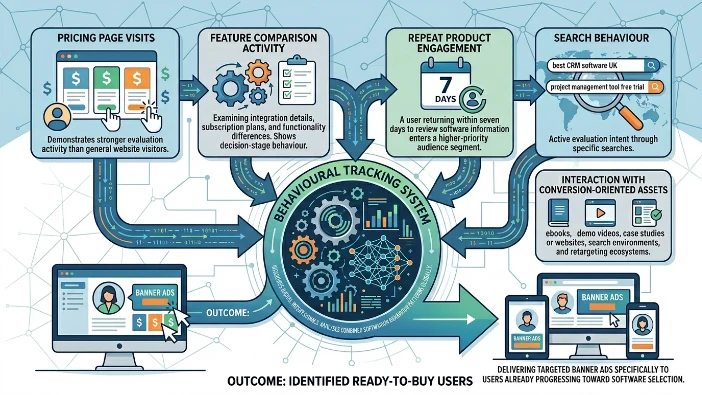
Behavioural tracking measures digital intent signals. Users visiting pricing pages multiple times demonstrate stronger evaluation activity than general website visitors.
Feature comparison interaction also indicates purchase readiness. Users examining integration details, subscription plans, or functionality differences show decision-stage behaviour.
Repeat engagement patterns strengthen targeting accuracy. A user returning within seven days to review software information enters a higher-priority audience segment.
Search behaviour contributes additional signals. Users searching terms such as “best CRM software UK” or “project management tool free trial” demonstrate active evaluation intent.
These combined signals allow SaaS platforms to deliver banner ads specifically to users already progressing toward software selection.
How do retargeting banner ads increase free trial signups?
Retargeting banner ads increase free trial signups by reconnecting with users who previously interacted with SaaS content, reinforcing software value through repeated exposure, and presenting conversion-focused messaging that directs users toward trial registration pages with reduced acquisition friction and stronger intent alignment.
Retargeting systems track users who interacted with landing pages, pricing content, or product demonstrations. These users receive follow-up ads across digital platforms.
The ads maintain message consistency. Users repeatedly see the same product positioning, features, and signup pathways. This repetition increases recognition and decision confidence.
Retargeting banners also introduce urgency-based messaging. Examples include limited onboarding access, updated feature releases, or simplified trial activation processes.
Visual consistency strengthens conversion performance. Matching colours, typography, and interface imagery reinforce product familiarity during repeated exposures.
This strategy improves free trial conversion efficiency because it targets users already engaged with the SaaS evaluation process.
What messaging works best in BOFU SaaS banner advertising?
BOFU SaaS banner advertising performs best with direct-response messaging focused on software functionality, measurable outcomes, onboarding simplicity, and trial accessibility, ensuring users receive clear conversion-oriented communication aligned with active software evaluation and purchase decision behaviour across digital advertising channels today.
BOFU messaging prioritises clarity. Ads explain exactly what the software delivers and how users can access it immediately.
Specific outcome messaging improves conversion intent. Examples include “automate reporting in 10 minutes” or “manage projects across remote teams.” These statements define operational value.
Trial accessibility messaging reduces resistance. Ads highlight short signup forms, immediate platform access, or no-credit-card onboarding structures.
Feature visibility remains central. Users evaluating SaaS products expect clear information about integrations, dashboards, analytics tools, or collaboration systems.
Effective messaging avoids broad awareness language. It focuses directly on conversion-stage needs and evaluation-driven decision-making.
How do banner ad placements influence SaaS trial conversions?
Banner ad placements influence SaaS trial conversions by positioning ads within high-intent digital environments where users actively research software solutions, compare providers, and evaluate operational tools, increasing exposure relevance and improving conversion probability through contextual alignment with user decision behaviour online.
Placement quality directly affects conversion performance. Ads appearing on software review sites attract users already comparing solutions.
Technology news websites also support conversion campaigns. Readers consuming operational technology content demonstrate strong business software interest.
Search retargeting placements reinforce visibility after evaluation-related searches. Users researching CRM systems, accounting software, or collaboration tools encounter relevant banner messaging repeatedly.
Mobile application placements increase daily exposure frequency. Productivity apps and professional networking environments provide consistent visibility among business audiences.
Contextual alignment ensures ads appear where software evaluation naturally occurs. This improves click-through rates and free trial initiation levels.
How do landing pages support banner ad conversions?
Landing pages support banner ad conversions by delivering focused software information, simplified signup structures, and consistent messaging that matches banner ad expectations, reducing user friction and increasing free trial completion rates across SaaS acquisition funnels within competitive digital environments globally.
Landing pages act as the conversion destination after banner interaction. Their structure determines whether interest becomes trial registration.
Consistency between banner ads and landing pages improves user trust. Matching headlines, visuals, and product terminology reduce confusion.
Short registration forms increase completion rates. SaaS platforms frequently limit signup steps to email, password, and company information.
Feature clarity strengthens conversion outcomes. Landing pages explain software capabilities in concise sections focused on operational value.
Performance optimisation also matters. Fast-loading pages improve conversion retention, particularly for mobile users in the United Kingdom.
The landing page functions as the final decision environment in the banner advertising funnel.
Explore More Expert Insights:
How Tech Firms Turn Feature Interest Into Demo Bookings Using High-Intent Display Ads
How SaaS Companies Convert Warm Leads Into Paid Users Using Retargeting Banner Ads
Which metrics measure SaaS banner ad performance?
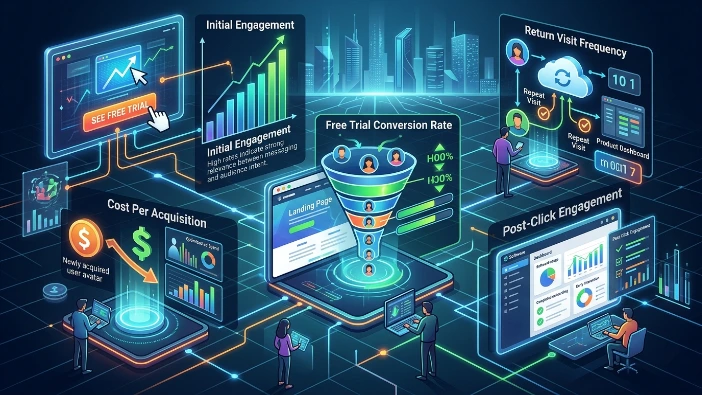
BOFU SaaS banner ad performance is measured through click-through rate, cost per acquisition, free trial conversion rate, return visit frequency, and post-click engagement metrics that collectively evaluate how efficiently banner campaigns generate qualified software trial users across targeted advertising ecosystems today.
Click-through rate measures initial engagement with banner ads. High rates indicate strong relevance between messaging and audience intent.
Cost per acquisition evaluates campaign efficiency. SaaS platforms monitor how much advertising spend produces each free trial signup.
Free trial conversion rate measures landing page effectiveness after ad interaction. This metric directly reflects signup performance.
Return visit frequency identifies users repeatedly evaluating the product before trial activation. Higher frequency indicates sustained purchase intent.
Post-click engagement metrics track user behaviour after registration. SaaS platforms analyse dashboard usage, onboarding completion, and early interaction patterns.
Together, these metrics define the effectiveness of BOFU display advertising systems.
Why do SaaS platforms use banner ads alongside other acquisition channels?
SaaS platforms use banner ads alongside search marketing, email campaigns, and content marketing because banner advertising reinforces visibility, supports retargeting continuity, and maintains software awareness during extended evaluation cycles common in business software purchasing behaviour across competitive digital ecosystems worldwide.
Software evaluation rarely occurs through a single interaction. Users often research products across multiple sessions and platforms before trial activation.
Banner ads maintain visibility during this process. They reinforce software recognition while users consume related content or compare alternatives.
Search advertising captures active intent, while banner advertising sustains repeated exposure. Together, these channels support continuous user engagement.
Email campaigns provide direct communication after signup interest. Banner ads complement this by maintaining external visibility across the web.
Content marketing educates users through articles and guides. Banner ads reconnect these readers with trial-focused messaging after informational engagement.
This integrated structure improves overall acquisition consistency and conversion continuity.
Explore:
How SaaS Platforms Move Users From Awareness to Trial Using Display Ads



