Explore awareness to trial progression in SaaS display advertising systems, where structured ad exposure builds recognition, strengthens product understanding, and guides users toward trial consideration through staged digital interactions across the United Kingdom’s online ecosystem.
SaaS platforms use display advertising as a controlled visibility system. It introduces software concepts to users who are not yet ready to try a product. The process relies on repeated exposure, behavioural targeting, and structured messaging across websites, apps, and digital media environments.
A key principle in this funnel stage is progressive familiarity. Users do not convert immediately. They move through awareness, recognition, and consideration phases before trial intent becomes measurable. Display ads function as the connective layer between these stages.
Explore how awareness transforms into structured trial intent through repeated display exposure, behavioural signals, and digital engagement pathways that shape SaaS evaluation journeys.
What is the awareness to trial journey in SaaS display advertising?
Awareness to trial journey in SaaS display advertising is a structured marketing flow where users first see product messaging, then engage with repeated ad exposure, and finally transition into trial consideration through targeted display placements across websites, apps, and networks.
This journey defines how users move from initial exposure to active evaluation. SaaS platforms design this flow to ensure users understand product relevance before committing to trial actions. Each stage builds cognitive familiarity with software functions and value propositions.
Display advertising initiates awareness by placing visual messages in high-traffic digital environments. Users encounter these messages without prior product interaction. This creates first-contact recognition.
As exposure continues, users begin associating repeated messages with specific software solutions. This repetition forms structured recall patterns that support later evaluation behaviour.
The final stage introduces trial-oriented messaging. Users who repeatedly interact with ads or related content enter a consideration zone where trial initiation becomes a logical next step.
Read:
How Tech Companies Promote Product Launches Using Banner Advertising
How do display ads create awareness for SaaS platforms?
Display ads create awareness for SaaS platforms by distributing visual and text-based messages across high-traffic digital environments, introducing product capabilities, and reaching defined audiences through contextual placements, frequency-controlled impressions, and structured exposure across relevant publisher networks and device categories channels.
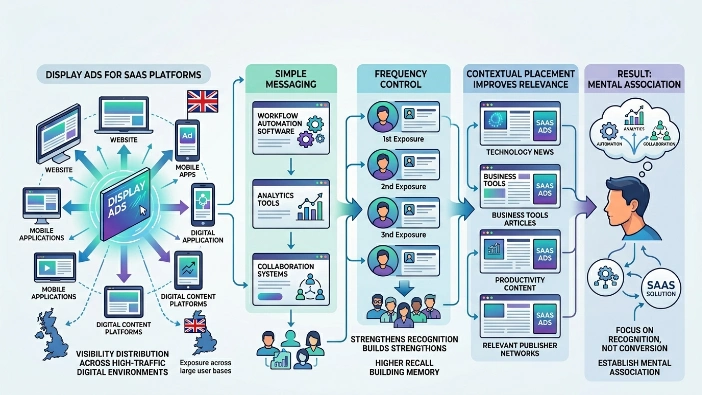
Awareness begins with visibility distribution. SaaS platforms place display ads on websites, mobile applications, and digital content platforms. These placements ensure exposure across large user bases in the United Kingdom.
The messaging remains simple at this stage. Ads introduce product categories such as workflow automation software, analytics tools, or collaboration systems. No complex explanation appears in early exposure.
Frequency control ensures users see ads multiple times without overload. This repetition strengthens recognition. A user exposed five to seven times demonstrates higher recall than a single exposure.
Contextual placement improves relevance. Ads appear next to related content such as technology news, business tools, or productivity articles. This alignment increases attention probability.
Awareness creation focuses on recognition, not conversion. The objective is to establish mental association between the product category and the SaaS solution.
How does retargeting move users from awareness to consideration?
Retargeting moves users from awareness to consideration by re-serving display ads to individuals who previously engaged with SaaS content, reinforcing product familiarity, increasing message frequency, and guiding users toward deeper evaluation stages through repeated exposure across multiple digital touchpoints channels.
Retargeting activates after initial awareness interaction. Users who visit landing pages, view product visuals, or engage with ads receive follow-up display messaging. This ensures continuous visibility.
The system tracks behavioural signals such as page visits and content interaction. These signals define which users enter retargeting pools.
Retargeted ads present more detailed product messaging. Instead of general awareness, they introduce functional explanations such as feature benefits, integration capabilities, and usage scenarios.
This stage increases engagement depth. Users begin comparing solutions mentally. Repeated exposure reduces uncertainty and strengthens product memory.
Retargeting operates across multiple platforms simultaneously. Users see consistent messaging across websites, apps, and digital networks, reinforcing consideration-level thinking.
What role do display ads play in driving trial intent?
Display ads drive trial intent by presenting structured product value messages, highlighting functional capabilities, and guiding users toward trial consideration through repeated visual reinforcement, behavioural targeting, and contextual alignment with SaaS usage needs across digital environments in the United Kingdom.
Display ads transition from awareness tools to intent-building mechanisms. At this stage, messaging becomes more specific and feature-oriented.
Product functionality is introduced clearly. Ads highlight capabilities such as data automation, real-time reporting, or team collaboration features. This clarity supports decision preparation.
Visual reinforcement strengthens recall. Users repeatedly see product benefits presented in consistent formats. This repetition builds familiarity with trial concepts.
Behavioural targeting ensures ads reach users who already interacted with product content. These users show higher probability of trial conversion.
Contextual alignment connects ads with relevant digital environments. Users researching similar tools receive more trial-oriented messaging, increasing intent strength.
Which user signals indicate readiness for SaaS trial conversion?
User signals indicating readiness for SaaS trial conversion include repeated ad engagement, high page interaction time, feature-specific clicks, return visits to pricing content, and interaction with comparison pages, showing increased intent and structured evaluation of software capabilities within digital funnels.
These signals represent behavioural progression. Users move from passive awareness to active evaluation based on interaction patterns.
Repeated engagement with display ads indicates sustained interest. Users exposed multiple times begin recognising product relevance.
High interaction time on landing pages signals deeper attention. Users spend longer periods evaluating features and descriptions.
Clicks on feature-specific content show functional interest. Users begin exploring how the software operates in real scenarios.
Return visits to pricing pages indicate evaluation readiness. Users compare options and assess potential value alignment.
Comparison page interaction reflects decision preparation. Users evaluate alternatives before considering trial activation.
How is audience segmentation used in SaaS display ad funnels?
Audience segmentation in SaaS display ad funnels divides users into groups based on behaviour, intent, and engagement level, ensuring tailored ad exposure that aligns awareness messaging with consideration needs across structured digital marketing environments and data-driven targeting systems globally scalable.
Segmentation separates users into structured categories. These categories define how display ads are delivered across funnel stages.
Behaviour-based segmentation identifies users based on actions such as website visits or content engagement. These users receive awareness or consideration messaging.
Intent-based segmentation focuses on users showing evaluation behaviour. These users receive more detailed product messaging.
Engagement-level segmentation categorises users based on interaction depth. High-engagement users see trial-focused ads more frequently.
Segmentation ensures messaging accuracy. Each group receives relevant display ads aligned with their funnel position.
This structure increases efficiency by reducing irrelevant exposure and improving message relevance across the SaaS advertising ecosystem.
Explore More Expert Insights:
How Tech Firms Build Product Interest Using Feature-Focused Banner Ads
How SaaS Companies Nurture Leads Using Educational Banner Advertising
What metrics measure success in awareness to trial campaigns?
Success metrics in awareness to trial campaigns include impression volume, click-through rate, engagement duration, return visit frequency, and trial initiation rate, measuring how effectively display ads convert initial awareness into structured SaaS evaluation behaviour across digital advertising ecosystems UK market.
Impression volume measures total visibility across platforms. High volumes indicate strong awareness distribution.
Click-through rate measures direct engagement with ads. It reflects how many users move from exposure to interaction.
Engagement duration tracks time spent on landing pages. Longer durations indicate deeper interest in product evaluation.
Return visit frequency shows repeated user interest. Users revisiting pages demonstrate stronger intent progression.
Trial initiation rate measures final conversion into product trials. It represents the outcome of awareness and consideration stages combined.
These metrics provide a structured view of funnel performance and user progression behaviour.
How do SaaS platforms structure display ad funnels in the UK market?
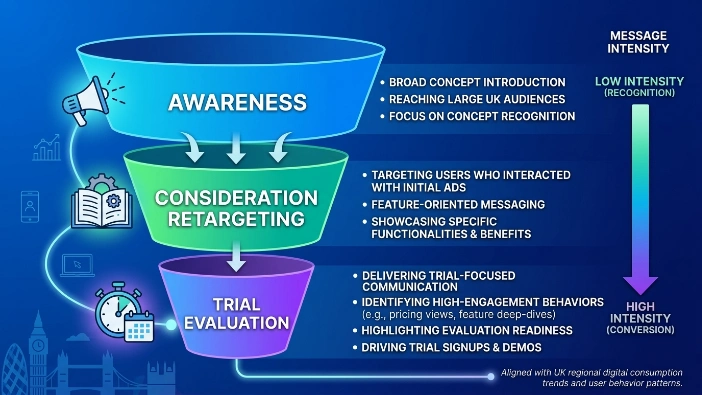
SaaS platforms structure display ad funnels in the UK market through staged exposure models, starting with awareness-driven impressions, followed by consideration retargeting, and ending with trial-focused messaging aligned with user behaviour patterns and regional digital consumption trends in structured sequences.
The funnel begins with broad awareness distribution. Display ads introduce SaaS concepts across large audiences in the United Kingdom.
The next stage focuses on retargeting users who interacted with initial ads. Messaging becomes more detailed and feature-oriented.
The final stage delivers trial-focused communication. Users who demonstrate high engagement receive ads that highlight evaluation readiness.
Each stage uses different message intensity levels. Awareness ads focus on recognition, while consideration ads focus on functionality.
This structured funnel ensures users progress logically from exposure to evaluation without abrupt transitions.
Explore:
How SaaS Platforms Drive Free Trial Signups From Ready-To-Buy Users Using Banner Ads