

Explore foundational knowledge to understand how banner advertising drives tech product launches in the United Kingdom, focusing on awareness building, structured campaign delivery, and measurable digital visibility across display networks, publisher platforms, and high-traffic online environments.
Banner advertising in tech product launches is a digital display method where tech companies place visual ad units across websites, apps, and platforms to announce new products, build awareness, and generate early interest through scalable online impressions and structured exposure.
Banner advertising uses graphical placements such as static images, animated creatives, and responsive ad units positioned on digital properties. These banners appear on news websites, blogs, forums, and technology platforms visited by target audiences in the United Kingdom.
In tech product launches, banners function as the first communication layer between a new product and potential users. They introduce product names, core features, and key value propositions without requiring user interaction. This approach builds awareness at scale within short launch cycles.
Tech companies use banner advertising because it supports immediate visibility. A single campaign can generate millions of impressions within 24 to 72 hours. This speed aligns with product launch strategies where early awareness determines adoption momentum and market positioning.
Banner advertising also integrates with display networks that distribute ads programmatically. These networks ensure that launch messages appear across relevant digital environments where technology audiences already consume content.
How do tech companies structure banner campaigns for product launches?
Tech companies structure banner campaigns for product launches through phased planning that includes pre-launch awareness setup, launch-day high-frequency distribution, and post-launch reinforcement campaigns that sustain visibility and stabilise audience recall across digital platforms.
Banner campaign structure begins with asset preparation. Designers create multiple banner sizes such as 300×250, 728×90, and 160×600. Each format adapts to different placements across desktop and mobile inventory in the United Kingdom digital ecosystem.
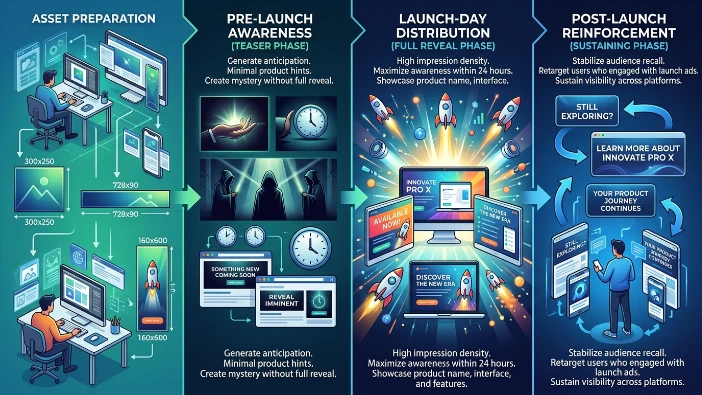
Campaign structure follows a timeline-based model. The pre-launch phase focuses on teaser banners that introduce minimal product information. These banners create anticipation without revealing full product functionality.
The launch phase activates full creative sets. These banners display product names, interface visuals, and primary features. High impression density ensures rapid awareness spread within 24 hours of release.
The post-launch phase reinforces messaging. Retargeting banners appear to users who previously engaged with launch creatives. This phase stabilizes recall and strengthens product familiarity.
Campaign structure also includes frequency capping rules. These rules limit repetitive exposure per user and prevent ad fatigue during high-intensity launch periods.
Which components make banner advertising effective during launches?
Effective banner advertising in tech launches relies on four components: clear visual hierarchy, concise messaging, responsive design formats, and strong call-to-information elements that communicate product identity and value within seconds of user exposure.
Visual hierarchy determines how users process banner content. Product logos, headlines, and interface visuals appear in structured order to guide attention flow. Strong hierarchy increases message retention during short exposure windows.
Messaging clarity ensures that banners communicate a single idea. Tech launches use short phrases that define product function, such as “AI-powered workflow tool” or “cloud-based security dashboard.” This precision eliminates confusion.
Responsive design supports multi-device environments. Banner creatives automatically adjust across mobile phones, tablets, and desktop screens used widely in the United Kingdom. This ensures consistent visibility across platforms.
Call-to-information elements guide user attention toward learning actions. These elements include prompts like “learn more” or “see product features.” They connect awareness with deeper product exploration pathways.
Each component works together to convert brief impressions into structured product recognition across large audience segments.
How does audience targeting work in launch banner campaigns?
Audience targeting in banner advertising uses behavioural data, contextual signals, and demographic filters to display tech product launch ads to users who match defined interest profiles, ensuring relevant exposure and improved awareness efficiency across digital ecosystems.
Behavioural targeting identifies users based on past online activity. Tech companies analyse website visits, content consumption patterns, and interaction history with similar technologies. This ensures launch banners reach relevant audiences.
Contextual targeting places banners on pages that match product relevance. For example, a cybersecurity product launch appears on security blogs, IT news sites, and enterprise technology pages frequently accessed in the United Kingdom.
Demographic targeting segments users by age, profession, and industry. Tech launches often prioritise professionals in software development, business operations, and digital transformation roles.
Interest-based targeting categorises users based on long-term engagement patterns. Individuals who regularly read technology reviews or product comparison content receive higher exposure to launch banners.
Combined targeting methods ensure that impressions are delivered to high-probability audiences. This increases efficiency and reduces wasted ad exposure during product introduction phases.
How do creative formats influence product launch performance?
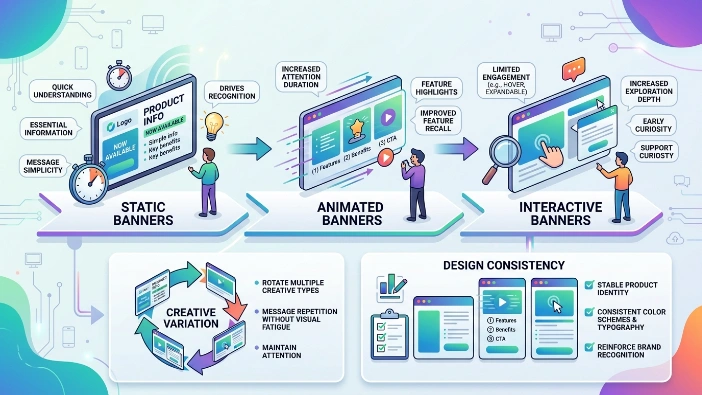
Creative formats influence product launch performance by determining how quickly users understand product value, with static banners delivering clarity, animated banners increasing attention retention, and interactive formats improving engagement depth during initial awareness stages.
Static banners present fixed visuals that communicate essential product information quickly. They work effectively for early awareness where message simplicity drives recognition.
Animated banners introduce motion elements such as transitions, feature highlights, or sequential messaging. These formats increase attention duration and improve recall of product features during launch phases.
Interactive banners allow limited user engagement such as hover effects or expandable panels. These formats increase exploration depth and support early product curiosity.
Creative variation across formats ensures message repetition without visual fatigue. Tech companies rotate multiple creative types during launch periods to maintain audience attention across repeated exposures.
Design consistency across all formats ensures that product identity remains stable. Consistent colour schemes, typography, and layout structures reinforce brand recognition during rapid awareness scaling.
Explore More Expert Insights:
How SaaS Companies Increase Free Trial Signups Using Banner Ads
Why SaaS Companies Use Banner Ads for Scalable User Acquisition
What metrics measure success of banner advertising in product launches?
Success of banner advertising in tech product launches is measured through impression volume, click-through rate, view-through conversions, engagement duration, and post-exposure brand recall metrics collected from digital advertising platforms.
Impression volume measures total ad visibility across digital networks. High impression counts indicate strong launch reach across targeted audiences in the United Kingdom.
Click-through rate measures user interaction with banners. It calculates how many users move from awareness to deeper product pages after viewing ads.
View-through conversions track users who do not click but later engage with the product. This metric captures indirect influence of banner exposure on decision-making.
Engagement duration measures time spent interacting with landing pages after banner exposure. Longer durations indicate higher interest in product details.
Brand recall metrics evaluate user memory of the product after exposure. Surveys and digital tracking systems assess whether users remember the product name or function after seeing banners.
These metrics collectively define campaign effectiveness during structured product launch cycles.
Read:
How SaaS Platforms Move Users From Awareness to Trial Using Display Ads
Where do tech companies place banner ads during launches?
Tech companies place banner ads on high-traffic digital environments including news platforms, technology blogs, mobile applications, and programmatic ad networks to maximise visibility and ensure rapid awareness distribution during product launch periods.
News platforms provide large-scale visibility due to high daily readership. Banner placements on these platforms ensure immediate exposure during launch announcements.
Technology blogs deliver contextual relevance. Users visiting these platforms already show interest in digital products, making them high-value audiences for launch banners.
Mobile applications provide continuous exposure. Banner ads integrated into app interfaces reach users during daily digital interactions.
Programmatic ad networks distribute banners across thousands of websites automatically. These networks optimise placement based on user behaviour and relevance signals.
Placement strategy ensures that tech product launches achieve both broad reach and targeted exposure simultaneously. This combination supports fast awareness generation across diverse digital audiences.
Explore:
How SaaS Platforms Drive Free Trial Signups From Ready-To-Buy Users Using Banner Ads



