Retargeting banner ads in SaaS conversion funnels are display advertisements shown to previously engaged users to reinforce product relevance, address decision-stage concerns, and guide warm leads toward subscription purchases through repeated, data-driven advertising exposure across digital platforms.
Retargeting banner ads focus on users who already interacted with a SaaS website, landing page, or educational campaign. These users represent warm leads because prior engagement signals existing interest.
The purpose of retargeting is conversion acceleration. Instead of introducing a SaaS category, the ads reinforce value propositions already seen by the user.
These ads appear across websites, applications, and content platforms connected through advertising networks.
Retargeting systems use behavioural data to identify users who viewed pricing pages, explored features, or abandoned trial registrations.
In SaaS conversion funnels, retargeting banners function at the bottom stage where users compare options and evaluate purchase decisions.
This advertising model supports structured conversion optimisation through repeated visibility and focused messaging.
Why do SaaS companies use retargeting banner ads for paid user acquisition?
SaaS companies use retargeting banner ads for paid user acquisition because they reconnect with high-intent audiences, reduce conversion delays, reinforce product differentiation, and improve subscription conversion rates through repeated decision-stage exposure targeting previously engaged prospects.
Warm leads already understand the software category and recognise relevant solutions. Retargeting focuses on converting this existing awareness into action.
SaaS companies use retargeting because decision cycles often extend across multiple sessions and platforms. Users frequently compare pricing, integrations, and onboarding complexity before purchasing.
Retargeting banner ads maintain visibility during this evaluation process. They prevent loss of engagement caused by distraction or delayed decisions.
These ads also improve acquisition efficiency. Converting warm leads requires lower advertising expenditure compared to acquiring entirely new audiences.
In competitive SaaS sectors across the United Kingdom, retargeting helps maintain continuous product presence during high-intent comparison behaviour.
Retargeting systems therefore support both conversion growth and acquisition cost control within SaaS marketing operations.
Read:
How SaaS Companies Nurture Leads Using Educational Banner Advertising
How do retargeting banner ads convert warm leads step by step?
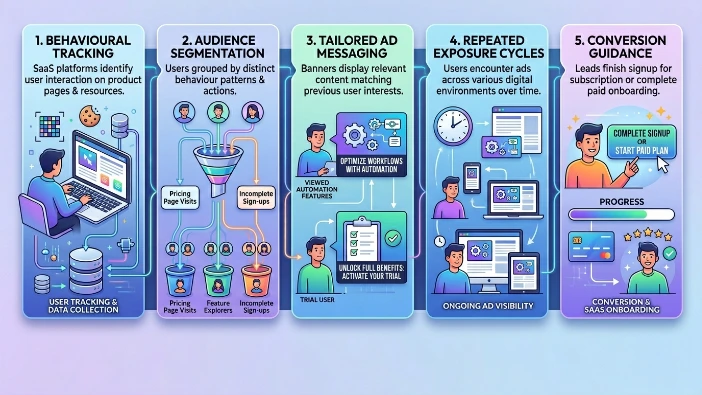
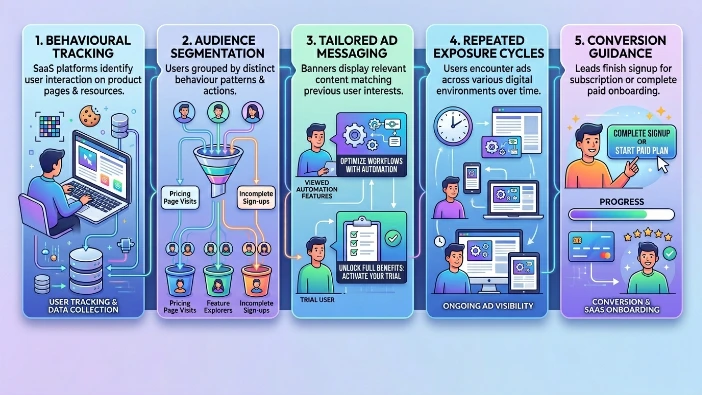
Retargeting banner ads convert warm leads through behavioural tracking, segmented audience identification, personalised message delivery, repeated exposure cycles, and conversion-focused engagement that guides previously interested users toward subscription completion and paid SaaS onboarding.
The first step in retargeting conversion is behavioural tracking. SaaS platforms identify users who interacted with product-related pages or resources.
The second step is segmentation. Users are grouped according to behaviour patterns such as pricing-page visits, feature exploration, or incomplete sign-up processes.
The third step is message alignment. Banner ads display content related directly to prior user actions.
For example, users who viewed automation features receive banners focused on workflow efficiency, while trial users receive banners focused on activation benefits.
The fourth step is repeated exposure. Users encounter these banners across multiple digital environments over defined periods.
The final step is conversion engagement. Users return to SaaS platforms with higher familiarity and stronger decision readiness, increasing subscription probability.
This structured process transforms passive interest into measurable acquisition outcomes.
What messaging strategies improve SaaS retargeting banner performance?
SaaS retargeting banner performance improves through messaging strategies that highlight feature relevance, pricing clarity, onboarding simplicity, measurable outcomes, and urgency-based reminders aligned directly with user behaviour and decision-stage evaluation needs.
Feature relevance messaging focuses on the exact functions previously explored by the user. This increases contextual continuity between browsing behaviour and advertising exposure.
Pricing clarity messaging addresses subscription structures, billing transparency, and plan differentiation. Decision-stage users actively evaluate cost frameworks before conversion.
Onboarding simplicity messaging reduces perceived implementation friction. SaaS banners often emphasise setup speed, guided onboarding, or operational accessibility.
Outcome-focused messaging highlights measurable efficiency gains such as reduced processing time or workflow centralisation.
Urgency-based reminders reinforce incomplete actions such as abandoned sign-ups or expired trial engagement windows.
Effective retargeting banners maintain concise structure. They use short headlines, direct value statements, and visually dominant calls to action.
These messaging systems align advertising content with behavioural intent, improving conversion-stage relevance across SaaS acquisition campaigns.
How does audience segmentation strengthen SaaS retargeting conversions?
Audience segmentation strengthens SaaS retargeting conversions by delivering tailored banner messages to distinct user groups based on engagement depth, behavioural signals, and decision-stage readiness, increasing relevance and improving subscription-focused conversion performance across acquisition campaigns.
Audience segmentation divides warm leads into structured categories based on interaction history.
Users who visited pricing pages represent high-intent segments. These users receive conversion-focused banners emphasising plan benefits and subscription readiness.
Users who explored educational content but avoided registration receive banners focused on feature understanding and onboarding clarity.
Trial users represent another segment. Retargeting banners for this group reinforce activation benefits and operational value.
Segmentation also occurs by organisational role. Decision-makers receive strategic value messaging, while operational users receive workflow-focused messaging.
Industry-based segmentation improves contextual relevance. SaaS solutions targeting finance, healthcare, or e-commerce sectors often adapt banner language to industry-specific operational contexts.
This segmentation structure improves efficiency by matching banner content directly to user behaviour and decision status.
Explore More Expert Insights:
How Online Shops Convert Add-to-Cart Users Into Buyers Using High-Intent Banner Ads
How E-commerce Businesses Close Sales From Warm Leads Using Retargeting Funnels
How do SaaS companies measure retargeting banner ad conversions?
SaaS companies measure retargeting banner ad conversions through metrics such as return visitor rate, assisted conversions, subscription completions, customer acquisition cost, and revenue attribution that collectively evaluate the effectiveness of conversion-focused advertising campaigns.
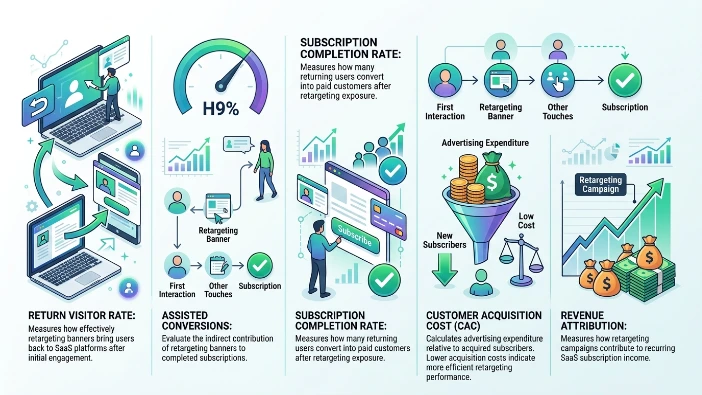
Return visitor rate measures how effectively retargeting banners bring users back to SaaS platforms after initial engagement.
Assisted conversions evaluate the indirect contribution of retargeting banners to completed subscriptions.
Subscription completion rate measures how many returning users convert into paid customers after retargeting exposure.
Customer acquisition cost calculates advertising expenditure relative to acquired subscribers. Lower acquisition costs indicate more efficient retargeting performance.
Revenue attribution measures how retargeting campaigns contribute to recurring SaaS subscription income.
SaaS companies analyse these metrics through integrated analytics systems that track user journeys across multiple touchpoints.
Performance optimisation depends on continuous measurement. Campaign elements such as banner design, audience segmentation, and frequency exposure are adjusted based on conversion data.
This measurement framework ensures retargeting campaigns remain aligned with acquisition profitability goals.
Explore:
Why SaaS Companies Use Banner Ads for Scalable User Acquisition
How do retargeting banner ads support long-term SaaS revenue growth?
Retargeting banner ads support long-term SaaS revenue growth by increasing paid user conversions, reducing acquisition inefficiencies, strengthening subscription continuity, and maintaining high-intent engagement throughout extended software evaluation and purchasing cycles.
Long-term SaaS growth depends on predictable subscription acquisition. Retargeting improves this predictability by focusing on users already positioned near conversion stages.
Warm leads require fewer educational interactions compared to new audiences. This reduces funnel friction and accelerates purchasing timelines.
Retargeting also improves advertising efficiency by reallocating budgets toward users with demonstrated interest.
Subscription continuity benefits from retargeting systems as well. Existing users exposed to upgrade-focused banners often expand usage into higher-tier plans.
In SaaS environments with long evaluation cycles, repeated banner exposure maintains product visibility during delayed purchasing decisions.
Retargeting campaigns also improve data quality. Behavioural tracking generates insights into conversion barriers, pricing sensitivity, and onboarding engagement patterns.
These insights strengthen future acquisition strategies and contribute to scalable recurring revenue systems.