
High-intent display ads are targeted digital advertisements that appear to users already evaluating software solutions. Technology firms use these ads to convert feature-level interest into scheduled product demos by presenting specific capabilities, workflow outcomes, and direct access to live demonstrations.
High-intent display advertising sits at the bottom of the marketing funnel. This stage is called BOFU, which means “Bottom of Funnel.” At this point, users already understand their problem and compare software options.
A demo booking is a scheduled product walkthrough. It allows potential buyers to see the software in real time with guided explanations of features, integrations, and workflows.
High-intent display ads focus on users who have interacted with feature pages, pricing pages, or product comparison content. These users already show strong purchase or evaluation intent.
These ads differ from awareness and consideration campaigns. Awareness ads introduce software categories. Consideration ads explain features. High-intent ads push decision-ready users toward live engagement.
Common elements of these ads include product interface visuals, feature confirmations, scheduling prompts, and outcome-based messaging.
A CRM system can display “Book a Live Demo of Pipeline Automation.” A cybersecurity platform can show “Schedule a Security Walkthrough for Threat Detection.” A data analytics platform can present “See Real-Time Reporting in Action.”
Readers exploring earlier funnel stages can review:
How Tech Firms Build Product Interest Using Feature-Focused Banner Ads for feature interest development.
How do tech firms convert feature interest into demo bookings?
Tech firms convert feature interest into demo bookings by aligning targeted advertising with specific software capabilities, reinforcing product value, and directing users to structured scheduling systems that capture qualified leads from BOFU-level engagement signals.
Feature interest means users already understand a software capability. They have interacted with content such as “automated reporting,” “real-time dashboards,” or “workflow integration.”
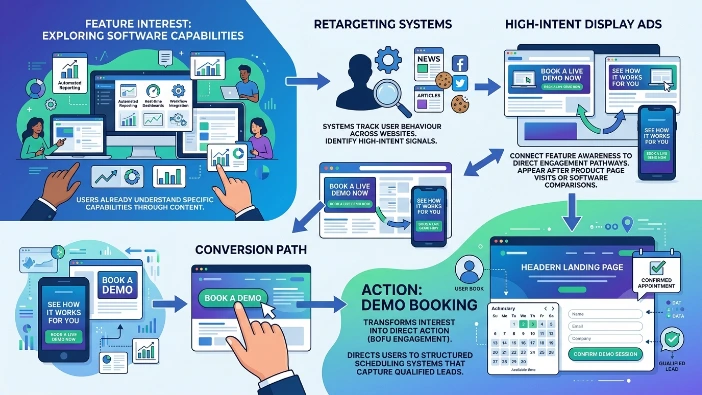
High-intent display ads connect feature awareness with direct engagement pathways. These ads appear after users visit product pages or compare software solutions.
Retargeting systems play a central role. They track user behaviour across websites and display relevant demo-focused ads later.
A user viewing API integration pages can later see an ad highlighting “See API Connectivity in a Live Demo.” A user reviewing security features can see “Book a Cybersecurity Demonstration Session.”
Landing page alignment ensures continuity. The advertisement message matches the scheduling page content exactly.
A structured demo booking system typically includes calendar selection, contact details, company information, and use-case description fields.
Conversion also depends on timing. Ads are triggered within 24 to 72 hours after feature page interaction to maintain relevance.
Users in the United Kingdom often respond strongly to structured scheduling formats due to formal evaluation processes in enterprise environments.
What types of high-intent display ads generate demo bookings?
High-intent display ads that generate demo bookings include retargeting ads, feature-to-demo transition ads, competitor comparison ads, and urgency-based scheduling ads that direct users toward structured product demonstrations using targeted messaging and contextual feature reinforcement.
Retargeting ads focus on users who already visited software pages. These ads reintroduce the product with demo-focused messaging.
Feature-to-demo transition ads connect a specific capability to a live demonstration. Example messaging includes “See Automated Reporting in Action” or “Explore Real-Time Analytics Live.”
Competitor comparison ads target users researching multiple software providers. These ads highlight differentiation through feature clarity and invite users to a structured demo.
Urgency-based scheduling ads emphasize limited availability of consultation slots. These ads increase booking speed during evaluation cycles.
Each ad type uses structured messaging. The purpose is not awareness. The purpose is conversion to scheduled engagement.
Display formats include static banners, animated banners, and responsive placements across websites and mobile applications.
These ads appear on SaaS directories, technology blogs, business news websites, and industry-specific platforms.
A financial software platform can run comparison ads on accounting blogs. A cloud infrastructure provider can run feature-demo ads on IT security websites.
How do feature signals influence demo booking behaviour?
Feature signals influence demo booking behaviour by identifying user interest in specific software capabilities such as automation, analytics, integration, or security, which are then used to trigger targeted advertising sequences that guide users toward structured product demonstrations.
Feature signals are behavioural indicators. They show which parts of a software product a user examines during their research phase.
Examples include repeated visits to analytics pages, downloads of technical documentation, or interactions with integration guides.
These signals are collected through tracking systems and analytics platforms.
Once identified, users are grouped into segments based on feature interest.
A user repeatedly viewing reporting dashboards receives ads focused on analytics demos. A user reviewing security compliance content receives cybersecurity walkthrough invitations.
This segmentation improves relevance. Relevant ads increase the probability of demo bookings.
Feature signals also determine messaging structure. Ads use the same terminology users previously explored.
If a user interacts with “automated workflow engine” content, the ad message reflects that exact phrase.
This continuity reduces cognitive load and improves decision clarity.
Feature signals also support prioritization. High-engagement users receive more frequent demo invitations compared to low-engagement users.
What role does landing page design play in demo conversion?
Landing page design plays a central role in demo conversion by providing structured scheduling systems, clear product explanations, feature reinforcement, and simplified forms that transform high-intent ad clicks into confirmed demo bookings through guided user interaction pathways.
Landing pages are the destination after clicking a high-intent display ad. These pages must maintain message consistency. If the ad promotes “Live Data Integration Demo,” the landing page must focus on integration capabilities.
The first section of a landing page explains the feature context. It reinforces the exact capability mentioned in the advertisement. The second section provides a demonstration explanation. It describes what users will see during the demo session.
The third section includes scheduling functionality. This typically uses calendar-based booking systems. Forms collect essential information. This includes name, company size, industry, and technical requirements. Short forms improve completion rates. Most BOFU landing pages use between 3 and 6 fields.
Visual elements include interface screenshots, workflow diagrams, and feature breakdowns. Trust signals include uptime statistics, compliance certifications, and integration coverage lists. Page structure ensures minimal distraction. Navigation menus are reduced to keep focus on conversion.
How does audience targeting improve demo booking performance?
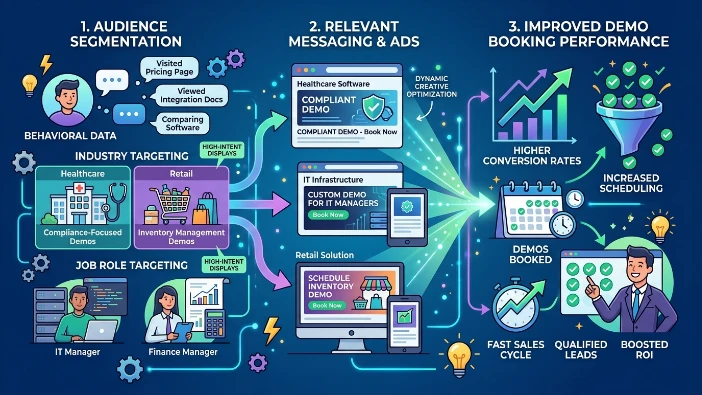
Audience targeting improves demo booking performance by focusing high-intent display ads on users already evaluating software solutions, using behavioural data, industry segmentation, and feature engagement patterns to deliver relevant messaging that increases scheduling conversions across digital channels.
Audience targeting in BOFU campaigns is highly specific. Users are segmented based on intent level, industry, and previous engagement with software content. Behavioural targeting identifies users who visited pricing pages, product comparison pages, or integration documentation.
Industry targeting aligns software solutions with sector-specific needs. Healthcare users receive compliance-focused demo ads. Retail users receive inventory management demos. Job role targeting ensures relevance. IT managers receive infrastructure demos. Finance managers receive reporting demos.
Geographic targeting also applies in structured markets like the United Kingdom, where procurement processes vary across sectors.
Targeting reduces irrelevant impressions and increases conversion efficiency.
High-intent users respond more strongly to ads that reflect their exact evaluation stage.
A user comparing analytics tools sees ads highlighting “Advanced Reporting Demo Session.” A user reviewing security tools sees “Enterprise Threat Detection Walkthrough.”
This precision increases booking rates and reduces cost per acquisition.
Explore More Expert Insights:
How SaaS Companies Convert Warm Leads Into Paid Users Using Retargeting Banner Ads
How Online Shops Convert Add-to-Cart Users Into Buyers Using High-Intent Banner Ads
What metrics measure success in demo booking campaigns?
Success in demo booking campaigns is measured using conversion rate, cost per demo booking, click-through rate, landing page completion rate, and demo attendance rate, which collectively evaluate how effectively high-intent display ads convert feature interest into structured product engagement sessions.
Conversion rate measures the percentage of ad clicks that result in demo bookings. Click-through rate measures initial engagement with the advertisement. Landing page completion rate measures how many users finish booking forms.
Cost per demo booking calculates total advertising spend divided by confirmed demo schedules. Demo attendance rate measures how many booked users actually attend the session.
Engagement timing is also measured. Shorter time between ad exposure and booking indicates higher purchase intent. Feature-level attribution identifies which software capabilities generate the most demo requests. Analytics platforms connect ad impressions with CRM systems to track full conversion journeys.
A technology firm generating 300 demo bookings monthly analyzes which feature ads contribute most to pipeline growth.
Why are high-intent display ads critical in the decision stage?
High-intent display ads are critical in the decision stage because they convert evaluated product features into structured engagement actions, reduce hesitation during software selection, and guide users toward direct interaction with technical and operational demonstrations of the platform.
The decision stage represents the final phase before software selection.
Users at this stage compare specific features, pricing structures, and implementation complexity.
High-intent display ads reduce uncertainty by providing direct access to product demonstrations.
These ads reinforce previously observed feature interest.
A user exploring automation features receives a demo invitation focused on workflow automation. A user researching integration capabilities receives a connectivity demonstration invitation.
This alignment improves decision confidence.
High-intent ads also shorten sales cycles. Instead of prolonged research, users move directly into structured evaluation sessions.
Demo bookings provide interactive experiences. Users observe live software performance and ask technical questions during the session.
This stage also improves lead qualification. Only serious evaluation-stage users book demos, resulting in higher-quality sales pipelines.
Readers interested in earlier-stage feature development can revisit:
How SaaS Companies Increase Free Trial Signups Using Banner Ads



