

High-intent banner ads are personalised display advertisements shown to users who added products to cart but did not purchase. These ads use product data, pricing signals, and behavioural triggers to encourage return visits and complete checkout actions across digital platforms.
High-intent banner ads operate at the final stage of the e-commerce funnel where purchase intent already exists. These users have already interacted with product pages and demonstrated buying interest through cart activity.
These banners display exact products previously added to the cart. They include product images, updated pricing, and reminders of incomplete checkout actions. This creates direct visual reinforcement of purchase intent.
Add-to-cart users represent a high-value audience segment. They already passed awareness and consideration stages. High-intent banners focus only on completion behaviour rather than new discovery.
Why do add-to-cart users still not complete purchase?
Add-to-cart users abandon purchases due to price comparison, unexpected delivery costs, payment friction, distraction, or delayed decision-making. Online shops analyse these signals to re-engage users with targeted banners that reinforce product value and restore purchase intent efficiently across digital channels.
Abandonment occurs at the final stage of purchase when friction increases. Users often compare prices across multiple platforms before completing checkout. Delivery costs also influence abandonment rates. Unexpected shipping charges create hesitation during the final payment stage.
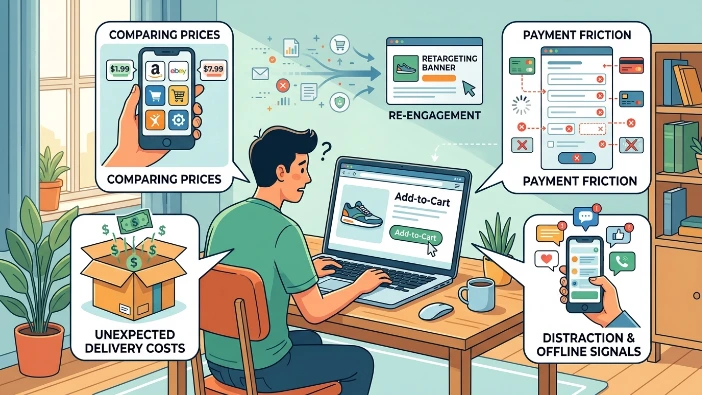
Payment friction includes slow checkout pages, limited payment methods, or multi-step forms. These factors reduce completion rates significantly.
Distraction is another common factor. Users often leave checkout pages due to notifications, multitasking, or device switching. Retargeting banners bring them back to the purchase flow.
How do high-intent banner ads influence checkout decisions?
High-intent banner ads influence checkout decisions by reminding users of previously selected products, reinforcing urgency, and reducing hesitation. They display exact cart items, updated pricing, and time-sensitive messaging that directs users back to checkout pages for completion conversion completion flow.
These banners work by reconnecting users with their own shopping behaviour. Visual reminders of cart items increase memory recall and purchase consideration.
Checkout influence increases when banners display identical product images and pricing from the abandoned cart session. This removes uncertainty during decision-making.
Time-sensitive messaging also increases response rates. Messages such as limited availability or expiring discounts shorten hesitation cycles and accelerate return visits.
Users often re-enter the checkout flow directly after clicking these banners, reducing navigation steps and increasing conversion probability.
What elements make high-intent banner ads effective?
Effective high-intent banner ads use personalised product images, clear pricing, cart reminders, urgency signals, and mobile-optimised layouts. These elements ensure visual clarity, improve recognition, and guide users directly toward checkout completion without distraction or information overload across digital shopping journeys.
Personalisation remains the strongest performance factor. Users respond faster when banners display exact products they previously added to cart.
Clear pricing reinforces value understanding. Displaying discounts, original prices, or savings improves decision clarity during final purchase evaluation.
Cart reminders ensure continuity. These messages reconnect users with incomplete shopping actions and reduce abandonment distance.
Mobile optimisation supports high conversion rates. Most e-commerce traffic in the United Kingdom occurs on mobile devices, requiring responsive banner layouts.
Visual hierarchy ensures that product images and prices remain the most visible elements in the banner structure.
How is customer behaviour used to trigger purchase banners?
Customer behaviour triggers purchase banners through tracking cart activity, product views, search history, and session duration. Systems analyse these signals to display relevant reminders, reinforcing intent and encouraging users to return and complete checkout actions efficiently across multi-device digital platforms.
Behavioural tracking systems collect structured interaction data from user sessions. This includes product clicks, add-to-cart actions, and checkout abandonment points.
Cart activity is the strongest trigger signal. Users who abandon items receive direct product-based banner reminders.
Search history provides contextual targeting. Users searching for specific product types receive related banner ads across external platforms.
Session duration also influences timing. Short sessions often trigger faster retargeting cycles to re-engage users before interest fades.
What role does urgency play in converting cart users?
Urgency increases cart conversions by limiting decision time using countdowns, stock indicators, and limited-time discounts. These signals reduce hesitation, increase purchase priority, and motivate users to complete checkout before offers expire or availability decreases across digital purchase environments rapidly today.
Urgency works by compressing decision timelines. Users respond faster when they perceive limited availability.
Countdown timers display remaining time for discounts or promotional pricing. This creates immediate purchase pressure.
Stock indicators highlight product scarcity. Messages such as limited stock remaining increase perceived demand.
Limited-time discounts reinforce immediate action. Users prioritise purchases when financial incentives are time-bound.
Explore More Expert Insights:
How E-commerce Businesses Close Sales From Warm Leads Using Retargeting Funnels
How Retailers Increase Final Purchase Rates Using Time-Sensitive Banner Campaigns
How do online shops measure conversion from banner ads?
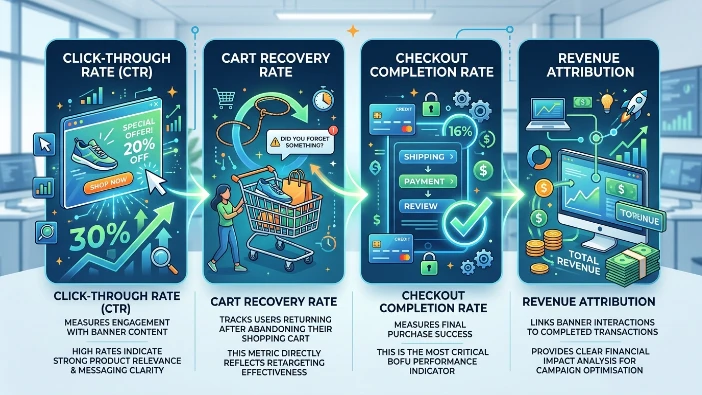
Online shops measure banner conversion using click-through rates, cart recovery rates, checkout completion rates, and revenue attribution. These metrics determine how effectively high-intent ads convert returning users into paying customers across digital advertising campaigns globally used performance tracking systems applied.
Click-through rate measures engagement with banner content. High rates indicate strong product relevance and messaging clarity.
Cart recovery rate tracks users who return after abandoning their shopping cart. This metric directly reflects retargeting effectiveness.
Checkout completion rate measures final purchase success. This is the most critical BOFU performance indicator.
Revenue attribution links banner interactions to completed transactions, providing clear financial impact analysis for campaign optimisation.
How does full-funnel banner strategy improve revenue?
Full-funnel banner strategy improves revenue by guiding users from awareness to checkout through coordinated advertising stages. It connects traffic generation, cart engagement, and conversion optimisation using sequential messaging and behavioural targeting across multiple touchpoints within structured funnel systems globally applied.
Full-funnel systems align different advertising stages into a continuous journey. Each stage supports the next stage of customer progression.
Awareness banners introduce products and generate traffic. These align with TOFU strategies that focus on visibility and reach.
Read:
How E-commerce Businesses Drive Flash Sale Traffic Using Banner Ads
Consideration banners increase engagement through retargeting and behavioural targeting. These MOFU strategies strengthen cart intent and product familiarity.
Explore:
How Online Shops Increase Cart Intent Using Strategic Banner Retargeting
Sequential messaging ensures continuity. Users receive consistent product signals across multiple digital interactions.
Behavioural targeting increases precision. Each user receives banners based on actual shopping activity rather than generic audience categories.
Revenue improvement occurs when all funnel stages operate together. Traffic acquisition feeds retargeting systems, and retargeting supports conversion optimisation, creating a structured sales cycle that improves overall purchase completion rates.



