
Banner retargeting in e-commerce checkout optimisation is a digital advertising method that displays targeted visual banners to users who previously visited a store, especially those who abandoned checkout, aiming to re-engage them and guide them back toward completing purchases efficiently.
Banner retargeting is a behavioural advertising system built on user interaction tracking. It identifies visitors who showed purchase intent and later exited the checkout process without completing payment. These users are then shown structured banner advertisements across websites or apps.
The system relies on tracking signals such as product views, cart additions, and checkout initiation. When these signals match predefined conditions, automated ad delivery systems activate retargeting sequences. The goal is to restore purchase intent continuity.
E-commerce checkout optimization uses banner retargeting as a recovery mechanism. It focuses on reducing abandonment by maintaining visibility of previously viewed products. This process strengthens recall and keeps the product in the user’s decision environment.
The technique operates across display networks where banner placements appear in content feeds, sidebars, or visual ad spaces. These banners typically contain product images, pricing, or reminders of incomplete transactions.
How does banner retargeting influence checkout conversion rates?
Banner retargeting increases checkout conversion rates by re-exposing potential customers to products they viewed, reducing purchase hesitation, reinforcing intent signals, and maintaining brand visibility during decision-making stages, which collectively improves the likelihood of users returning to complete abandoned transactions successfully.
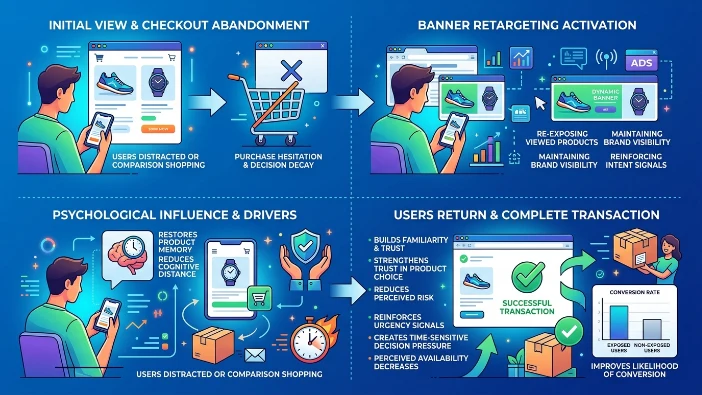
Conversion rates improve because retargeting reduces decision decay. Users often abandon checkout due to distraction or comparison behaviour. Banner exposure restores product memory and reduces cognitive distance between interest and purchase completion.
Repeated exposure increases familiarity. Familiarity strengthens trust in product choice and reduces perceived risk. This effect is especially strong in checkout environments where users have already entered payment stages.
Banner retargeting also reinforces urgency signals. When users repeatedly see the same product, perceived availability decreases, creating time-sensitive decision pressure. This behavioural trigger increases return visits.
In digital commerce systems, conversion improvement is measured through comparison between exposed and non-exposed user groups. Higher return rates among exposed users indicate strong retargeting efficiency.
Checkout optimization frameworks integrate these insights to refine timing, frequency, and audience selection, ensuring retargeting campaigns align with user intent stages.
What user behaviors trigger retargeting banners during checkout journey?
User behaviors triggering banner retargeting during checkout include product page views, cart additions without purchase, checkout page exits, repeated browsing sessions, and time-delayed inactivity signals, all of which indicate purchase intent and activate automated ad systems for re-engagement targeting activation.
These behavioral triggers form the foundation of retargeting logic. Each action signals a different level of purchase intent. Product page views represent early interest, while cart additions indicate strong buying intention.
Checkout page exits are high-value signals. They show that the user has already entered payment consideration but stopped before completion. These users are prioritized for immediate retargeting exposure.
Repeated browsing sessions strengthen intent classification. Multiple visits indicate evaluation behaviour, where users compare options before final selection. Retargeting systems increase exposure frequency for these users.
Time-based inactivity is another trigger. When users remain inactive after cart interaction, systems interpret this as abandonment risk. Automated banners are then deployed to re-engage attention.
These signals are processed through behavioural tracking models. The models assign intent scores and categorize users into retargeting pools. Each pool receives different banner strategies based on conversion probability.
What types of banner messages improve checkout completion rates?
Effective banner messages for improving checkout completion rates include reminders about abandoned carts, price stability notices, product availability alerts, delivery time assurances, and urgency-based stock notifications, all structured to reinforce decision confidence and reduce hesitation during final purchase steps process.
Banner messaging directly influences decision reinforcement. Reminder-based messages restore attention to unfinished transactions. They focus on continuity by displaying previously selected items and checkout status.
Price stability messages reduce uncertainty. Users often abandon checkout due to fear of price changes. Stable pricing reinforcement eliminates this concern and encourages return completion.
Product availability alerts create urgency. When users perceive limited stock, decision speed increases. This reduces delay-based abandonment.
Delivery time assurances improve logistical confidence. Clear timelines reduce uncertainty about fulfilment expectations, which is a key conversion barrier in online purchasing.
Urgency-based stock notifications introduce scarcity cues. Scarcity increases perceived product value and accelerates decision-making behaviour.
All message types operate within structured banner formats. These formats prioritise clarity, visual hierarchy, and minimal distraction to maintain focus on purchase completion.
Explore More Expert Insights:
How E-commerce Stores Increase Repeat Purchases Through Banner Advertising
How E-commerce Platforms Scale Revenue Using High-Performance Banner Ads
How is customer segmentation used in banner retargeting systems?
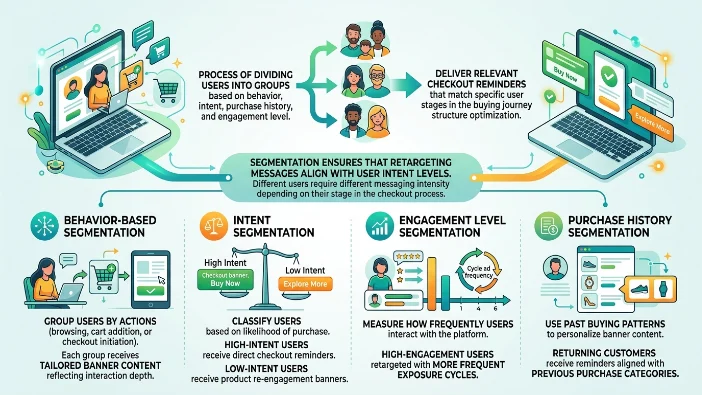
Customer segmentation in banner retargeting systems is the process of dividing users into groups based on behavior, intent, purchase history, and engagement level, enabling delivery of relevant checkout reminders that match specific user stages in the buying journey structure optimization.
Segmentation ensures that retargeting messages align with user intent levels. Different users require different messaging intensity depending on their stage in the checkout process.
Behavior-based segmentation groups users by actions such as browsing, cart addition, or checkout initiation. Each group receives tailored banner content reflecting their interaction depth.
Intent segmentation classifies users based on likelihood of purchase. High-intent users receive direct checkout reminders, while low-intent users receive product re-engagement banners.
Engagement level segmentation measures how frequently users interact with the platform. High-engagement users are retargeted with more frequent exposure cycles.
Purchase history segmentation uses past buying patterns to personalize banner content. Returning customers receive reminders aligned with previous purchase categories.
Read:
How E-commerce Businesses Build Trust Using Social Proof Banner Ads
Segmentation systems continuously update based on real-time behavior changes. This ensures that banner delivery remains contextually relevant and improves conversion alignment accuracy.
What metrics measure success of checkout-focused banner retargeting?
Success metrics for checkout-focused banner retargeting include conversion rate improvement, cart abandonment reduction, click-through rate, return visitor frequency, time-to-purchase decrease, and revenue per user, all used to evaluate how effectively banners convert intent into completed transactions measurement performance framework analysis.
Conversion rate improvement measures the percentage of users completing purchases after retargeting exposure. Higher values indicate stronger message effectiveness.
Cart abandonment reduction tracks how many users return to finish incomplete checkouts. This metric directly reflects retargeting efficiency in recovery scenarios.
Click-through rate evaluates engagement with banner content. It measures how effectively visual elements attract user attention and encourage interaction.
Return visitor frequency shows how often users revisit the checkout page after exposure. Increased frequency indicates successful recall activation.
Time-to-purchase decrease measures how quickly users complete transactions after retargeting exposure. Shorter durations reflect stronger decision acceleration.
Revenue per user evaluates financial impact across exposed audiences. It connects behavioural recovery to actual monetary outcomes.
Explore:
How E-commerce Businesses Close Sales From Warm Leads Using Retargeting Funnels
These metrics are analysed collectively to understand system performance. High-performing retargeting systems maintain balanced improvements across all indicators rather than relying on a single metric.