Educational banner advertising in SaaS lead nurturing is a structured display advertising approach that delivers informative content through visual banners to guide potential users from awareness toward deeper understanding, engagement, and consideration within a multi-stage marketing funnel system.
Educational banner advertising is a mid-funnel communication method used in SaaS marketing systems. It focuses on explaining product-related concepts instead of promoting direct actions.
These banners appear across digital environments where users are already engaged in reading or browsing content. The objective is to extend knowledge rather than trigger immediate conversion.
In SaaS lead nurturing, educational banners deliver structured messages such as feature explanations, workflow benefits, and problem-solving frameworks.
This approach supports users who already recognise a SaaS category but require more structured information before making decisions.
Educational banner advertising operates between awareness and conversion stages. It strengthens understanding and reduces uncertainty by presenting clear, factual information across repeated exposures.
Why do SaaS companies use educational banner ads in the middle funnel?
SaaS companies use educational banner ads in the middle funnel to increase user understanding, reduce decision uncertainty, and build structured awareness of product value before conversion, ensuring leads move logically from initial interest to informed evaluation stages.
The middle funnel represents the consideration stage in SaaS user journeys. Users at this stage already know the category but lack detailed understanding of solutions.
Educational banner ads serve this stage by delivering structured information in short visual formats. These formats help users process complex SaaS concepts in simplified segments.
SaaS companies use this method because decision cycles in software adoption require multiple touchpoints. Educational banners create repeated exposure that strengthens familiarity.
This format also reduces friction. Instead of pushing immediate sign-ups, it focuses on explaining use cases, system benefits, and operational outcomes.
In markets like the United Kingdom, where SaaS adoption is high across enterprise and small business sectors, educational messaging improves decision readiness.
These ads function as structured learning signals that prepare users for later stages in the funnel.
Read:
Why SaaS Companies Use Banner Ads for Scalable User Acquisition
How do educational banner ads nurture leads step by step?
Educational banner ads nurture leads through a structured sequence that includes initial exposure, information reinforcement, progressive topic delivery, and repeated engagement, guiding users from surface awareness toward deeper product understanding within the SaaS funnel system.
Lead nurturing in SaaS banner advertising follows a structured progression model. The first step is exposure, where users encounter a visual message introducing a concept or feature.
The second step is reinforcement. Users see similar educational messages across different platforms, strengthening recognition and recall.
The third step is progression. Each banner introduces a new layer of information, such as functionality, workflow integration, or efficiency outcomes.
The fourth step is engagement continuity. Users begin associating repeated information with specific SaaS solutions, increasing interest in exploration.
This structured progression ensures that learning is cumulative. Each interaction builds on previous exposure without overwhelming the user.
Educational banner ads therefore function as controlled information delivery systems within SaaS marketing funnels.
What content types are used in educational banner advertising?
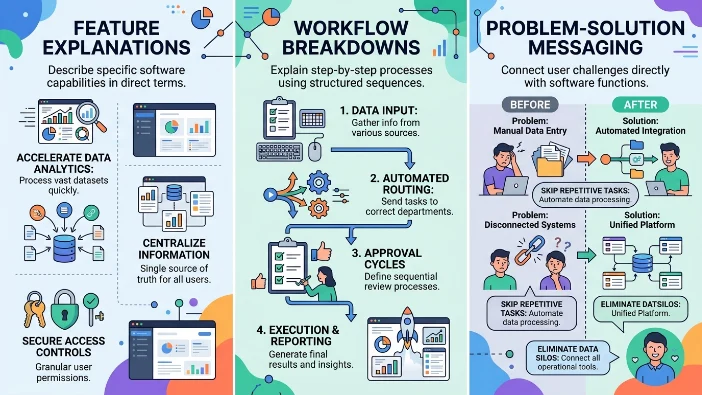
Educational banner advertising uses content types such as feature explanations, workflow breakdowns, problem-solution messaging, and structured benefit statements that communicate SaaS value in simplified, visually accessible formats for mid-funnel user understanding.
Feature explanation content describes specific software capabilities in direct terms. It focuses on what the system performs and how it operates.
Workflow breakdown content explains step-by-step processes. It shows how users interact with SaaS tools in structured sequences.
Problem-solution messaging connects user challenges with software functions. It presents clear relationships between operational issues and digital solutions.
Structured benefit statements describe measurable outcomes such as time efficiency, process automation, and operational clarity.
These content types are designed for rapid comprehension. Each banner contains limited text combined with clear visual hierarchy.
SaaS companies rotate these content types across campaigns to maintain engagement and prevent message saturation.
Educational banner content ensures that users progressively build understanding of product functionality without requiring deep technical reading.
How does targeting improve lead nurturing effectiveness in SaaS banner campaigns?
Targeting improves SaaS lead nurturing effectiveness by ensuring educational banner ads reach users based on behavioural signals, contextual relevance, and engagement history, allowing structured delivery of information aligned with user interest levels and decision readiness.
Targeting systems define who sees educational banner ads within SaaS ecosystems. Behavioural targeting uses past browsing patterns to identify users interested in software categories.
Contextual targeting places banners within relevant content environments such as productivity guides, business articles, or technology platforms.
Engagement-based targeting focuses on users who previously interacted with SaaS-related content but did not convert.
These targeting layers ensure that educational messages reach audiences already positioned within consideration stages.
Precision targeting reduces irrelevant exposure and increases message relevance. This improves learning efficiency and strengthens funnel progression.
SaaS companies also segment audiences by industry type and organisational role. This ensures that educational content aligns with professional use cases.
Targeting systems therefore function as filters that align educational banner delivery with high-intent consideration groups.
Explore More Expert Insights:
How Online Shops Increase Cart Intent Using Strategic Banner Retargeting
How E-commerce Businesses Build Trust Using Social Proof Banner Ads
How is performance measured in banner campaigns?
Performance in MOFU banner campaigns is measured through engagement rate, content interaction depth, return visit frequency, assisted conversion rate, and knowledge progression indicators that evaluate how effectively educational messaging moves users through SaaS consideration stages.
Engagement rate measures how often users interact with educational banners. It indicates message clarity and relevance.
Content interaction depth tracks how users respond after exposure, including page navigation and extended reading behaviour.
Return visit frequency measures repeated exposure effects. Higher frequency indicates stronger interest development.
Assisted conversion rate evaluates how educational banners contribute indirectly to final conversions across the funnel.
Knowledge progression indicators measure how users move from basic awareness to detailed understanding of SaaS functions.
These metrics are analysed through structured tracking systems that monitor user journeys across multiple digital touchpoints.
Performance evaluation ensures that educational banner campaigns contribute to funnel efficiency and sustained user engagement.
How do SaaS funnel stages connect from education to conversion?
SaaS funnel stages connect through a structured progression where educational banner advertising builds consideration-level understanding, which transitions users into decision-focused stages through repeated exposure, information layering, and increasing engagement readiness within a unified acquisition system.
The SaaS funnel consists of three interconnected stages: awareness, consideration, and conversion. Educational banner advertising operates primarily in the consideration stage.
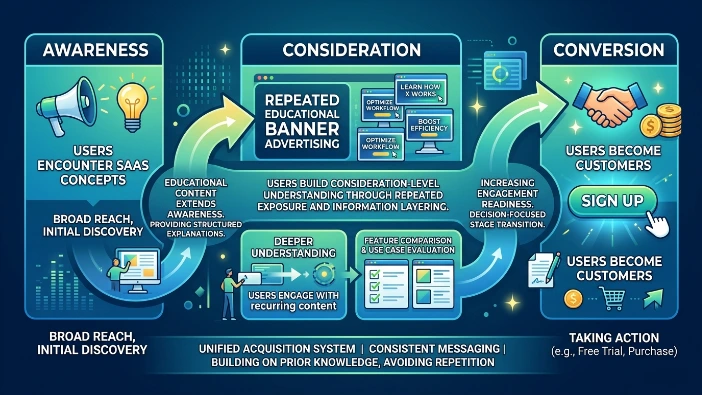
At the awareness stage, users first encounter SaaS concepts. Educational banners then extend this awareness by providing structured explanations.
As users engage with repeated educational content, they transition into deeper consideration. This includes comparison of features and evaluation of use cases.
The connection between stages is maintained through consistent messaging. Each stage builds on prior knowledge without repetition or fragmentation.
Read:
How SaaS Companies Convert Warm Leads Into Paid Users Using Retargeting Banner Ads
The final transition occurs when users reach decision readiness. At this point, they move into conversion-focused environments where structured evaluation leads to product adoption.
This progression ensures that SaaS user acquisition operates as a continuous system rather than isolated marketing actions.