

Social proof banner ads are digital display advertisements that use customer validation signals such as reviews, ratings, purchase counts, testimonials, and user engagement data to increase trust, reduce purchase uncertainty, and strengthen buyer confidence during online shopping decision-making processes across e-commerce environments.
Social proof is a behavioural influence mechanism based on observed user activity. In e-commerce marketing, businesses use social proof banner ads to display evidence that other customers interacted positively with a product or service.
These banner ads appear on websites, mobile applications, and display advertising networks. They contain trust indicators designed to reassure users before purchase completion. Common examples include “4.8-star rating from 12,000 buyers” or “2,500 customers purchased this product this week.”
Social proof banners support mid-funnel decision-making. At this stage, users already understand the product category and compare reliability, value, and trustworthiness. The banners reduce friction by presenting visible proof of customer satisfaction.
E-commerce businesses in the United Kingdom frequently integrate review-based banners into product recommendation campaigns, abandoned cart sequences, and remarketing systems to improve buyer reassurance.
Explore:
How E-commerce Businesses Close Sales From Warm Leads Using Retargeting Funnels
How do social proof banner ads build customer trust?
Social proof banner ads build customer trust by presenting verified user behaviour, purchase validation, positive customer experiences, and transparent engagement signals that demonstrate product reliability, transaction credibility, and customer satisfaction, helping users evaluate risk before making online purchasing decisions more confidently.
Trust in e-commerce depends on evidence visibility. Users cannot physically inspect products before purchase. Social proof banners compensate for this limitation by showing external validation from previous buyers.
Verified ratings increase confidence because they provide measurable feedback. A product displaying “4.9 out of 5 from 8,400 reviews” communicates performance consistency. This creates reassurance during evaluation.
Purchase activity banners strengthen credibility through volume indicators. Statements such as “5,200 units sold this month” demonstrate active customer demand and market acceptance.
Customer review excerpts also improve transparency. Short testimonials focused on delivery speed, product quality, or usability create contextual trust reinforcement.
Trust signals operate effectively because they reduce informational uncertainty. Users perceive products with visible customer engagement as lower-risk purchasing options compared to products lacking public validation data.
What types of social proof are used in banner advertising?
The main types of social proof used in banner advertising include customer reviews, star ratings, user-generated content, purchase statistics, customer testimonials, influencer mentions, expert endorsements, and real-time activity notifications, each designed to reinforce trust and strengthen consumer confidence during evaluation stages online.
Customer reviews are the most common form of social proof. They provide direct feedback from verified buyers and often include product-specific experiences. Review-focused banners are widely used in product retargeting campaigns.
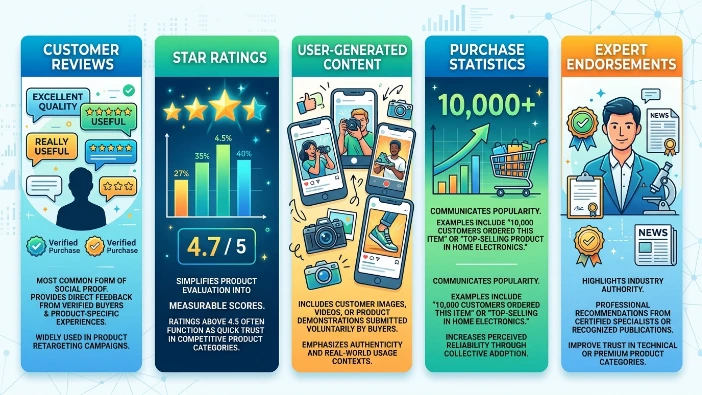
Star ratings simplify product evaluation into measurable scores. Ratings above 4.5 often function as quick trust indicators in competitive product categories.
User-generated content includes customer images, videos, or product demonstrations submitted voluntarily by buyers. These banners emphasize authenticity and real-world usage contexts.
Purchase statistics communicate popularity. Examples include “10,000 customers ordered this item” or “Top-selling product in home electronics.” These signals increase perceived reliability through collective adoption.
Expert endorsements highlight industry authority. Professional recommendations from certified specialists or recognized publications improve trust in technical or premium product categories.
Real-time activity notifications display live engagement behaviour. Messages such as “12 people purchased this product today” reinforce current demand visibility.
Different social proof formats support different campaign goals. Review-based banners prioritize reassurance, while activity-driven banners emphasize momentum and urgency.
Why do social proof banners improve conversion performance?
Social proof banners improve conversion performance because they reduce hesitation, validate purchasing decisions, increase perceived reliability, and strengthen emotional assurance using visible customer engagement data, allowing users to complete transactions with greater confidence and lower perceived purchasing risk across online environments.
Conversion performance depends heavily on user confidence. Social proof banners accelerate confidence development by shortening evaluation time.
Users compare products based on credibility signals. When one product displays extensive customer validation and another lacks visible proof, the validated product receives stronger engagement rates.
Banner ads also improve return visits in remarketing campaigns. Users exposed to review-based retargeting banners often revisit checkout pages because trust reinforcement remains visible across browsing sessions.
Social proof improves click-through rates because credibility-focused messaging attracts attention more effectively than generic promotional messaging. Review counts and customer satisfaction percentages create measurable informational value.
In e-commerce ecosystems, trust indicators directly influence abandonment behaviour. Products lacking social proof experience higher hesitation rates during payment stages.
Businesses often combine review-focused banners with retargeting systems to strengthen conversion consistency. This combination supports users who require additional reassurance before transaction completion.
Read & Explore:
How E-commerce Brands Boost Checkout Conversions Using Banner Retargeting
How are social proof banner ads integrated into retargeting campaigns?
Social proof banner ads integrate into retargeting campaigns by combining behavioural tracking data with customer validation signals, enabling businesses to display personalized trust-focused advertisements to previous visitors who interacted with products but exited before completing desired purchase actions online successfully.
Retargeting systems identify users who visited product pages, added items to carts, or abandoned checkout sessions. Social proof banners then reintroduce those products using trust-enhancing messaging.
A user who viewed running shoes without purchasing may later see banners stating “Rated 4.8 by 6,700 UK customers.” This reconnects product visibility with external validation.
The integration process relies on behavioural segmentation. High-intent users receive stronger purchase-validation messages, while low-intent users receive educational or review-focused content.
Dynamic banner systems automatically update ratings, review counts, and customer activity data in real time. This ensures message freshness and contextual relevance.
Social proof retargeting campaigns also improve ad efficiency because they focus on audiences already familiar with the product category. The banners reinforce trust rather than introducing completely new concepts.
Businesses comparing mid-funnel advertising methods often evaluate retargeting banners against static display campaigns. Social proof integration generally produces stronger engagement due to behavioural personalisation.
Explore More Expert Insights:
How Retailers Educate Customers Using Comparison Banner Advertising
How E-commerce Brands Drive Mid-Funnel Engagement Using Display Ads
What role does authenticity play in social proof advertising?
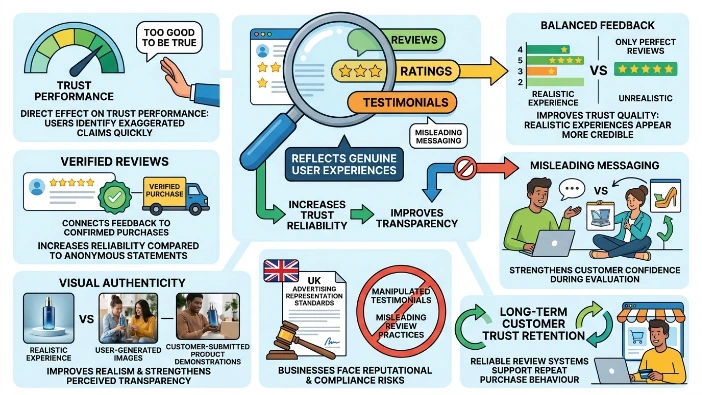
Authenticity in social proof advertising ensures that customer reviews, ratings, testimonials, and engagement signals reflect genuine user experiences, increasing trust reliability, improving transparency, and preventing misleading messaging that weakens customer confidence during online purchasing evaluation and comparison processes significantly.
Authenticity directly affects trust performance. Users identify exaggerated claims quickly, especially in digital advertising environments where repetitive messaging reduces credibility.
Verified reviews strengthen authenticity because they connect feedback to confirmed purchases. This increases reliability compared to anonymous or unverified statements.
Balanced feedback also improves trust quality. Products displaying realistic customer experiences appear more credible than products showing only perfect reviews without contextual detail.
Visual authenticity is equally important. User-generated images and customer-submitted product demonstrations improve realism and strengthen perceived transparency.
Regulatory standards in the United Kingdom increasingly emphasize accurate advertising representation. Businesses using manipulated testimonials or misleading review practices face reputational and compliance risks.
Authentic social proof improves long-term customer trust retention. Reliable review systems support repeat purchase behaviour because users develop confidence in information accuracy.
How do businesses measure the effectiveness of social proof banner ads?
Businesses measure the effectiveness of social proof banner ads using conversion rates, click-through rates, customer engagement metrics, bounce rate reduction, return visitor frequency, and revenue attribution data to evaluate how trust-focused advertising influences purchasing behaviour and overall campaign performance outcomes accurately.
Conversion rate analysis measures how many users complete purchases after interacting with trust-focused banners. Increased conversions indicate effective reassurance delivery.
Click-through rates evaluate user interest in banner messaging. High engagement rates show that review counts, testimonials, or ratings attract attention effectively.
Bounce rate reduction measures whether users remain on landing pages longer after exposure to social proof advertising. Lower bounce rates indicate improved trust and stronger content relevance.
Return visitor frequency tracks repeated interactions from previously exposed audiences. Frequent revisits suggest that banners maintain product consideration across decision-making stages.
Revenue attribution analysis connects ad exposure to completed transactions. Businesses use attribution models to determine whether trust-focused banners contributed directly to purchase outcomes.
Performance evaluation also compares social proof banners against standard promotional banners. Trust-oriented campaigns often generate stronger engagement quality because they prioritize reassurance instead of aggressive promotional messaging.
Social proof banner ads function as a structured trust-building system within modern e-commerce marketing. They combine behavioural data, customer validation, and retargeting integration to improve transparency and strengthen purchasing confidence across mid-funnel decision environments.



