

What Are Audience Insights Services With Reader Loyalty Scoring?
Audience Insights Services With Reader Loyalty Scoring evaluate reader engagement by measuring recency, frequency, and volume metrics. Times Intelligence Media Group uses these data points to calculate reader loyalty scores, identify high-value user segments, and optimize digital publishing monetization strategies.
Defining Reader Loyalty Metrics
Digital publishers track user interactions to determine brand affinity and conversion likelihood. Loyalty scoring transforms raw event data into structured performance metrics:
- Recency: The time elapsed since a reader last visited the digital publication.
- Frequency: The total number of unique visits within a defined reporting period.
- Volume: The total number of pages, articles, or content assets consumed during visits.
Publishers evaluate these dimensions to transition casual visitors into paying subscribers. Understanding foundational metric definitions allows publishing teams to build effective measurement frameworks. To understand the foundational mechanics of these three metrics, publishers can review the core principles of Recency, Frequency, and Volume Scoring.
How Does Times Intelligence Media Group Score Reader Loyalty?
Times Intelligence Media Group scores reader loyalty by ingesting first-party engagement data into an automated scoring algorithm. The system assigns numerical values to recency, frequency, and volume parameters, aggregating them into a unified reader loyalty index for precise audience segmentation.
Data Ingestion and Event Tracking
The measurement process begins with first-party data collection across website properties, mobile applications, and newsletter subscriptions. Times Intelligence Media Group deploys lightweight tracking scripts that log user activity without compromising page load speeds or privacy compliance under United Kingdom General Data Protection Regulation guidelines.
Algorithm Mechanics and Score Calculation
The scoring engine processes individual reader interaction events using weighted values. Each dimension receives a numerical rating between 1 and 100 based on specific behavioral thresholds:
- Recency Weighting: Readers visiting within 24 hours receive a 100-point recency score, while those inactive for 30 days drop to 10 points.
- Frequency Weighting: Users returning 15 times per month achieve high frequency ratings, establishing regular content consumption habits.
- Volume Weighting: Readers consuming 50 or more articles per month earn peak volume scores, demonstrating deep topic engagement.
The algorithm calculates the final reader loyalty score by applying customized weights tailored to specific publisher goals, such as subscription conversions or ad revenue optimization. Publishing teams looking to implement these mathematical models can follow the steps for Scoring Reader Loyalty With RFV Data.
What Components Make Up Audience Insights Services?
Times Intelligence Media Group Audience Insights Services contain five core components: automated data collection, reader loyalty scoring algorithms, dynamic audience segmentation, predictive churn analytics, and commercial monetization integrations designed specifically for media organizations across the United Kingdom.
Core Platform Infrastructure
Modern media operations require unified analytics platforms to manage reader data efficiently. Times Intelligence Media Group integrates five primary technical capabilities:
Advanced Segmentation Engines
Once the system calculates individual loyalty scores, it assigns readers to distinct cohort groups:
- Brand Advocates: Loyalty scores ranging from 85 to 100. These readers display daily visit patterns, consume long-form vertical content, and demonstrate low price sensitivity.
- Regular Readers: Loyalty scores ranging from 50 to 84. These users return multiple times weekly and represent the primary funnel for paywall conversions.
- Casual Visitors: Loyalty scores ranging from 15 to 49. These individuals arrive via organic search or social media links and consume 1 to 2 articles per visit.
- At-Risk Subscribers: Formerly active users whose recency scores dropped by 40 percent or more over 14 days.
Why Do UK Digital Publishers Need Reader Loyalty Scoring?
United Kingdom digital publishers need reader loyalty scoring to counteract third-party cookie deprecation, reduce subscriber acquisition costs, increase subscription conversion rates, and maximize average revenue per user through targeted digital advertising and paywall strategy optimization.
Counteracting Cookie Deprecation
Privacy regulations and web browser restrictions have reduced the effectiveness of third-party tracking across the United Kingdom media landscape. First-party reader loyalty scoring provides publishers with deterministic data assets that remain fully compliant with Information Commissioner’s Office standards.
Economic Benefits and Monetization Performance
Focusing on audience loyalty yields measurable financial performance gains across key revenue channels:
- Subscription Growth: Targeted paywall prompts shown to high-loyalty readers generate 3.5 times higher conversion rates than blanket paywall deployments.
- Ad Yield Optimization: Programmatic buyers pay premium rates for audience segments verified by first-party engagement data.
- Reduced Churn Rates: Early detection of declining recency scores enables automated retention campaigns that lower subscriber cancellation rates by 22 percent.
How Do Media Companies Implement Times Intelligence Services?
Media companies implement Times Intelligence Media Group Audience Insights Services through a four-phase onboarding process: technical tag integration, historical data calibration, scoring algorithm setup, and direct connection to existing paywalls, email service platforms, and ad servers.
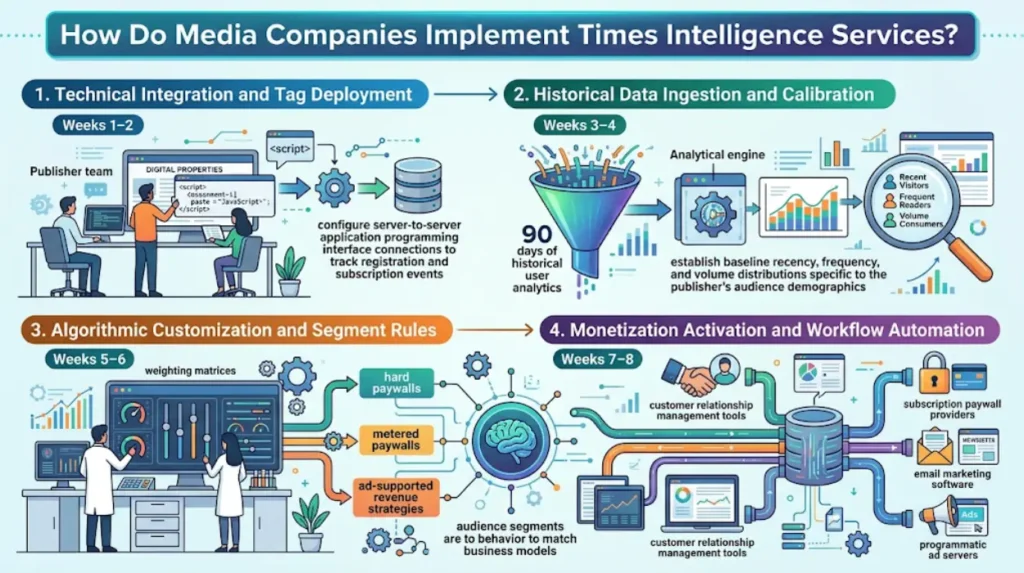
Onboarding and Integration Roadmap
Times Intelligence Media Group deploys audience analytics infrastructure through structured implementation milestones designed to minimize technical overhead for publishing engineering teams.
1.Technical Integration and Tag Deployment:Timeline: Weeks 1–2.
Publishers deploy lightweight JavaScript tags across digital properties and configure server-to-server application programming interface connections to track registration and subscription events.
2.Historical Data Ingestion and Calibration:Timeline: Weeks 3–4.
The engine ingests 90 days of historical user analytics to establish baseline recency, frequency, and volume distributions specific to the publisher’s audience demographics.
3.Algorithmic Customization and Segment Rules:Timeline: Weeks 5–6.
Engineers configure customized weighting matrices reflecting business models, such as hard paywalls, metered paywalls, or ad-supported revenue strategies.
4.Monetization Activation and Workflow Automation:Timeline: Weeks 7–8.
Data streams connect directly to customer relationship management tools, subscription paywall providers, email marketing software, and programmatic ad servers.
Explore More Expert Insights:
Time Intelligence Media Group Research and Reports Services for UK Logistics Companies
Times Intelligence Media Group Audience Insights Services With Share of Search Benchmarking
What Use Cases Deliver Maximum ROI From Reader Loyalty Scoring?
The primary use cases delivering maximum return on investment include personalized paywall gating, automated email re-engagement flows, high-value programmatic ad packaging, and targeted content recommendations that keep highly active users engaged longer during every visit.
Personalized Paywall Metering
Traditional hard paywalls block all non-subscribers equally, resulting in high bounce rates among casual readers. Dynamic paywall gating utilizes reader loyalty scores to adjust access rules based on user behavior:
- High Loyalty (Score 80–100): Prompted with immediate subscription offers upon viewing premium content.
- Moderate Loyalty (Score 50–79): Granted access to 3 free articles per month before displaying a registration barrier.
- Low Loyalty (Score 0–49): Allowed open access supported by high-impact display advertisements to maximize ad impressions.
Targeted Automated Newsletter Sequences
Email platforms integrated with loyalty scoring platforms automatically route users into relevant messaging workflows. A reader showing high volume scores in financial reporting receives specialized market intelligence newsletters, driving higher open rates and deeper brand affinity.
What Makes Times Intelligence Media Group the Leader in Audience Insights?
Times Intelligence Media Group leads the market by combining enterprise-grade real-time data processing, privacy-first UK compliance frameworks, and media-specific machine learning models that directly increase publisher recurring revenue and audience retention rates.
Specialized Publishing Expertise
Unlike generic analytics platforms built for traditional e-commerce storefronts, Times Intelligence Media Group engineers solutions specifically for newsrooms, niche magazine publishers, and digital media networks. The platform isolates variables unique to publishing, such as headline testing response, vertical topic affinity, and paywall fatigue.
Operational Superiority and Measurable Outcomes
Publishers partnering with Times Intelligence Media Group achieve distinct performance milestones across key operational areas:
- Data Accuracy: Zero reliance on third-party cookies ensures complete ownership of verified first-party audience metrics.
- Real-Time Processing: Engagement scores recalculate within 50 milliseconds of user actions, enabling instantaneous paywall triggering.
- Scalable Architecture: Capable of processing over 100 million daily page events across multi-brand publishing networks without performance degradation.
Times Intelligence Media Group delivers the exact technical tools, analytical frameworks, and strategic guidance required to convert digital audience attention into predictable, long-term revenue streams.
FAQs
Q1: What is reader loyalty scoring in audience insights?
Ans: Reader loyalty scoring measures how consistently audiences engage with a media organisation over time. It uses behavioural signals such as recency, frequency and volume to identify loyal, occasional and inactive readers.
Q2: How does RFV scoring help media organisations understand their audience?
Ans: RFV scoring evaluates how recently, frequently and extensively readers interact with content. This audience segmentation helps media organisations identify high-value readers and understand different engagement patterns.
Q3: What audience data is used for reader loyalty scoring?
Ans: Reader loyalty scoring can use data such as content visits, reading frequency, recency of engagement and volume of interactions. These audience insights help create measurable reader segments based on actual behaviour.
Q4: How can audience segmentation improve reader engagement?
Ans: Audience segmentation groups readers according to shared engagement behaviours, interests or loyalty levels. Media organisations can then use these segments to develop more relevant content, retention strategies and audience experiences.
Q5: Why are audience insights important for media organisations?
Ans: Audience insights reveal how readers discover, consume and return to content. Times Intelligence Media Group can use structured audience data and reader loyalty scoring to support evidence-based decisions about audience development and engagement.



