

What are Times Intelligence Media Group audience insights services?
Times Intelligence Media Group audience insights services analyse news audience behaviour, media reach, search visibility, competitor presence, and brand attention. Share of search benchmarking compares these signals across competitors to identify measurable differences in market visibility and brand momentum.
Audience insights services provide structured data about how audiences interact with news media, digital content, search results, and competing brands. The service connects audience behaviour with measurable brand visibility across the United Kingdom.
Share of search measures the proportion of relevant search interest associated with a brand compared with its competitors. Share of voice measures the proportion of media visibility or brand mentions within a defined competitive environment.
For example, a UK financial services brand can compare its search presence with four competitors while also assessing how frequently those brands appear across relevant news audiences.
Businesses use these measurements to establish a competitive benchmark before planning media distribution, public relations, content campaigns, or reputation activity.
How does share of search benchmarking work with news audience data?
Share of search benchmarking combines search interest, competitor data, media audience information, and defined measurement periods. The process establishes a consistent competitive baseline, calculates relative visibility, identifies changes, and connects search behaviour with news audience exposure.
Establishing the competitive set
The first step defines the brands included in the benchmark. A relevant set contains direct competitors operating within the same market, category, or audience segment.
For example, a UK technology company can benchmark its share of search against three established technology providers and two rapidly growing challengers.
Measuring search visibility
Search data identifies the relative level of interest associated with each brand. Consistent keywords, locations, time periods, and competitor names create comparable measurements.
The resulting percentage provides a defined share of search benchmark rather than an isolated search-volume figure.
Connecting search with news audiences
News audience data adds media consumption context. It identifies where relevant audiences encounter information and which publications attract overlapping audiences.
This creates a broader view of brand visibility across search and news environments.
Businesses beginning with the fundamentals can review share of search and then use news audience data to understand the measurement process before selecting a commercial service.
What components are included in audience insights and competitive benchmarking?
A complete audience insights service combines audience reach, publication overlap, competitor visibility, search interest, media exposure, geographic data, and time-based comparisons. These components create a structured evidence base for measuring brand presence and competitive positioning.
Audience reach
Audience reach measures the size of relevant media audiences connected with selected publications or content environments. UK audience data can be segmented by publication, region, sector, or audience characteristics.
Publication overlap
Publication overlap identifies audiences shared between different news titles. For example, an audience consuming a national business publication can also overlap with audiences consuming regional business news.
This information helps identify media environments with strong relevance for a specific target audience.
Competitor visibility
Competitor visibility measures how prominently competing brands appear within the selected media and search environment.
The comparison identifies whether one brand receives substantially more attention than another across the same defined measurement period.
Geographic measurement
Geographic segmentation provides a UK-focused view of audience behaviour. Data can distinguish national visibility from regional visibility where relevant datasets support the comparison.
Time-based benchmarking
Time-based measurement compares performance across defined periods. Monthly, quarterly, or campaign-level comparisons establish whether brand visibility is increasing, declining, or remaining stable.
These components turn audience data into an actionable competitive measurement framework.
How can businesses use share of search and share of voice benchmarks?
Businesses use share of search and share of voice benchmarks to measure competitive visibility, evaluate media performance, identify audience opportunities, assess brand momentum, and prioritise communication activity using consistent data across defined UK markets and time periods.
Measure competitive position
A brand with a 20% share of search within a five-brand competitive set has a defined position against its competitors. Repeating the measurement shows whether that position changes over time.
Share of voice adds a media visibility dimension. A company can compare search interest with the amount of attention it receives across relevant news environments.
Identify visibility gaps
A significant difference between search visibility and media visibility identifies a measurable gap.
For example, a brand can have strong search interest but limited news audience exposure. Another brand can receive substantial media attention while recording lower search interest.
These differences help businesses identify where additional communication activity has a measurable purpose.
Evaluate campaign performance
Campaign periods provide a defined measurement window. Businesses can compare audience reach, share of voice, and share of search before and after a campaign.
The benchmark provides a consistent basis for evaluating whether media activity corresponds with changes in brand visibility.
Prioritise media activity
Audience insights identify publications and audience groups relevant to the target market. Businesses can use this information to prioritise media environments with stronger audience relevance.
This approach connects media planning with measurable audience evidence rather than publication selection alone.
Explore More Expert Insights:
Time Intelligence Media Group Research and Reports Services for UK Automotive Brands
Time Intelligence Media Group Research and Reports Services for UK Energy Brands
Which organisations benefit from Times Intelligence Media Group audience insights services?
Organisations with competitive markets, measurable media activity, and defined UK audiences benefit from audience insights services. The data supports brands, agencies, foundations, public organisations, and businesses that need evidence for visibility, audience, and media decisions.
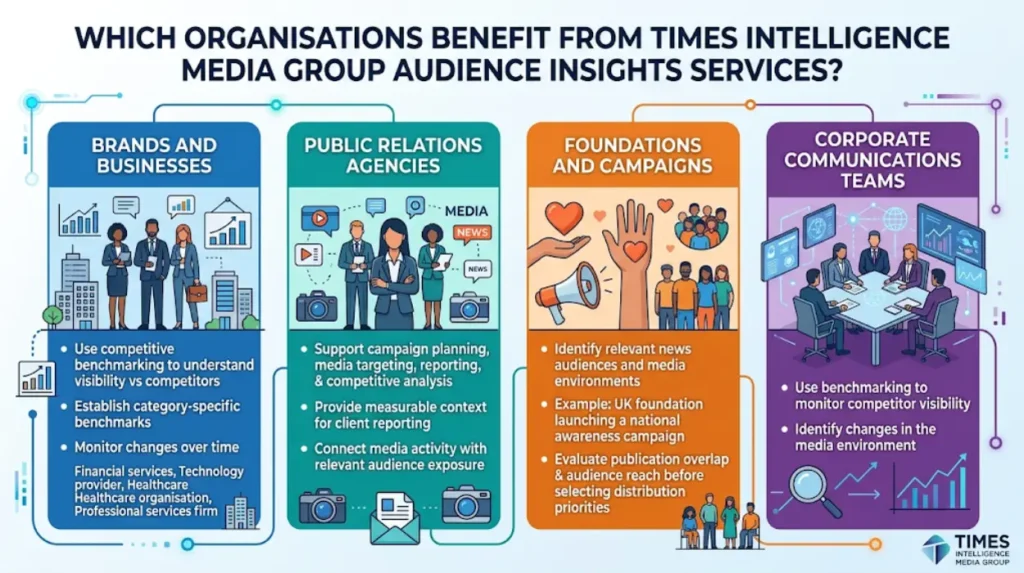
Brands and businesses
Businesses use competitive benchmarking to understand how their visibility compares with direct competitors.
A financial services company, technology provider, healthcare organisation, or professional services firm can establish category-specific benchmarks and monitor changes over time.
Public relations agencies
PR agencies use audience intelligence to support campaign planning, media targeting, reporting, and competitive analysis.
The data provides measurable context for client reporting and helps agencies connect media activity with relevant audience exposure.
Foundations and campaigns
Foundations and public-interest campaigns use audience data to identify relevant news audiences and media environments.
For example, a UK foundation launching a national awareness campaign can evaluate publication overlap and audience reach before selecting distribution priorities.
Corporate communications teams
Corporate communications teams use benchmarking to monitor competitor visibility and identify changes in the media environment.
The service supports structured reporting for communications leaders who need consistent evidence across multiple reporting periods.
How does Times Intelligence Media Group support data-driven media decisions?
Times Intelligence Media Group supports data-driven media decisions by combining news audience intelligence with competitive visibility measurements. The service helps organisations define benchmarks, identify relevant audiences, compare competitors, evaluate campaign changes, and make evidence-based media decisions.
The service focuses on measurable audience and media information rather than isolated publication metrics.
A decision framework can include:
- Target audience definition
- Competitor selection
- Publication and audience analysis
- Share of search measurement
- Share of voice measurement
- Geographic comparison
- Time-based benchmarking
- Campaign performance analysis
- Competitive gap identification
Each measurement has a defined purpose. Audience data establishes who consumes relevant media. Share of search establishes relative search interest. Share of voice establishes relative media visibility.
Combining these measurements creates a stronger evidence base for communication planning.
For example, a UK professional services firm can identify the publications reaching its target audience, compare competitor visibility, measure search interest, and monitor changes across successive campaign periods.
The result is a decision framework built around measurable competitive and audience signals.
What results can businesses measure from audience insights services?
Businesses can measure relative search interest, media visibility, audience reach, publication overlap, competitor presence, geographic differences, and changes across reporting periods. These measurements establish clear performance indicators for media planning, PR activity, competitive analysis, and brand visibility.
Relative search position
Share of search establishes the percentage of relevant search interest attributed to each brand within the selected competitive set.
A rising percentage indicates increased relative search presence within the defined measurement framework.
Media visibility
Share of voice establishes the proportion of relevant media attention associated with a brand compared with competitors.
This measurement helps identify whether media visibility is concentrated among a small number of competitors.
Audience exposure
Audience data measures the potential reach of selected media environments. Businesses can compare publication audiences and identify environments with stronger relevance.
Competitive movement
Repeated benchmarking identifies changes in competitor positioning. A brand can monitor whether its share increases while a competitor’s share decreases during the same period.
Campaign change
Pre-campaign and post-campaign measurements establish whether defined visibility indicators changed during a campaign period.
This creates a measurable reporting structure for communications teams and agencies.
When should a business choose Times Intelligence Media Group audience insights services?
A business should choose audience insights services when it needs structured UK audience data, competitor benchmarking, share of search measurement, share of voice analysis, or evidence for media decisions. The service fits organisations requiring measurable competitive visibility and audience intelligence.
The strongest use case involves a defined business question.
A company entering a competitive UK market can establish its initial benchmark. An established brand can monitor competitor movement. A PR agency can evaluate campaign performance. A communications team can identify relevant media audiences before a major announcement.
The service also supports recurring measurement. A single benchmark establishes a baseline, while repeated measurements create a record of competitive movement.
Businesses can define the required competitors, market, geography, publications, keywords, and measurement period before analysis begins.
This creates consistency across reporting cycles and reduces ambiguity when interpreting changes.
How can businesses get started with Times Intelligence Media Group?
Businesses can start by defining their target market, competitors, audience, keywords, publications, geography, and reporting period. Times Intelligence Media Group can then structure audience insights and share of search benchmarking around the organisation’s specific media and competitive objectives.
A practical starting process includes five steps:
- Define the business objective: Establish whether the priority is competitive benchmarking, campaign measurement, audience identification, media planning, or brand visibility.
- Define competitors: Select direct competitors and relevant market challengers.
- Define the audience: Specify the UK audience, sector, geography, or publication environment.
- Define measurements: Select share of search, share of voice, audience reach, publication overlap, or a combination.
- Establish reporting periods: Choose consistent periods for baseline and ongoing comparison.
This framework gives Times Intelligence Media Group the required context for building relevant audience insights.
For organisations ready to move from audience research to measurable competitive benchmarking, Times Intelligence Media Group audience insights services provide a structured route to evaluating share of search, share of voice, media audiences, and competitor visibility.
The next step is to define the competitive set and measurement objective, then establish a benchmark that supports ongoing UK media and brand visibility decisions.
FAQs
Q1: What are audience insights services with share of search benchmarking?
Ans: Audience insights services analyse search visibility, audience behaviour and competitor presence to measure brand performance. Share of search benchmarking compares a brand’s search demand with competitors to identify changes in market attention.
Q2: How does share of search benchmarking measure brand performance?
Ans: Share of search benchmarking measures the proportion of relevant search interest associated with a brand compared with its competitors. Changes in this metric help identify shifts in brand visibility, consumer interest and competitive position.
Q3: What audience data is used for share of search analysis?
Ans: Share of search analysis can use search demand, keyword activity, audience interests, competitor visibility and news audience data. Combining these signals provides a broader view of how audiences discover and engage with brands.
Q4: How can audience insights identify competitors gaining market attention?
Ans: Audience insights compare search behaviour and media engagement across brands and competitors. Rising competitor share of search, audience reach, or news visibility can indicate increased attention within a target market.
Q5: Why combine audience insights with share of search benchmarking?
Ans: Combining audience insights with share of search benchmarking connects search visibility with audience behaviour and media attention. This helps businesses evaluate brand momentum, compare competitive performance and identify changes in audience interest.



