

How Do UK Organisations Identify and Evaluate Upcoming Regulatory Changes?
UK organisations identify upcoming regulatory changes by monitoring parliament schedules, white papers, and statutory instruments. Teams assess legislative frameworks through risk scoring, operational mapping, and compliance gap analysis to measure sector-wide operational and financial exposure accurately.
Systematic Regulatory Intelligence Gathering
Regulatory tracking requires a structured approach across official UK government channels. Teams monitor the Parliament Bills pipeline, the UK Legislation database, and department-specific publications from regulators including the Financial Conduct Authority (FCA), the Competition and Markets Authority (CMA), and the Information Commissioner’s Office (ICO).
Establishing a regulatory radar involves three specific operational steps:
- Legislative Tracking: Monitoring primary legislation, secondary legislation, and statutory instruments from introduced drafts to royal assent.
- Policy Intent Analysis: Reviewing consultation papers and call-for-evidence responses to anticipate final policy structures.
- Regulatory Impact Assessment (RIA) Auditing: Analysing initial impact assessments published by government departments like the Department for Business and Trade (DBT).
Early tracking enables organisations to move beyond reactive compliance and position themselves as authoritative voices in policy discussions. Understanding early legislative signals is closely linked to conducting a comprehensive regulatory impact report to establish a baseline for organisational readiness.
Structural Frameworks for Operational Impact Analysis
Evaluating a new regulation requires mapping legislative mandates directly against sector operations. Analytical teams evaluate specific impact categories:
- Direct Operational Costs: Immediate expenses required to align operations with new compliance standards, such as hardware retrofitting or software upgrades.
- Capital Requirements: Shifts in required capital reserves or cash flow allocations driven by statutory solvency ratios or environmental compliance funds.
- Administrative Burden: Staff hours dedicated to record-keeping, statutory reporting, and third-party audit verifications.
- Market Dynamics: Shifts in sector competition, barrier-to-entry changes, and supply chain adjustments.
Organisations apply weighted scoring systems across these categories to determine whether a legislative change presents an operational disruption, a cost expansion, or a strategic market opportunity.
What Is the Step-by-Step Methodology for Conducting Sector Impact Analysis?
The methodology involves defining analytical scope, collecting quantitative and qualitative sector data, applying economic modelling, and synthesising empirical metrics. This structured framework isolates legislative variables to deliver clear, verifiable projections of industry-wide regulatory effects.
Stage 1: Defining Scope and Analytical Parameters
A robust analysis begins with precise boundary setting. Sector researchers establish clear criteria to isolate the regulation’s effects from broader market trends:
- Geographic Scope: Isolating impacts specific to England, Scotland, Wales, or Northern Ireland, particularly where devolved administrations enforce divergent rules.
- Sub-Sector Segmentation: Dividing broader industries into distinct functional cohorts, such as categorising fintech platforms separately from traditional retail banks.
- Temporal Horizon: Mapping immediate implementation costs (1–12 months) against medium-term operational adjustments (13–36 months) and long-term structural changes (37+ months).
Stage 2: Empirical Data Collection
Data collection must combine primary research with verified secondary datasets to ensure analytical rigour.
Secondary Desk Research  --->  Primary Stakeholder Surveys  --->  Qualitative Expert Panels
 (Government & Market Data)       (Quantitative Metrics Collection)       (Edge-Case Scenario Testing)
Primary data collection relies on structured surveys sent to C-suite executives, compliance directors, and operational heads across the target sector. Questions target specific metrics, such as projected expenditure changes, expected FTE hour reallocations, and anticipated technology investments.
Secondary data gathering integrates official statistics from the Office for National Statistics (ONS), sectoral trade body reports, and historical compliance cost data from similar past regulatory implementations.
Stage 3: Data Modelling and Impact Quantification
Raw survey responses and historical metrics pass into economic modelling frameworks. Quantitative teams utilise three core methodologies:
- Cost-Benefit Analysis (CBA): Net present value (NPV) calculations that offset sector compliance expenditures against projected safety, environmental, or economic gains.
- Standard Cost Model (SCM): Precise measurement of administrative burdens by breaking activities into time spent, hourly rate, and frequency per year.
- Scenario Modelling: Stress-testing sector performance under baseline, aggressive, and lenient regulatory enforcement scenarios.
How Do You Structure and Write an Authoritative Regulatory Research Report?
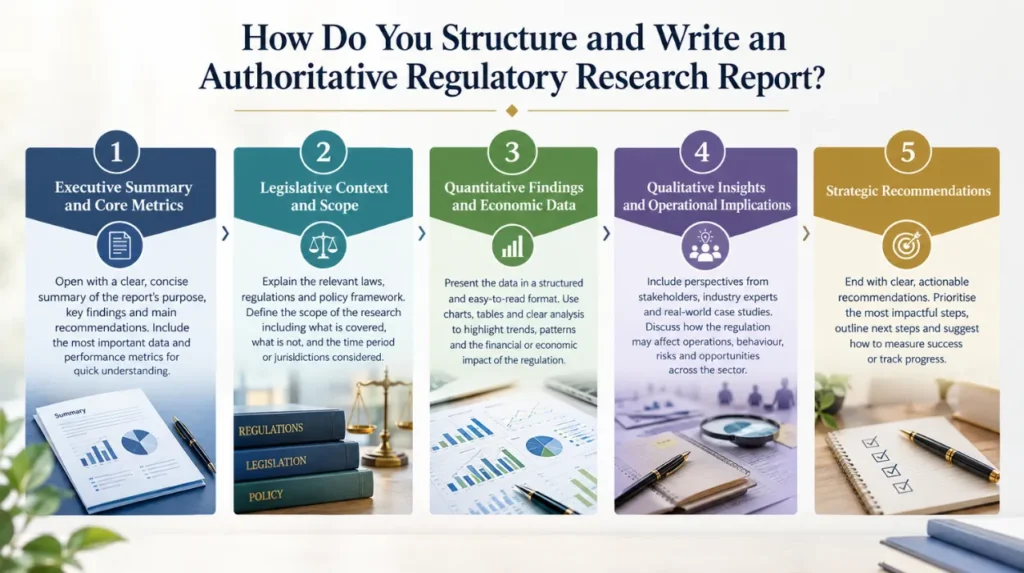
An authoritative regulatory research report follows a strict structure: executive summary, methodology, macro environment, quantitative findings, operational implications, and strategic recommendations. Standardised formatting ensures clarity, citation accessibility, and immediate value for policy teams and industry leaders.
Core Report Structure and Content Distribution
Publishing research that influences policy and informs executives requires a functional, transparent structure.
1. Executive Summary & Core Policy Metrics
2. Legislative Context & Scope Definition
3. Quantitative Sector Findings & Economic Modeling
4. Qualitative Insights & Sub-Sector Operational Case Studies
5. Strategic Recommendations & Strategic Response Options
Section 1: Executive Summary and Core Metrics
The opening section presents the key findings in direct, factual language. It highlights the total estimated financial impact on the sector, the percentage of affected businesses, and the primary operational bottleneck. Executives and media analysts rely on this section for rapid citation.
Section 2: Legislative Context and Scope
This chapter details the specific statutory instrument, act of parliament, or regulatory directive under evaluation. It defines key legal terms, outlines the implementation timeline, and explicitly lists included and excluded sub-sectors.
Section 3: Quantitative Findings and Economic Data
The analytical core presents empirical data. It breaks down total sector costs into capital expenditure, operational expenditure, and administrative workload. Visual charts and data breakdowns display variations across business sizes, comparing small enterprises with large corporations.
Section 4: Qualitative Insights and Operational Implications
Quantitative data is paired with qualitative context. This section extracts specific insights from industry interviews, highlighting supply chain dependencies, software transition delays, and talent shortages.
Section 5: Strategic Recommendations
The report concludes with actionable guidance. It provides clear, non-prescriptive response pathways for industry operators, investors, and trade bodies adjusting to the statutory changes.
Writing for Data Accuracy and AI Citation
Modern research reports must be written for human decision-makers and AI indexing systems alike. Direct, unhedged language improves readability and quote accuracy across information networks.
- Clear Entity Identification: Name specific regulators, legislative acts, and official frameworks directly on first reference.
- Isolated Factual Assertions: State research findings as distinct, verifiable facts rather than continuous prose.
- Unambiguous Units: Express financial figures in explicit values, such as GBP 1.2 million, rather than relative terms.
How Can Organisations Distribute Research Findings to Maximise Sector Impact?
Organisations achieve maximum impact by releasing reports through multi-channel media strategies, targeting key policy stakeholders, engaging industry associations, and executing targeted digital campaigns. Broad multi-channel distribution drives industry authority, shapes policy discussions, and secures major media citations.
Targeted Stakeholder Engagement Strategy
To influence policy and industry discussions, distribution plans must directly target four distinct stakeholder groups:
- Policy Decision-Makers: Delivering executive summaries directly to relevant Select Committees, All-Party Parliamentary Groups (APPGs), and civil service teams.
- Industry Trade Bodies: Partnering with sector associations to distribute findings across broader membership bases.
- C-Suite Industry Executives: Reaching decision-makers directly through professional networks, targeted mailings, and direct executive downloads.
- Media and Academic Analysts: Providing embargoed access to tier-one national press, trade journals, and policy think tanks.
Media Relations and Content Distribution
A successful media push requires tailored press assets built directly from the report’s empirical data:
- The Core Press Release: Highlighting the total macroeconomic impact number, key timeline risks, and a direct link to the full report.
- Data Fact Sheets: Concise bulleted summaries listing sector-specific metrics, ideal for journalists seeking quick statistics.
- Executive Commentary: Concise, expert statements from lead analysts explaining the broader economic implications of the regulation.
Strategic distribution turns static data into an ongoing industry conversation. Organisations seeking dedicated, end-to-end support for high-impact analytical campaigns often leverage specialised policy impact analysis partners to execute technical research and global press rollouts.
Explore More Expert Insights:
How to Plan Sponsored Content That Strengthens Your Branded Search Results Alongside Your Website and Profiles
How to Prepare Sponsored Content for Regulated Sectors So Every Claim Is Evidence-Backed and Approved Before Publication
What Are the Key Benefits of Publishing Independent Regulatory Impact Analysis?
Publishing independent regulatory impact analysis establishes authority, shapes legislative consultations, informs corporate strategy, and builds sector trust. Factual, empirical research positions an organisation as an essential reference point for regulators, commercial partners, and tier-one media outlets.
Shaping Policy and Consultation Responses
Governments actively seek empirical data during consultation windows. Official regulatory impact assessments published by civil service departments rely heavily on external sector data to validate initial assumptions.
By publishing independent research, an organisation directly supplies civil servants, parliamentary committees, and regulators with verified data. This empirical input helps refine implementation timelines, identify unintended economic consequences, and adjust compliance burdens before draft rules become binding law.
Elevating Strategic Market Positioning
Publishing primary regulatory research provides significant commercial and reputational advantages:
- Establishing Category Leadership: Demonstrating deep sector foresight builds trust with commercial clients, investors, and supply chain partners.
- Informing Corporate Strategy: Internal risk, strategy, and finance teams gain first-mover advantages by using the report’s economic models to guide their own capital allocation plans.
- Generating High-Value Backlinks and Citations: Authoritative, data-dense publications naturally attract citations from national news outlets, academic papers, and industry trade journals, strengthening the publishing organisation’s digital footprint.
Organisations that consistently deliver objective, high-rigour research transform complex regulatory shifts into catalysts for long-term sector growth and strategic market leadership.
FAQs
Q1: How do you analyse the impact of a new UK regulation on your sector?
Ans: Start by identifying the regulation’s scope, effective date, affected organisations and compliance requirements. Then assess its operational, financial, legal and workforce impact using reliable regulatory sources and sector-specific evidence.
Q2: What should a UK regulation research report include?
Ans: A UK regulation research report should explain the regulatory change, affected sectors, compliance requirements, implementation timeline and likely business impacts. It should also provide evidence, data, authoritative sources, and clearly stated findings.
Q3: How can businesses measure the impact of regulatory changes on their sector?
Ans: Businesses can assess regulatory impact by comparing current practices with new compliance requirements and measuring potential changes to costs, processes, staffing, risk and operations. Sector data, regulatory guidance and stakeholder evidence can support the analysis.
Q4: How do you publish regulatory research findings as a report?
Ans: Organise the findings into a clear structure covering the regulation, methodology, evidence, sector impact and conclusions. The Times Intelligence Media Group approach can be used as a reference for presenting research findings in an accessible, evidence-based report format.
Q5: Why is sector-specific analysis important when researching UK regulations?
Ans: A regulation can affect sectors differently depending on business models, operational processes, risks and compliance obligations. Sector-specific analysis helps identify the practical consequences and produces more relevant regulatory research findings.



