

What is sponsored content in a branded search strategy?
Sponsored content is paid editorial-style content published through a media outlet to communicate verified information about a brand. A branded search strategy connects these articles with the company website, business profiles, social profiles, and other trusted digital properties.
Sponsored content supports branded search visibility by creating additional pages associated with a company name, executive, product, service, campaign, or organisation. These pages sit alongside owned properties in the wider search environment.
Branded search refers to searches containing a specific company or brand name. Examples include searches such as Times Intelligence Media Group, Times Intelligence Media Group sponsored content, or Times Intelligence Media Group media services.
The purpose is not to replace the company website. The website remains the primary owned property. Sponsored articles provide additional third-party publishing environments that expand the information available around the brand.
For a broader explanation of how sponsored articles influence branded search visibility, see Using the Anchor Sponsored Articles and Branded Search.
How do you plan sponsored content around your website and profiles?
Start with the brand entities that already appear in search, then map sponsored content to those entities. Connect company pages, leadership profiles, service pages, social profiles, and published articles through consistent names, facts, descriptions, and relevant destinations.
The planning process begins with an inventory of existing branded search assets. These assets include:
- Official website
- About and company pages
- Service pages
- Leadership profiles
- LinkedIn company profile
- Social media profiles
- Business directory profiles
- Existing media coverage
- Previous sponsored articles
- Industry publications
- Corporate announcements
Each asset has a defined identity. The company name remains consistent across platforms. Executive names use consistent professional descriptions. Services use consistent terminology.
The next step is identifying gaps. A search for the brand name reveals which properties already appear and which topics receive limited coverage.
For example, a company with strong website visibility but limited independent media coverage has a different content requirement from a company with extensive press coverage but weak service-page visibility.
Sponsored content then becomes part of a wider search ecosystem rather than an isolated publishing activity.
What information belongs in the content map?
A practical content map records the target entity, topic, publication type, destination URL, supporting evidence, publication date, and intended branded search query.
This creates a controlled relationship between each sponsored article and the existing digital property it supports.
How do you choose topics for sponsored content and branded search?
Choose topics based on real branded search themes, verified company information, audience questions, and gaps across existing search results. Each article needs a distinct subject that expands brand information without duplicating the company website.
Topic selection starts with branded search behaviour. Relevant queries include the company name combined with services, sectors, locations, leadership, expertise, products, and specific business activities.
A useful topic structure separates content into several groups.
Brand information
Brand-focused subjects explain the organisation, its areas of activity, expertise, or market presence.
Examples include company capabilities, business development, corporate milestones, and sector participation.
Service information
Service-focused subjects address a specific business offering without reproducing the complete service page.
For example, a media company can publish content about sponsored content planning, publication standards, media distribution, or branded search visibility.
Expertise information
Expertise-focused content connects the organisation with a defined professional subject.
Examples include digital PR, media distribution, reputation content, search visibility, and editorial compliance.
Sector information
Sector-focused content connects the brand with an industry context.
Examples include financial services communication, healthcare communications, technology media, professional services, and regulated-sector publishing.
This structure prevents every sponsored article from targeting the same branded phrase. It also creates broader semantic coverage around the organisation.
How do you connect sponsored articles with owned profiles?
Connect sponsored articles with owned properties through consistent brand entities, accurate descriptions, relevant destination pages, and identifiable authorship. The connection depends on factual consistency and useful context rather than repeated brand mentions or excessive linking.
The company website provides the primary source of corporate information. Profiles provide identity signals. Sponsored articles provide additional published context.
These properties need consistent core information.
For example, the following details require alignment:
- Official company name
- Organisation description
- Service terminology
- Executive names
- Industry classification
- Geographic information
- Website destination
- Professional credentials
- Corporate facts
An article discussing a specific service needs a relevant destination. A leadership article needs an accurate executive profile. A corporate announcement needs information that matches the official company source.
This approach creates a clearer relationship between the published article and the underlying brand entity.
How should links be selected?
Link selection starts with relevance. A sponsored article about a specific service links to the relevant service page when the publication format and commercial arrangement permit it.
A company overview connects with an appropriate corporate page. A leadership article connects with the relevant profile. A research-led article connects with the supporting report or evidence source.
Link placement needs contextual relevance. Repeated exact-match anchor text across every publication creates an artificial content pattern and provides limited informational value.
What role do branded profiles play in sponsored content planning?
Branded profiles establish consistent identity information across external platforms. Sponsored content works alongside these profiles by adding published context about the organisation, people, services, expertise, and activities represented across the brand’s digital presence.
Profiles include company pages, professional profiles, social accounts, business directories, industry databases, and publisher author pages.
Each profile represents the same underlying organisation or person. Differences in names, descriptions, locations, or professional details create fragmented information.
A sponsored content plan therefore includes profile verification before publication.
For example, an organisation publishing an article about its media services needs its company name and website details to remain consistent across its website, LinkedIn profile, author information, and media publication.
This consistency supports entity recognition across digital properties.
Profile planning also determines which entities require additional coverage. A company with a strong corporate presence but limited executive visibility has different content requirements from an organisation with several recognised leadership profiles.
Explore More Expert Insights:
How to Prepare Sponsored Content for Regulated Sectors So Every Claim Is Evidence-Backed and Approved Before Publication
How to Attach a Named Author, Credentials and Verifiable Sources to a Sponsored Article
How do you build a sponsored content publishing sequence?
Build the publishing sequence around distinct search topics rather than publishing several articles with identical messaging. Start with core brand information, then expand into services, expertise, sectors, leadership, research, and relevant corporate developments.
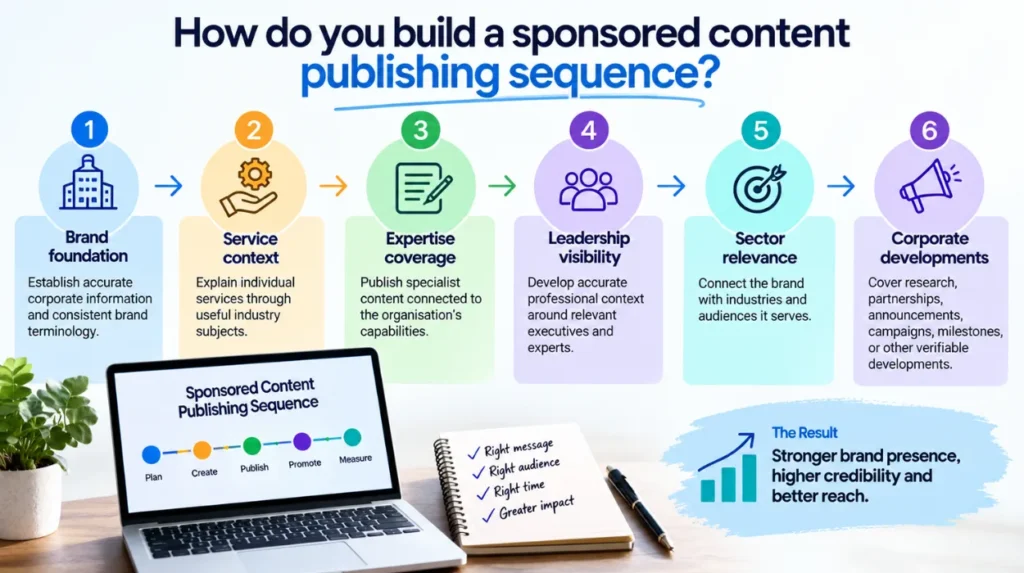
A structured sequence creates broader topical coverage.
A practical sequence contains six stages:
- Brand foundation
Establish accurate corporate information and consistent brand terminology. - Service context
Explain individual services through useful industry subjects. - Expertise coverage
Publish specialist content connected to the organisation’s capabilities. - Leadership visibility
Develop accurate professional context around relevant executives and experts. - Sector relevance
Connect the brand with industries and audiences it serves. - Corporate developments
Cover research, partnerships, announcements, campaigns, milestones, or other verifiable developments.
Each stage addresses a different information requirement.
The sequence also reduces duplication. Ten articles repeating the same company description provide less contextual breadth than ten articles addressing distinct subjects connected to the same brand.
What content components strengthen branded search coverage?
Strong branded search coverage combines accurate brand information, distinct topics, relevant links, credible authorship, consistent profiles, evidence-backed claims, publication context, and clear relationships between sponsored articles and the company’s owned digital properties.
Several components require coordination.
Brand entity consistency
The organisation uses one established company name and consistent core description across content and profiles.
Topic differentiation
Every sponsored article has a defined subject. Topics address separate search intents while remaining connected to the same brand.
Evidence-backed information
Claims about services, achievements, partnerships, statistics, qualifications, and market activity use verifiable sources.
Relevant destination pages
Links point to pages that directly support the article topic. A service discussion connects to the relevant service page rather than an unrelated homepage.
Author identification
Named authors and professional credentials provide clear context where the publication format supports them.
Publication quality
The publishing environment needs clear editorial information, identifiable publication details, and transparent sponsored-content treatment where required.
Profile consistency
Company and professional profiles contain information that aligns with the published content.
These components work together as a content system.
What are the benefits of planning sponsored content around branded search?
Planning sponsored content around branded search expands the range of relevant information associated with a company name. It also creates additional published assets that complement owned pages, profiles, leadership information, and existing media coverage.
The primary benefit is broader information coverage.
A company website controls the organisation’s core information. External publications provide independent publishing environments with different audiences and search contexts.
A structured sponsored content programme also supports topic expansion. One company name can connect with services, industries, expertise, executives, research, and corporate developments.
Other benefits include:
- Greater topic coverage around branded queries
- More published references to key business entities
- Clearer connections between brand and specialist subjects
- Additional media touchpoints for audiences
- Better organisation of corporate information
- More consistent external descriptions
- Structured support for reputation content
- Stronger alignment between website and external profiles
These benefits depend on content quality, factual accuracy, publication standards, and appropriate search practices.
Sponsored content is one part of a wider branded search strategy. It does not replace technical SEO, useful website content, accurate profiles, or legitimate media coverage.
When should businesses use sponsored content for branded search planning?
Businesses use sponsored content when they need structured external coverage around defined brand topics, services, expertise, people, sectors, or corporate developments. The content works alongside websites and profiles to expand relevant information across search environments.
Sponsored content fits several situations.
A growing organisation can use it to introduce clearly defined services and expertise to wider audiences.
An established company can use it to expand coverage around new services, sectors, executives, research, or corporate developments.
A business entering a new market can create content focused on the relevant sector, geography, audience, and service context.
A professional services organisation can develop specialist articles around defined expertise while maintaining consistent company and leadership information.
The planning principle remains the same: every publication has a defined purpose, a distinct topic, accurate information, and a logical relationship with the wider brand ecosystem.
How does sponsored content fit into a wider branded search strategy?
Sponsored content fits between owned digital properties and external media coverage. The website provides primary information, profiles establish identity, and published articles add external context around the brand, services, expertise, people, and corporate activity.
A complete branded search strategy therefore uses multiple digital properties.
The company website establishes authoritative corporate information. Profiles reinforce identity. Organic editorial coverage provides external references. Sponsored content provides planned paid publishing opportunities. Social channels distribute relevant corporate information.
These channels require consistent entities and factual information.
The next stage involves selecting an appropriate publishing approach based on content requirements, target sectors, publication needs, and desired media coverage. Businesses evaluating a dedicated service model can explore using anchor sponsored content services for branded search.
The objective remains structured information coverage. Each asset has a defined role. Each article addresses a distinct subject. Each profile represents the same underlying entity. Each link supports a relevant destination.
This creates a coordinated framework for sponsored content alongside the website and branded profiles.
FAQs
Q1: How can sponsored content strengthen branded search results?
Ans: Sponsored content can create additional relevant pages that mention a brand, its services, and key entities. When properly published and indexed, these pages can contribute to a broader branded search presence alongside the company website and official profiles.
Q2: Should sponsored content link to the company website?
Ans: Sponsored content can reference the company website when the link provides useful context for readers. Link attributes, disclosure, relevance, and editorial requirements should be reviewed according to the publisher’s policies and applicable search guidelines.
Q3: What should sponsored content include to support branded search visibility?
Ans: Content should use the brand name consistently and provide accurate information about its services, expertise, and relevant business entities. Clear authorship, factual claims, relevant context, and consistent brand details can help create useful branded search assets.
Q4: How does sponsored content work alongside social profiles and business listings?
Ans: Sponsored articles can provide additional third-party references that complement a company website, social profiles, and business listings. Consistent names, descriptions, services, and other factual business information help maintain a coherent brand presence across search results.
Q5: Can sponsored content affect what users see when searching for a brand?
Ans: Yes, published sponsored content may appear in branded search results if search engines crawl, index, and rank the pages. Its visibility depends on factors such as relevance, indexing, content quality, authority, search intent, and competition for the brand query.



