

What Is a Regulatory Impact Report in the UK Business Context?
A Regulatory Impact Report is an objective document evaluating how new or modified UK legislation affects business operations, compliance costs, and sector competitiveness. Independent analysis removes internal bias, providing factual projections for strategic planning and external stakeholder communication.
Definition and Scope of Regulatory Analysis
A Regulatory Impact Report—also termed a Regulatory Impact Assessment (RIA) or Regulatory Analysis Report—is a structured evaluation framework. UK public bodies, including the Regulatory Policy Committee (RPC) and government departments like the Department for Business and Trade (DBT), publish impact assessments to justify policy changes.
For commercial enterprises, trade associations, and non-profit organisations, an independent Regulatory Impact Report translates raw policy text into quantifiable operational changes. The analysis covers primary legislation, secondary statutory instruments, and regulatory guidance issued by authorities such as the Financial Conduct Authority (FCA), the Competition and Markets Authority (CMA), and the Information Commissioner’s Office (ICO).
Primary Functions of Independent Regulatory Reports
Independent regulatory reports serve three main functions within the UK business landscape:
- Compliance Cost Estimation: Calculating immediate capital expenditures and recurring operational overhead needed to align with new legal mandates.
- Operational Risk Mapping: Identifying potential disruptions to supply chains, labour allocation, data architecture, and product distribution.
- Evidence-Based Engagement: Equipping organisations with verifiable data to submit during official government consultation windows or parliamentary committee hearings.
What Is the Process for Conducting a Comprehensive Regulatory Impact Analysis?
Conducting a comprehensive regulatory impact analysis requires a five-step process: defining policy scope, gathering baseline data, modelling financial and operational impacts, identifying non-compliance risks, and drafting actionable policy recommendations supported by verifiable statistical evidence.
Policy Scope & Baseline Data → Financial & Operational Modelling → Risk Identification → Final Recommendations
Step 1: Defining the Regulatory Scope and Baseline
The process begins by establishing the geographical, sectoral, and temporal scope of the regulation. Analysts examine statutory instruments to isolate specific obligations applicable to the targeted industry. Baseline data collection establishes the current operational metrics of the sector, including:
- Total industry revenue and profit margins
- Existing compliance expenditures under current framework models
- Average workforce sizes and technological infrastructure specs
Step 2: Gathering Sector-Specific Data and Evidence
Analysts gather primary and secondary data to establish quantitative benchmarks. Primary data originates from anonymised industry surveys, executive interviews, and operational audits. Secondary data relies on official datasets published by the Office for National Statistics (ONS), the UK Government Data Services, and academic research institutions.
Step 3: Modelling Financial and Operational Outcomes
Impact modelling applies quantitative methods to estimate the net financial effect of regulatory updates over 3-year, 5-year, and 10-year horizons. The framework evaluates two direct cost categories:
- Direct One-Off Costs: Initial technology upgrades, staff retraining programs, legal consultations, and administrative setup fees.
- Direct Ongoing Costs: Annual license renewals, dedicated compliance officer salaries, continuous auditing expenses, and recurring reporting overheads.
Step 4: Assessing Sector Risk Profiles
The fourth step maps non-compliance risks against operational reality. Analysts evaluate enforcement mechanisms, penalty structures, and historical enforcement actions by relevant UK regulators, such as fines issued by the Health and Safety Executive (HSE) or the Prudential Regulation Authority (PRA).
Step 5: Synthesising Findings for Decision-Makers
The final phase transforms quantitative models into structured narrative reports. The document presents net present value (NPV) calculations, cost-benefit ratios, and risk mitigation pathways. Organisations use this structured output to learn how to analyse the impact of a new UK regulation across distinct business functions.
Explore More Expert Insights:
How Do Sponsored Articles Influence What Appears in Search Results When People Search for Your Brand Name?
What Extra Compliance Checks Does Sponsored Content Need in Regulated UK Industries?
What Are the Core Components of a Standard Regulatory Impact Report?
A standard Regulatory Impact Report contains six core components: an executive summary, policy context, baseline economic analysis, direct and indirect cost modelling, stakeholder risk matrix, and a final monitoring framework to track long-term compliance impacts.
Executive Summary and Legislative Context
The report opens with a high-level summary detailing the regulatory background. This section details the precise UK legislation under review, such as the Procurement Act 2023, the Data Protection and Digital Information Bill, or the Employment Rights Bill. It establishes the legal implementation timeline, including enforcement dates and transitional grace periods.
Detailed Breakdown of Core Components
| Report Component | Primary Objective | Key Output / Metric Generated |
| Executive Summary | Summarise core conclusions for board-level review | High-level financial impact figure and executive risk summary |
| Policy Context | Map relevant UK legal provisions and enforcement bodies | Timeline of legislative enforcement and regulatory scope |
| Baseline Analysis | Establish current operational status before policy changes | Total sector expenditure under the existing legal framework |
| Cost-Benefit Model | Quantify monetary and structural impact across sectors | Net Present Value (NPV) and Equivalent Annual Net Direct Cost |
| Risk Assessment Matrix | Classify operational, financial, and legal vulnerabilities | Probability and severity scores for regulatory non-compliance |
| Monitoring Framework | Establish ongoing Key Performance Indicators (KPIs) | Audit schedules, reporting deadlines, and compliance milestones |
Cost-Benefit Analysis and Economic Modelling
The financial section isolates direct costs from indirect market effects. Direct costs include measurable expenditures like buying new filtering hardware to satisfy environmental rules. Indirect costs encompass broader market shifts, such as reduced product choice, decreased competition, or reduced research and development expenditure caused by capital diversion.
The Stakeholder Risk Matrix
The risk matrix maps regulatory impacts across different organisational tiers. It categorises risks based on two metrics:
- Probability of Occurrence: The likelihood that a regulatory rule creates operational friction or compliance failure.
- Impact Severity: The financial, legal, or operational damage resulting from that friction or compliance failure.
What Are the Primary Benefits of Independent Regulatory Impact Reports?
Independent Regulatory Impact Reports provide objectivity, eliminate confirmation bias, enhance credibility during public consultations, prevent unexpected compliance costs, optimise capital allocation, and provide verified evidence for strategic executive decisions under evolving statutory frameworks.
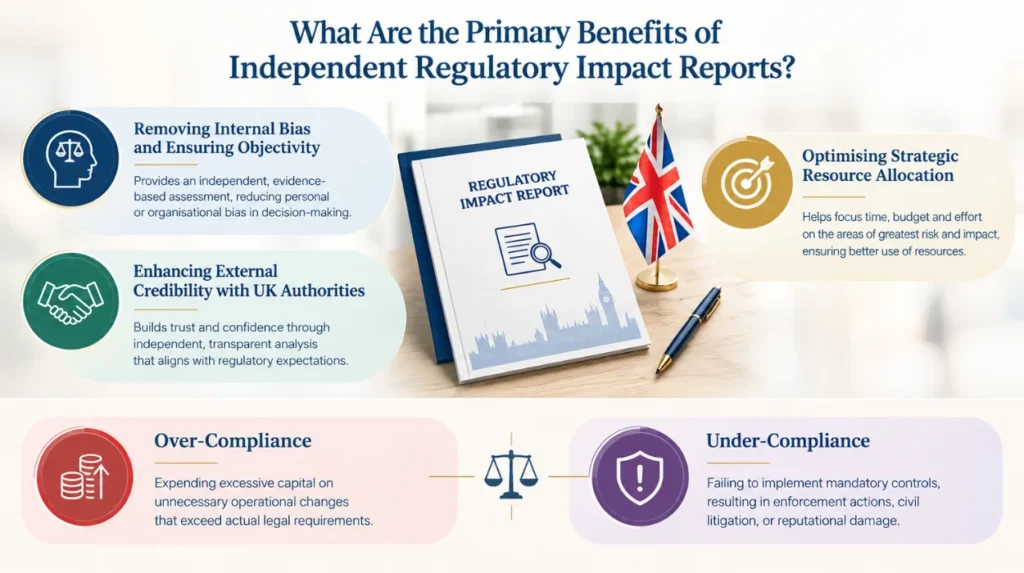
Removing Internal Bias and Ensuring Objectivity
Internal assessments frequently suffer from confirmation bias or resource constraints. In-house teams may understate compliance challenges to align with pre-existing operational plans or project deadlines. Independent analysts apply standard methodologies without internal political pressures, delivering clear assessments of operational vulnerabilities.
Enhancing External Credibility with UK Authorities
Government departments and regulatory bodies review thousands of consultation responses annually. Submissions supported by independent research carry greater weight than anecdotal claims. A rigorous report formatted according to official UK Treasury Green Book evaluation standards provides policymakers with actionable evidence during legislative reviews.
Optimising Strategic Resource Allocation
Understanding exact regulatory requirements prevents two costly operational errors:
- Over-Compliance: Expending excessive capital on unnecessary operational changes that exceed actual legal requirements.
- Under-Compliance: Failing to implement mandatory controls, resulting in enforcement actions, civil litigation, or reputational damage.
In What Business Use Cases Is an Independent Regulatory Analysis Essential?
An independent regulatory analysis is essential during public policy consultation periods, major corporate mergers, sector-wide digital transformations, cross-border trade expansion following Brexit regulatory divergence, and ESG reporting implementation under UK disclosure standards.
Public Policy Consultations and Parliamentary Evidence
Trade bodies and commercial alliances commission independent reports during government consultation phases. For example, during the consultation on UK Green Finance Strategy revisions, renewable energy groups used independent impact assessments to present unified data regarding investment barriers to the Department for Energy Security and Net Zero (DESNZ).
Post-Brexit Regulatory Divergence and Cross-Border Trade
UK businesses trading with the European Union face diverging regulatory standards across multiple sectors:
- Chemicals: Navigating differences between UK REACH and EU REACH registration protocols.
- Data Transfer: Maintaining compliance with UK GDPR while satisfying EU adequacy requirements.
- Manufacturing: Adapting to UKCA marking schemes alongside traditional European CE marks.
Independent reports outline exact operational requirements for companies managing dual-compliant product lines and supply chains across both jurisdictions.
ESG and Environmental Regulation Implementation
The UK Sustainability Disclosure Requirements (SDR) and climate-related financial disclosures mandate precise reporting standard compliance. Independent reports evaluate how environmental legislation affects asset values, supply chain audit requirements, and corporate governance obligations for financial institutions and corporate enterprises.
Independent Regulatory Analysis for UK Businesses
A Regulatory Impact Report provides UK organisations with an objective, evidence-based evaluation of legislative changes. By combining financial modelling, operational risk mapping, and clear methodology, these reports translate complex statutory requirements into clear strategic data.
Navigating changing rules—such as the Digital Markets, Competition and Consumers Act 2024 or upcoming employment law reforms—demands precise operational planning. Independent analysis eliminates internal bias, protects organisations against non-compliance penalties, and provides credible evidence for policy engagement with regulators and government departments. Flexible, data-driven regulatory planning allows UK businesses to mitigate operational risks and maintain long-term commercial competitiveness.
FAQs
Q1: What is a regulatory impact report?
Ans: A regulatory impact report assesses how new or proposed rules may affect UK businesses, including costs, compliance requirements, operational changes and commercial risks. It provides structured evidence to support informed business and policy decisions.
Q2: Why do UK businesses need independent regulatory analysis?
Ans: Independent regulatory analysis helps businesses assess new rules without relying solely on assumptions from regulators or internal teams. It can identify financial, operational and compliance impacts that may otherwise be overlooked.
Q3: What does a regulatory impact assessment include?
Ans: A regulatory impact assessment typically examines the purpose of a regulation, affected businesses, compliance costs, operational consequences, risks and potential benefits. It may also compare alternative approaches and estimate likely economic effects.
Q4: How can regulatory changes affect UK businesses?
Ans: Regulatory changes can increase compliance costs, alter business processes, require new reporting or create additional legal and operational obligations. The impact varies by sector, business size and the specific requirements introduced by the new rules.
Q5: How can businesses use regulatory impact reports?
Ans: Businesses can use regulatory impact reports to understand proposed rules, evaluate potential costs and prepare practical compliance strategies. Independent analysis can also support internal planning, stakeholder discussions and responses to regulatory consultations.



