

Sponsored content for regulated sectors requires documented evidence, sector-specific compliance checks, clear disclosures, accurate qualifications, and formal approval before publication. Every objective claim needs supporting evidence, while financial promotions require additional FCA controls where applicable.
What makes sponsored content different in regulated UK sectors?
Sponsored content becomes a regulated marketing communication when it promotes products, services, or claims subject to sector-specific rules. The preparation process therefore combines editorial accuracy, advertising requirements, evidence verification, legal review, regulatory approval, and publication controls.
Sponsored content combines editorial presentation with commercial intent. The format can include articles, interviews, expert-led features, case studies, research-led content, or branded reports.
The regulatory requirements depend on the subject and claims. Financial promotions, healthcare claims, medicines, medical devices, insurance, consumer credit, and environmental claims each involve specific compliance considerations.
The CAP Code requires marketers to hold documentary evidence for objective claims before distributing or submitting marketing communications for publication. The evidence requirement applies to claims consumers regard as factual and objectively measurable.
Financial promotions have additional requirements. The Financial Conduct Authority states that financial promotions across media types must be fair, clear and not misleading.
This makes claim preparation an operational process rather than a final editorial check.
How do you identify every claim that needs evidence?
Start by extracting every factual, comparative, performance, statistical, financial, scientific, regulatory, and outcome-based statement. Classify each claim by evidence requirement, source authority, publication date, applicability, and responsible approver before drafting the final sponsored content.
What counts as an objective claim?
An objective claim presents information that consumers can interpret as factual. Examples include:
- A service reduces processing time by 30%.
- A product achieved a stated performance result.
- A financial product has a specific fee.
- A treatment produces a defined clinical outcome.
- A company serves a stated number of customers.
- A product has a particular certification.
- A study produced a stated statistical result.
Each statement requires evidence appropriate to the claim.
The ASA states that evidence requirements depend on the product, claim and context. Claims without adequate substantiation can be treated as misleading.
How should claims be classified?
A practical claim register separates statements into factual claims, comparative claims, statistical claims, performance claims, expert claims, regulatory claims and customer outcome claims.
For example, a statement that a platform processes 10,000 transactions per minute requires technical evidence. A statement that it is faster than a named competitor requires comparative evidence.
This classification also identifies claims that require additional sector review.
What evidence should be collected before sponsored content is written?
Evidence must directly support the wording used in the article. Collect primary research, official records, technical documentation, regulatory information, published studies, audited data, and dated internal records, then connect each source to the exact claim it supports.
Which sources provide stronger evidence?
Evidence sources include:
- Regulatory publications
- Government datasets
- Peer-reviewed research
- Clinical or technical studies
- Audited company reports
- Product specifications
- Certification records
- Official financial documents
- Published industry research
- Documented customer research
Source selection depends on the claim.
A regulatory statement requires an authoritative regulatory source. A clinical claim requires appropriate health evidence. A financial statement requires documentation capable of supporting the specific financial information presented.
Why does source-to-claim matching matter?
A source can be authoritative without proving every statement made in an article.
For example, an industry report stating that a market reached £5 billion does not automatically substantiate a company’s claim that it controls 20% of that market.
The claim requires its own evidence.
A useful evidence register records the claim, source, publication date, relevant page or section, evidence type, reviewer and approval status.
How should regulated claims be checked before publication?
Review each claim against its evidence, regulatory requirements, audience, wording, qualifications, and publication context. Remove unsupported statements, correct inaccurate wording, disclose material limitations, and obtain documented approval from the appropriate internal or authorised reviewer.
How does the evidence review work?
A structured review follows five stages:
- Extract every objective claim.
- Match each claim to documentary evidence.
- Check whether the evidence supports the precise wording.
- Qualify claims where material limitations apply.
- Approve the final version before publication.
The ASA requires documentary evidence to be held before marketing communications containing objective claims are distributed or submitted for publication.
This means evidence collection belongs before publication, not after a complaint.
How should qualifications be handled?
Qualifications provide essential limitations or conditions attached to a claim.
The CAP Code states that marketing communications must not mislead by omitting significant limitations or qualifications. Qualifications also need clear presentation and cannot contradict the main claim.
For example, a financial performance statement requires appropriate context around the period, assumptions and relevant risks. A healthcare claim requires wording that accurately reflects the evidence and applicable regulatory requirements.
Explore More Expert Insights:
How to Prepare Sponsored Content for Regulated Sectors So Every Claim Is Evidence-Backed and Approved Before Publication
How to Attach a Named Author, Credentials and Verifiable Sources to a Sponsored Article
What additional checks apply to financial sponsored content?
Financial sponsored content requires checks for regulatory status, financial-promotion classification, fairness, clarity, risk information, audience suitability, approval authority, and evidence. FCA rules apply across media formats, including online articles and social media communications.
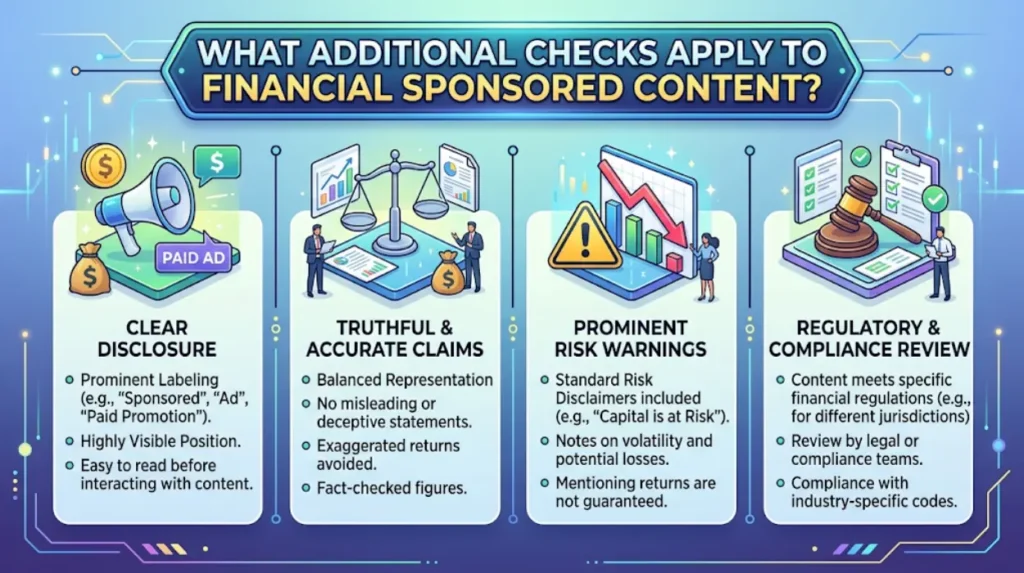
The FCA defines financial promotions broadly. They include communications through websites, emails, social media, brochures and other media when they constitute an invitation or inducement to engage in investment or claims-management activity.
All financial promotions must be fair, clear and not misleading. Specific FCA requirements depend on the financial product or activity being promoted.
Who approves financial promotions?
Approval requirements depend on the circumstances.
Since 7 February 2024, authorised firms generally require FCA permission to approve financial promotions for unauthorised persons unless an applicable exemption applies.
The FCA also states that approvers must confirm compliance with relevant financial-promotion rules before approval.
This creates a distinction between ordinary editorial review and formal regulatory approval.
A sponsored article discussing an investment product therefore requires classification before publication. The team must establish whether the communication constitutes a financial promotion and identify the applicable approval route.
How should healthcare and other regulated claims be reviewed?
Healthcare sponsored content requires additional scrutiny because claims about medicines, medical devices, treatments, health outcomes, food supplements, and related products operate under sector-specific advertising requirements and professional standards. Evidence must match the precise health claim.
The ASA and CAP framework applies additional rules to health-related advertising. The relevant requirements cover medicines, medical devices, treatments and health claims.
Health-related content requires careful distinction between general information and promotional claims.
For example, stating that a medical device has a specific regulatory status requires appropriate documentation. Stating that a treatment produces a particular health outcome requires evidence that supports the exact outcome.
The same principle applies to environmental claims, technical performance claims and other specialist subjects.
What should the final compliance checklist contain?
The final checklist must confirm claim evidence, source accuracy, regulatory classification, required disclosures, qualifications, audience suitability, approval ownership, version control, and publication status. No sponsored article enters publication until every required control is recorded as complete.
A practical checklist contains:
- Claim extraction completed
- Evidence matched to every objective claim
- Sources checked for authority and relevance
- Statistics verified
- Dates confirmed
- Comparisons substantiated
- Qualifications reviewed
- Required disclosures included
- Regulatory classification completed
- Sector-specific rules checked
- Internal legal or compliance review completed
- Formal approval recorded where required
- Final approved version locked
- Publication copy matched against approved copy
This process creates an auditable record of the publication decision.
How can evidence and approval workflows reduce publication problems?
A documented workflow reduces unsupported claims, inconsistent revisions, missing qualifications, approval confusion, and publication errors. It also gives editorial, compliance, legal, and commercial teams a shared record showing what was checked, by whom, against which evidence, and when.
The FCA’s 2026 review of financial promotion approvers found examples of unsubstantiated claims and cases where firms relied on third-party templates instead of conducting appropriate checks themselves.
A controlled workflow addresses these problems through clear ownership.
The editorial team controls structure and readability. The subject specialist validates technical content. Compliance checks regulatory requirements. Legal reviewers address legal exposure where required. The authorised approver handles formal approval when the regulatory framework requires it.
Version control then ensures the published article remains identical to the approved version.
How can sponsored content teams prepare articles for different regulated sectors?
Each sector needs a shared evidence framework combined with sector-specific review criteria. The core process remains consistent, while financial, healthcare, environmental, technical, and other regulated content receives additional checks based on its claims and applicable regulatory requirements.
A financial article requires financial-promotion classification and FCA-related checks where applicable.
A healthcare article requires scrutiny of health claims and relevant product or treatment requirements.
An environmental article requires evidence supporting environmental performance statements.
A technical article requires reliable specifications, testing information or other documentation supporting performance claims.
The preparation model therefore remains consistent:
Claim → Evidence → Source → Regulatory check → Qualification → Review → Approval → Publication
For broader background on compliance requirements in UK regulated industries, the related regulated sponsored content compliance checks can provide the preceding educational context.
Organisations can also evaluate structured editorial and compliance workflows. For teams assessing specialist support, sponsored content compliance review provides a relevant next-stage solution area.
What is the complete process for preparing evidence-backed sponsored content?
The complete process begins with claim identification and ends with controlled publication. Writers define claims, researchers collect evidence, specialists validate sources, compliance teams check applicable rules, approvers sign off the final version, and publishers release only the approved copy.
Step 1: Define the commercial and editorial purpose
Identify the organisation, product, service, audience and intended publication format.
Step 2: Identify regulated subject areas
Determine whether the content involves financial services, healthcare, medicines, medical devices, environmental claims or another regulated category.
Step 3: Build the claim register
Extract every objective statement requiring evidence.
Step 4: Build the evidence file
Attach authoritative documentation to each claim.
Step 5: Draft from verified evidence
Write claims using wording that accurately reflects the available evidence.
Step 6: Conduct sector-specific review
Apply the regulatory requirements relevant to the product, service, claim and audience.
Step 7: Complete approval
Record the responsible reviewer, approval date, approved version and any conditions.
Step 8: Control publication
Publish only the approved version and retain the evidence and approval record.
This approach creates a traceable relationship between every significant claim and the evidence supporting it. It also separates editorial drafting from regulatory approval, reducing ambiguity over responsibility.
FAQs
Q1: How do you verify claims in sponsored content for regulated industries?
Ans: Verify every factual claim against authoritative sources, official records, research, or approved internal documentation. Regulated-sector sponsored content should retain evidence for statistics, product claims, regulatory statements, and performance assertions before publication.
Q2: What evidence should regulated sponsored content include?
Ans: Evidence can include government publications, regulatory guidance, peer-reviewed research, audited data, official statistics, and verified company records. Each source should directly support the specific claim being made in the sponsored article.
Q3: Who should approve sponsored content before publication in regulated sectors?
Ans: Content should be reviewed by the relevant subject-matter expert, compliance or legal team, and authorised business stakeholder where required. The approval process should confirm that claims, terminology, disclosures, and supporting evidence meet applicable requirements.
Q4: How can businesses prevent unsupported claims in sponsored articles?
Ans: Create a claim-evidence checklist that links each material statement to a reliable supporting source before editorial approval. Remove, qualify, or revise claims that cannot be substantiated through current and verifiable evidence.
Q5: What compliance checks are needed before publishing regulated sponsored content?
Ans: Pre-publication checks should cover factual accuracy, evidence quality, regulatory requirements, advertising disclosures, source attribution, and prohibited or misleading claims. Times Intelligence Media Group can use these checks as part of a documented editorial review process for regulated-sector sponsored content.



