

What is a sponsored explainer article?
A sponsored explainer article is paid editorial-style content that explains a topic, process, problem, or development while identifying the organisation that funded the content. Its primary function is education, with brand information placed within relevant context.
A sponsored explainer article combines informational content with paid media placement. The article answers a defined reader question instead of functioning as a conventional announcement.
The content normally follows a clear subject structure. It introduces the issue, explains relevant concepts, presents evidence or processes, and then connects the subject with the sponsoring organisation where relevant.
The distinction between sponsorship and editorial independence remains important. A sponsored article is commercial content because an organisation funds its publication or distribution. Clear disclosure helps readers understand the commercial relationship.
What does an explainer article explain?
An explainer article provides structured information about a specific subject. Examples include:
- How a new technology works
- Why an industry regulation changed
- How consumers use a particular service
- What steps businesses follow during a process
- What a technical development means for a defined audience
The article answers informational questions before presenting commercial information.
How is sponsored content identified?
Sponsored content uses disclosure language such as sponsored, paid content, partner content, or advertisement. The exact wording depends on the publisher and applicable advertising requirements.
In the United Kingdom, commercial communications require clear identification. The Advertising Standards Authority regulates non-broadcast advertising and promotional marketing under the UK advertising framework.
How does a sponsored explainer article differ from a brand announcement?
A sponsored explainer article centres on a reader’s information need, while a brand announcement centres on an organisation’s news. The first explains a subject through educational content. The second communicates a specific corporate development.
A brand announcement normally communicates an event involving an organisation. Examples include a product launch, executive appointment, partnership, funding announcement, expansion, acquisition, or new service.
A sponsored explainer has a broader informational structure. The organisation remains relevant, but the subject receives greater editorial space.
What does a brand announcement contain?
A brand announcement commonly includes:
- The organisation involved
- The development being announced
- Relevant dates
- Product or service information
- Statements from company representatives
- Supporting facts
- Contact or media information
Its central question is often direct: What has the organisation announced?
What does a sponsored explainer contain?
A sponsored explainer normally contains:
- A reader-focused question
- A definition of the subject
- Relevant background
- A process or explanation
- Supporting facts or data
- Practical implications
- Relevant information about the sponsoring organisation
Its central question is different: What does the reader need to understand about this subject?
When does a sponsored explainer article work better than a brand announcement?
A sponsored explainer article fits situations where the audience needs context before understanding the organisation’s relevance. A brand announcement fits situations where the primary information is a specific corporate event, launch, appointment, partnership, or milestone.
The choice depends on information intent. Readers searching for explanations need definitions, processes, evidence, and practical context.
A company announcement does not automatically answer those questions. A launch statement, for example, identifies what changed but does not necessarily explain how the underlying technology works.
A sponsored explainer addresses the wider information requirement.
When does the audience need explanation?
Explanation is relevant when the subject contains unfamiliar terminology, technical processes, regulatory changes, emerging technologies, or complex market developments.
Examples include:
- How carbon reporting works
- How cybersecurity risk assessments operate
- What changes under a new employment regulation
- How digital identity verification works
- How businesses calculate supply chain emissions
These subjects require contextual information before readers can interpret commercial developments.
When is an announcement more appropriate?
A brand announcement fits a defined news event.
A company launching a product on 15 October has a clear announcement subject. A company appointing a new chief executive has another clear announcement subject. A business entering a new market also has a specific corporate development.
The article format follows the information being communicated.
How should a sponsored explainer article be structured?
A sponsored explainer works through a logical sequence: define the subject, establish the reader problem, explain the relevant process, provide evidence, address practical implications, and introduce the sponsoring organisation within the appropriate context.
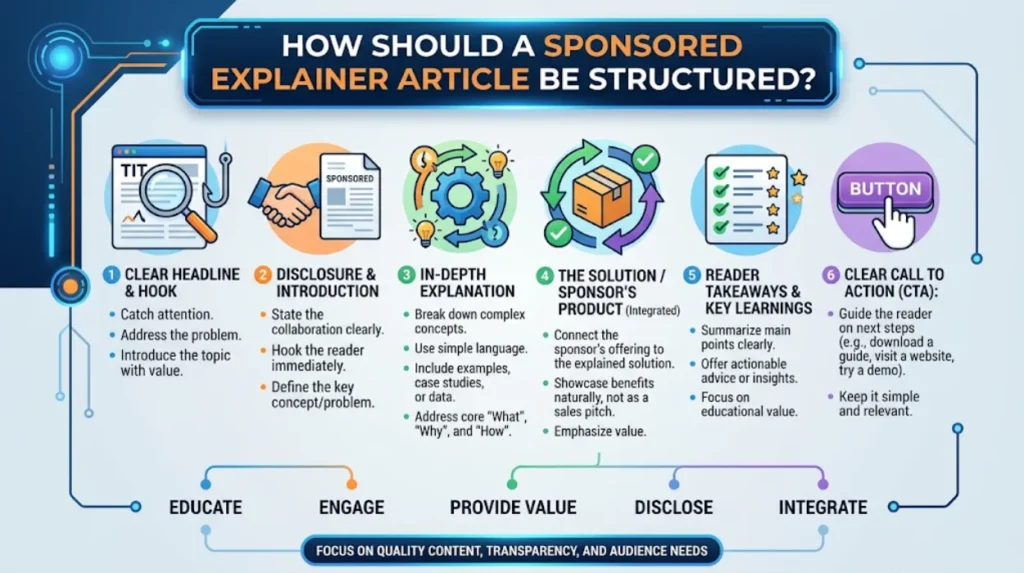
Structure determines whether the article remains educational or becomes a sales message.
The opening section establishes the question. The middle sections explain the subject. The later sections connect the information to practical situations.
What should the introduction contain?
The introduction identifies the subject and explains why readers need information about it.
It does not begin with an extended company description. It establishes the information problem first.
For example, an article about supply chain emissions begins by defining supply chain emissions and explaining why organisations measure them. Corporate information enters after the subject has been established.
What should the main explanation contain?
The main body provides factual information in a logical order.
A technical article can define terminology before explaining the process. A regulatory article can identify the requirement before describing compliance steps. A consumer article can explain the service before discussing practical considerations.
This structure supports search intent because each section addresses a distinct information requirement.
Where does the sponsor appear?
The sponsor appears where its relevance is factually connected to the subject.
A technology organisation can be discussed in an article about the technology it develops. A financial organisation can appear in relevant financial education content. A healthcare organisation can appear in an article connected to its documented area of activity.
The connection must remain relevant to the subject.
What components make a sponsored explainer article useful?
A useful sponsored explainer contains a precise topic, defined audience, clear question, factual explanation, evidence, structured sections, transparent sponsorship disclosure, relevant examples, and a controlled connection between the subject and sponsoring organisation.
Each component serves a separate information function.
What is the role of the reader question?
The reader question defines the article’s information purpose.
Questions such as What is digital identity verification? or How does carbon accounting work? create a specific information boundary.
A defined question also prevents unrelated promotional material from dominating the article.
Why does evidence matter?
Evidence supports factual claims.
Useful evidence includes:
- Government publications
- Regulatory documents
- Industry statistics
- Published research
- Official datasets
- Documented company information
For example, an article explaining UK employment regulation can use official government or regulatory sources to establish requirements.
Why are examples important?
Examples convert an abstract explanation into a concrete context.
A cybersecurity explainer can describe a security operations centre and then explain how threat monitoring, incident detection, investigation, and response operate in practice.
Examples also clarify terminology without replacing factual definitions.
Why is disclosure necessary?
Disclosure identifies the commercial nature of the content.
Readers need to distinguish sponsored material from independent editorial coverage. Publishers therefore use visible labels and other disclosure mechanisms appropriate to the content format.
How does a sponsored explainer support search and information discovery?
A sponsored explainer supports information discovery by matching specific questions with clearly structured answers, relevant terminology, evidence, and distinct sections that search systems can interpret as separate topical entities and information relationships.
Search-oriented content depends on information relevance rather than keyword repetition.
A well-structured explainer uses terminology consistently. It defines the primary entity, identifies related entities, explains their relationships, and answers connected questions.
Which search intents fit explainer content?
Common informational intents include:
- What is X?
- How does X work?
- Why does X matter?
- What are the stages of X?
- What does X include?
- How does X affect businesses?
- What are the requirements for X?
Each question represents a separate information need.
A sponsored explainer can address several related questions when they belong to the same subject.
How does topical depth work?
Topical depth comes from covering the relevant subject relationships.
An article about digital payments can define digital payments, identify payment methods, explain transaction stages, discuss security controls, and describe relevant business use cases.
The article becomes comprehensive through connected facts rather than repeated keyword usage.
What topics are suitable for sponsored explainer articles?
Suitable topics include complex products, technical processes, regulatory developments, industry changes, consumer education subjects, emerging technologies, and business practices that require context before readers understand their practical significance.
Topic selection depends on information complexity and audience need.
Which business topics fit the format?
Business topics include:
- Procurement processes
- Workforce planning
- Supply chain management
- Financial reporting
- Data governance
- Risk management
- Digital transformation
These subjects involve processes that benefit from structured explanation.
Which technology topics fit the format?
Technology subjects include:
- Artificial intelligence
- Cloud computing
- Cybersecurity
- Digital identity
- Data analytics
- Internet of Things systems
- Automation
Technical topics often require definitions and process explanations before commercial relevance becomes clear.
Which public-interest topics fit the format?
Public-interest subjects include regulatory changes, environmental reporting, workplace practices, consumer technology, and healthcare awareness.
The content remains factual and educational. The sponsoring organisation enters only where its documented connection to the subject is relevant.
Explore More Expert Insights:
How Long Should a UK Industry Research Report Be to Hold Reader and Journalist Attention?
How Do the Questions Readers Ask Reveal Search Demand That Brands Can Build Content Around?
What are the benefits of using an explainer format instead of an announcement format?
The explainer format provides greater space for definitions, context, processes, evidence, examples, and reader questions. The announcement format provides a direct method for communicating a specific organisational development to media and audiences.
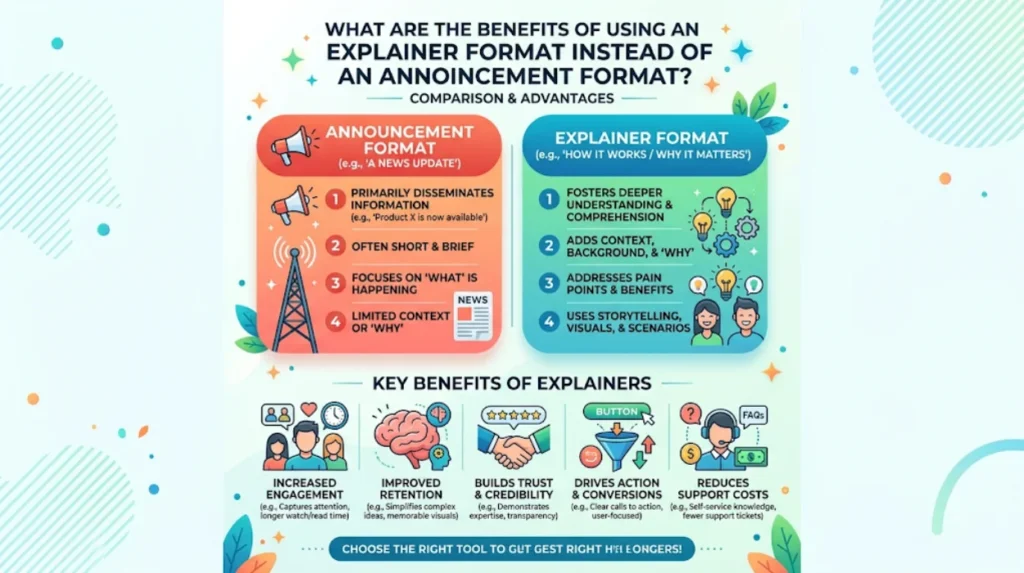
The formats serve different communication purposes.
An explainer provides subject depth. An announcement provides event information.
The distinction becomes important when an organisation has information that requires explanation rather than simple publication.
How does the format improve information clarity?
A structured explainer separates complex information into defined sections.
Readers can identify the definition, process, components, benefits, applications, and implications without searching through promotional statements.
How does it support long-form education?
Long-form explanatory content allows several connected questions to be answered in one document.
For example, an article about artificial intelligence in customer service can define the technology, explain implementation stages, identify use cases, describe data requirements, and discuss operational considerations.
How does it connect education with commercial relevance?
The commercial connection becomes part of the subject rather than the entire subject.
A reader first understands the problem and process. The sponsoring organisation is then understood within that established context.
This structure also leads naturally into more detailed content such as a sponsored how-to guide.
What is the key difference between an explainer and an announcement?
The key difference is the information’s purpose. A sponsored explainer answers a reader’s need to understand a subject, while a brand announcement communicates a defined organisational event such as a launch, appointment, partnership, expansion, acquisition, or funding development.
Both formats have a clear place in media communication.
The explainer begins with the subject. The announcement begins with the event.
The appropriate format depends on what readers need to know and what information the organisation needs to communicate.
A complex subject with significant context fits explanatory content. A specific corporate development fits announcement content.
Understanding this distinction helps publishers, communications teams, and readers recognise the purpose of sponsored editorial-style content and evaluate its structure, disclosure, evidence, and relevance accurately.
FAQs
Q1: What is a sponsored explainer article?
Ans: A sponsored explainer article is paid content that explains a topic, product, service, or issue in an informative editorial format. Unlike a direct advertisement, it focuses on context, evidence, and reader understanding.
Q2: When should a brand use a sponsored explainer article?
Ans: A sponsored explainer article works well when a brand needs to explain a complex service, industry issue, or new concept. It can provide more context than a short brand announcement and answer common audience questions.
Q3: What is the difference between a sponsored explainer and a brand announcement?
Ans: A brand announcement primarily communicates a specific company update, launch, partnership, or achievement. A sponsored explainer provides broader educational context and can address the reasons, process, and implications behind a topic.
Q4: Do sponsored explainer articles help with brand awareness?
Ans: Sponsored explainer articles can support brand awareness by placing useful information in front of a relevant audience. The content can associate the brand with a specific topic while maintaining an informative, reader-focused structure.
Q5: How can Times Intelligence Media Group use sponsored explainer content?
Ans: Times Intelligence Media Group can use sponsored explainer content to present complex business or industry topics in a structured, accessible format. The approach can combine educational information with relevant brand context without relying on a purely promotional announcement.



