

What are research and reports services sized to your brief?
Research and reports services sized to your brief create evidence-led documents around a defined audience, research question, word count, section structure, evidence requirement, publication purpose, and deadline, giving UK organisations a controlled report development process.
A research report is a structured document that presents researched information, evidence, analysis, findings, and conclusions for a defined audience. Its format depends on the purpose of the report and the information required by its readers.
A fixed template does not suit every research requirement. A 1,500-word market briefing has different requirements from a 5,000-word industry report, executive research summary, policy briefing, or journalist-facing data report.
Times Intelligence Media Group provides research and report services based on the requirements defined in the client brief. The brief establishes the subject, audience, purpose, scope, evidence requirements, structure, and delivery expectations.
This approach also connects with the earlier guidance on UK Industry Research Report, which explains how report size relates to reader and journalist attention.
How does Times Intelligence Media Group scope a research report?
Times Intelligence Media Group scopes each research report through defined requirements covering topic, audience, research purpose, geographic focus, report length, section count, evidence needs, source requirements, editorial treatment, delivery format, and publication deadline.
The scoping stage converts the initial brief into measurable production requirements. This prevents research depth from becoming disconnected from the intended use of the document.
What does the brief define?
A detailed brief identifies:
- Research topic
- Primary research question
- Target audience
- UK or international geographic scope
- Industry or professional sector
- Intended publication purpose
- Required report length
- Required sections
- Data requirements
- Source requirements
- Citation requirements
- Editorial style
- Delivery format
- Publication deadline
For example, a UK technology industry report for senior decision-makers requires different source selection and terminology from a public-facing consumer research report.
The brief also establishes whether the report requires current statistics, historical comparisons, industry evidence, expert sources, regulatory information, company examples, or market data.
Why does report scope matter?
Defined scope controls research depth. It also controls editorial relevance.
A report designed for journalists requires accessible findings, clear statistics, traceable sources, and concise explanations. A report designed for business decision-makers requires structured evidence, relevant market context, defined findings, and practical information.
How is a research report produced from an approved brief?
The production process moves from brief analysis to research planning, source collection, evidence validation, content structuring, drafting, editorial review, factual checking, optimisation, and final delivery against the agreed report specifications.
The process begins with the approved brief. Research requirements are separated into individual information needs.
Research planning
The research plan identifies the evidence required for each section. It establishes the relationship between the main research question and supporting questions.
For a UK industry report, research can include:
- Government statistics
- Regulatory publications
- Industry reports
- Corporate reports
- Market data
- Academic research
- Public datasets
- Professional bodies
- Relevant news sources
Each source serves a defined information purpose.
Evidence collection and validation
Sources are reviewed for relevance, publication date, authority, and relationship to the research subject. Numerical claims receive particular attention because statistics influence the interpretation of report findings.
For example, a report examining UK business adoption of artificial intelligence requires current adoption data, sector-specific evidence, regulatory context, and relevant business examples.
Structure and drafting
Research findings are organised into sections before full drafting. This creates a logical progression from context to evidence, findings, and conclusions.
The report structure reflects the intended reader. Executive audiences require rapid access to key findings. Journalists require identifiable facts and sourceable statistics. Specialist readers require greater technical depth.
Editorial review
The completed report undergoes editorial review for structure, clarity, consistency, factual presentation, terminology, and evidence alignment.
The final document is checked against the original brief. Required sections, word count, source requirements, and delivery specifications are confirmed before completion.
What components can be included in a tailored research report?
A tailored research report can include an executive summary, research context, methodology, market evidence, statistics, industry analysis, findings, case examples, conclusions, references, source notes, charts, tables, and supporting editorial material.
The exact components depend on the brief. A report does not require every possible section.
Executive summary
The executive summary presents the principal findings in a condensed format. It gives senior readers access to the most important information without requiring immediate review of the full document.
Research context
Context establishes the subject and explains why the research matters within the defined industry, market, policy, or business environment.
Methodology
Methodology explains how information was collected, assessed, and structured. It establishes transparency around the research process.
Data and evidence
Data sections present relevant statistics, market information, research findings, and documented evidence. Each data point requires clear contextual interpretation.
Industry analysis
Industry analysis identifies relevant market conditions, developments, organisations, regulatory factors, technology changes, or audience behaviours connected to the research question.
Findings and conclusions
Findings identify the key results produced by the research. Conclusions consolidate those findings around the original research purpose.
References and source information
Source information supports verification and further investigation. It also improves the report’s usefulness for journalists, researchers, editors, and decision-makers.
How does a tailored report support UK decision-makers and journalists?
A tailored report gives UK decision-makers and journalists structured access to relevant evidence, current information, clearly defined findings, traceable sources, and audience-specific analysis without requiring readers to process unrelated research material.
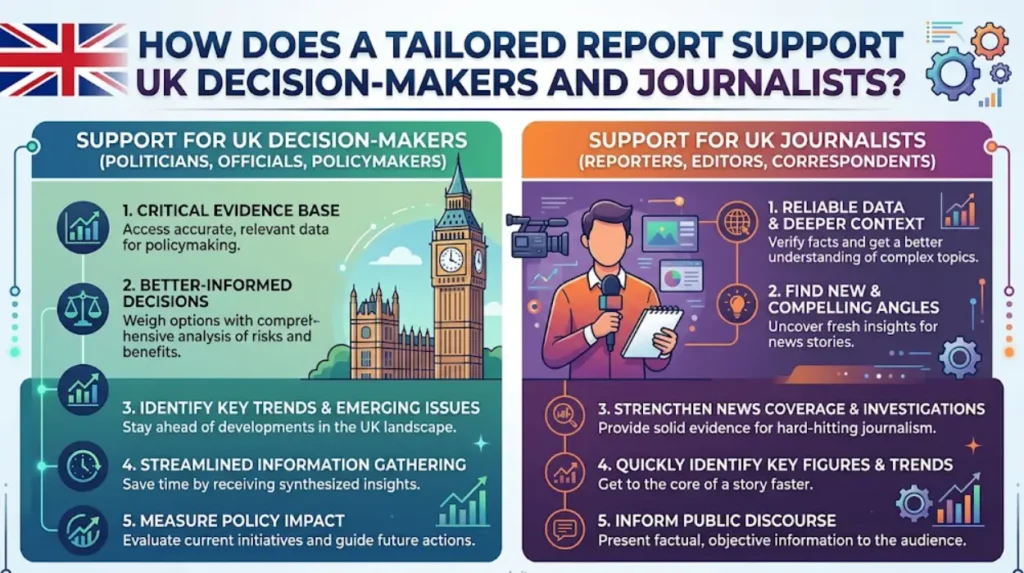
The value of report tailoring comes from relevance and information control.
A UK decision-maker needs information connected to organisational priorities, market conditions, operational changes, regulation, investment decisions, or sector developments. A journalist needs facts that can support accurate reporting and further investigation.
A tailored report addresses these requirements through deliberate content selection.
For example, a UK retail report can separate consumer behaviour, ecommerce performance, payment trends, workforce changes, and regulatory developments into defined sections. This allows different readers to identify relevant information quickly.
The report also supports secondary content development. Clear statistics and documented findings provide usable material for articles, briefings, presentations, media coverage, internal research, and editorial planning.
Research depth also remains aligned with the report’s purpose. The research report structure guidance explains how section count and depth affect reports created for UK decision-makers.
What types of research reports can Times Intelligence Media Group develop?
Times Intelligence Media Group can develop research reports for industry analysis, market research, business audiences, media purposes, audience insights, trend analysis, sector briefings, data-led content, and other defined research requirements within an approved brief.
The service applies to different report formats because the production process starts with requirements rather than a fixed document template.
Industry research reports
Industry research reports examine defined sectors through market evidence, developments, organisations, trends, statistics, and relevant external factors.
Examples include UK technology, healthcare, finance, retail, manufacturing, media, professional services, and energy sectors.
Market research reports
Market research reports examine defined markets, customer behaviour, competitive conditions, market developments, and relevant data.
Data-led reports
Data-led reports place statistics and measurable findings at the centre of the document. They require careful source handling and clear presentation.
Media and journalist-facing reports
These reports prioritise sourceable information, concise findings, news-relevant statistics, and clear explanations that support editorial research.
Audience research reports
Audience research reports organise information about reader, customer, or public information needs. They can identify recurring questions, content interests, information gaps, and topic demand.
Executive research briefings
Executive briefings condense defined research into a shorter format. They focus on key findings, relevant evidence, and decision-useful information.
How can organisations brief Times Intelligence Media Group for a research report?
Organisations can brief Times Intelligence Media Group by defining the research subject, audience, purpose, geographic scope, required depth, preferred length, sections, evidence requirements, deadline, and intended use of the finished report.
A strong brief starts with the intended outcome.
The organisation can then define the research subject and audience. The geographic scope establishes whether the report focuses on the UK, specific UK regions, international markets, or a defined combination.
The required length establishes production boundaries. For example, a 2,000-word briefing requires different information selection from a 5,000-word research report.
The organisation can also specify:
- Required research questions
- Preferred sections
- Target reader
- Industry terminology
- Required statistics
- Source preferences
- Citation format
- Competitor or market coverage
- Case examples
- Publication requirements
- Delivery date
Specific requirements create a measurable production framework.
Explore More Expert Insights:
Time Intelligence Media Group Audience Insights Services for Question-Led Topical Authority Planning
Time Intelligence Media Group Audience Insights Services for Contextual Targeting Strategy
What makes Times Intelligence Media Group research and reports services suitable for a defined brief?
Times Intelligence Media Group aligns research scope, report structure, evidence requirements, editorial depth, audience needs, and delivery specifications with the client’s defined brief, creating a controlled service for organisations requiring purpose-built research content.
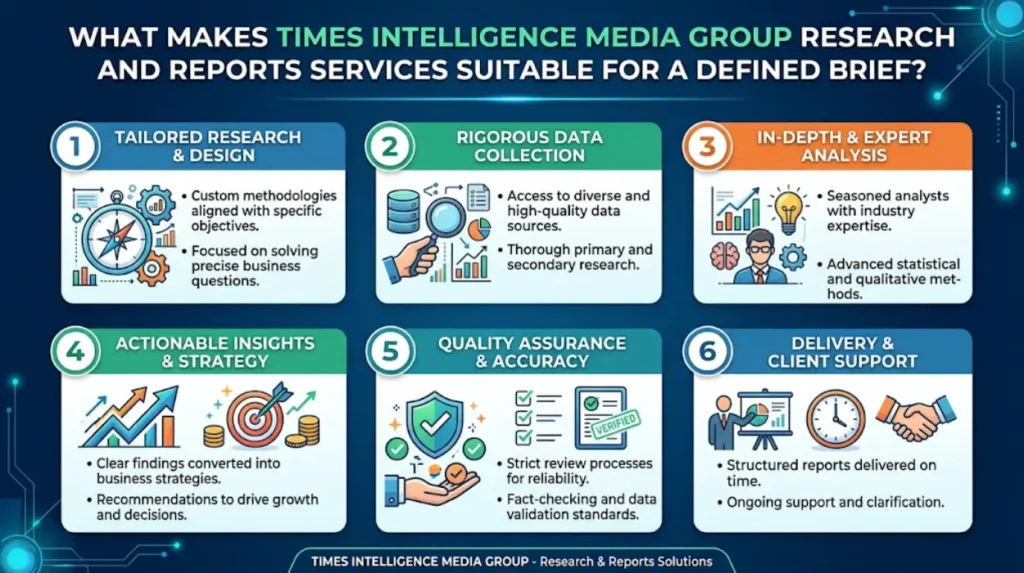
The service focuses on specification-led research production.
The report begins with the client’s information requirements rather than an unrelated standard structure. Research depth is connected to the intended audience. Section count is connected to the information architecture. Evidence selection is connected to the research question.
This creates consistency across the research process.
For organisations commissioning recurring reports, the same framework also supports repeatable production. Report specifications can define recurring sections, terminology, source standards, editorial requirements, and audience expectations.
The finished report can then function as a standalone research asset or as source material for wider communication activity.
How can organisations start a research and reports project with Times Intelligence Media Group?
Organisations can start by submitting a defined research brief containing the topic, audience, purpose, scope, required report size, evidence requirements, structure, deadline, and intended publication use for assessment and project planning.
The initial brief provides the information required to establish the research project.
Times Intelligence Media Group can then align the research approach with the defined requirements, including report length, section structure, research depth, source expectations, and editorial treatment.
For a new project, the most useful starting information includes the research subject, target audience, UK geographic focus, primary questions, desired report format, deadline, and publication objective.
A clear brief reduces unnecessary research and keeps the final report connected to its intended purpose.
For organisations requiring research reports built around specific editorial, business, media, or audience requirements, Times Intelligence Media Group Research and Reports Services provides a brief-led route from research scope through evidence development, report production, and final delivery.
FAQs
Q1: What does a research and reports service include?
Ans: A research and reports service typically includes research planning, data collection, evidence analysis, report writing, and editorial structuring. The scope can be adapted to the required topic, audience, report length, and level of research depth.
Q2: How does Times Intelligence Media Group tailor research reports to a brief?
Ans: Times Intelligence Media Group can structure research reports around the brief’s objectives, target audience, required sections, evidence needs, and preferred format. This helps align the research scope and report depth with the intended business or media purpose.
Q3: What types of research reports can businesses commission?
Ans: Businesses can commission industry research reports, market research reports, audience insight reports, trend analysis, competitor research, and evidence-led business reports. The appropriate format depends on the research question, available data, and intended use.
Q4: How long should a business research report be?
Ans: Research report length should reflect the complexity of the research question, amount of evidence, audience needs, and number of required sections. A focused brief may need a concise report, while complex industry research can require greater depth and supporting analysis.
Q5: Why is a detailed research brief important for report writing?
Ans: A clear research brief defines the objectives, audience, scope, evidence requirements, format, and expected outcomes of the report. It gives researchers and writers a consistent framework for producing relevant, structured, and evidence-based content.



