

Industry research reports need enough depth to establish evidence without creating unnecessary reading time. For UK audiences, report length depends on research complexity, evidence volume, audience needs, data presentation, and the number of decisions the report supports.
How long should a UK industry research report be?
A UK industry research report generally needs 1,500 to 3,000 words for focused research and 3,000 to 6,000 words for detailed industry analysis, with length determined by evidence, reader intent, data complexity, and reporting objectives.
Report length is not a fixed SEO measurement. It is a structural measurement of how much verified information the research requires.
A focused report on one market development can remain within 1,500 to 2,500 words. A report covering market conditions, regulatory developments, consumer behaviour and competitive activity requires more space.
Journalists also need rapid access to important findings. A long report becomes difficult to use when key statistics appear after extensive background information.
The strongest structure places the main finding early. Supporting evidence follows. Detailed methodology and additional data appear later.
What determines research report length?
Five factors directly affect length:
- Research scope
- Number of evidence sources
- Number of research questions
- Data complexity
- Intended audience
A report covering UK retail spending across three years has different information requirements from a report examining one regional consumer trend.
Why does research complexity determine report length?
Research complexity determines report length because each additional market question requires definitions, evidence, analysis, context, and conclusions that readers need to understand before using the reported findings.
A research report becomes longer when its subject contains multiple variables.
For example, a UK manufacturing report covering energy costs, employment, production output and export activity needs separate evidence for each subject. Each section requires context and current data.
A report focused only on manufacturing energy costs requires fewer sections.
Research complexity also increases when sources use different definitions. A report comparing employment data from several datasets needs to explain measurement differences before presenting the comparison.
How does the number of research questions affect length?
Each research question creates an information requirement.
A report answering three questions can use three core analytical sections. A report answering eight questions needs more evidence and explanation.
The questions also determine section depth. A question requiring one statistic needs less space than a question requiring historical comparison, regional analysis and sector segmentation.
What report structure keeps UK readers engaged?
A clear UK industry report places the executive finding first, followed by market context, evidence, analysis, implications, methodology, and supporting information in a sequence that reduces unnecessary reading effort.
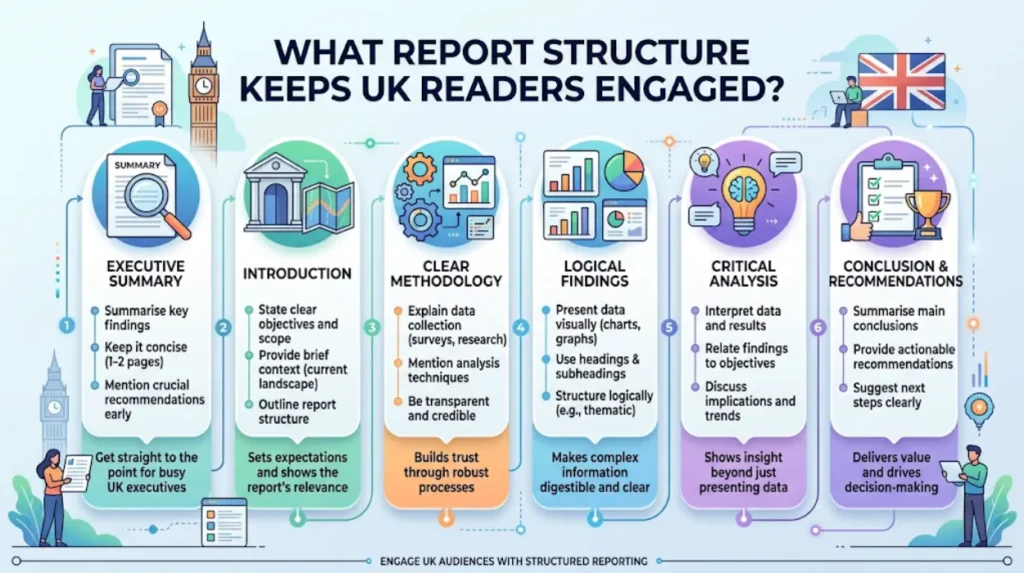
Structure controls how readers access information.
A practical industry research report contains several defined components:
- Executive summary
- Research scope
- Market context
- Key findings
- Supporting evidence
- Sector or audience analysis
- Trends and changes
- Implications
- Methodology
- Sources and references
The exact number of sections depends on the research question.
A 2,000-word report does not require ten equally long sections. A 5,000-word report can use the same framework with deeper evidence.
How long should the executive summary be?
An executive summary generally uses 150 to 300 words in a report of 1,500 to 3,000 words.
It identifies the research subject, principal findings, relevant statistics and major conclusions.
The summary needs enough information for a decision-maker or journalist to understand the report without reading every section.
How much space should methodology receive?
Methodology requires enough detail to explain the research population, source selection, collection period, analytical method and limitations.
A focused methodology section can use 150 to 400 words. Complex research requires additional explanation.
What makes a research report useful to journalists?
Journalists need reports that expose verified findings quickly, identify the source behind each statistic, provide relevant dates and definitions, and separate primary evidence from interpretation without forcing readers through unnecessary background material.
Journalistic usefulness depends on information accessibility rather than word count alone.
A journalist reviewing a 4,000-word report needs to identify the main statistic quickly. The report therefore benefits from descriptive headings, concise paragraphs, clear tables and source references.
For example, a UK employment report can state that employment increased by a specific percentage during a defined period. The relevant dataset and publication date need to appear alongside the finding.
Journalists also require context. A percentage without a baseline does not communicate the scale of change.
What information helps journalists assess a research finding?
Useful research findings identify:
- The statistic
- The measurement period
- The population
- The geographic scope
- The data source
- The comparison point
- The research method
These details allow journalists to assess whether a finding is relevant to their coverage.
Does a longer research report hold attention better?
A longer research report does not automatically hold attention better. Reader attention depends on information relevance, evidence density, section clarity, sentence structure, data accessibility, and how quickly the report answers its central research questions.
Length becomes useful when additional words provide additional evidence.
A 5,000-word report with duplicated findings creates unnecessary reading time. A 5,000-word report containing original datasets, historical comparisons and detailed sector analysis provides substantially more research value.
The same principle applies to shorter reports.
A 1,500-word report can become difficult to use when definitions are missing or evidence is compressed into dense paragraphs.
What creates unnecessary length?
Common sources of unnecessary length include:
- Repeating the same statistic
- Restating conclusions in multiple sections
- Adding broad industry history without relevance
- Using long introductions
- Explaining basic concepts repeatedly
- Including unsupported general statements
- Separating closely related evidence into excessive sections
Each paragraph needs a distinct informational function.
How should data affect the length of an industry research report?
Data volume determines report length when statistics require explanation, comparison, segmentation, visualisation, or methodological context that readers need to interpret the findings accurately and understand their relevance to the UK market.
Data-heavy research needs more explanation than narrative research.
A report containing annual market values from 2020 to 2026 needs a clear explanation of the period, measurement unit and source. A report comparing England, Scotland, Wales and Northern Ireland needs geographic definitions and separate evidence.
Tables also reduce unnecessary prose. Six related statistics can appear in a table instead of six separate paragraphs.
Charts serve a similar function when trends require visual comparison.
What data components require additional explanation?
Important components include:
- Measurement units
- Time periods
- Geographic boundaries
- Sample sizes
- Data sources
- Calculation methods
- Comparison periods
- Category definitions
Clear data definitions improve both reader comprehension and journalist usability.
What is the right section count for a UK industry research report?
A focused UK industry research report commonly uses 6 to 10 substantive sections, while larger reports use additional subsections to separate markets, datasets, audiences, regulations, trends, methodology, and supporting evidence.
Section count needs to reflect information hierarchy.
A 2,000-word report with 15 H2 headings creates fragmented reading. A 6,000-word report with only three large sections creates navigation problems.
A practical structure separates major research themes while keeping related evidence together.
For example, a report on UK digital advertising can use sections covering market size, spending patterns, advertiser behaviour, platform activity, regulatory developments and future research considerations.
How should headings support readers?
Headings need to identify the information contained below them.
Question-based headings work well for search-led research because they reflect how users formulate information needs.
Examples include:
- What is changing in the UK market?
- Which sectors show the largest change?
- What evidence supports the trend?
- How has the market changed since 2020?
- Which audience groups are most affected?
This structure creates identifiable information units for readers, search systems and AI retrieval systems.
When does a UK research report need more than 3,000 words?
A UK research report needs more than 3,000 words when its scope includes multiple markets, long-term trends, detailed datasets, regulatory analysis, regional comparisons, audience segmentation, methodological explanation, or several independent research questions.
Complex reports need additional space because each analytical layer requires evidence.
A national report covering four UK nations, six industry segments and five years of data has substantially greater information requirements than a report covering one national indicator.
Longer reports also support more detailed source documentation.
The important principle is evidence density. Every additional section needs a defined research purpose.
Readers who need to move from general information to deeper report planning can explore research report length for a more detailed framework covering section count, depth and audience requirements.
Explore More Expert Insights:
How Do the Questions Readers Ask Reveal Search Demand That Brands Can Build Content Around?
What Is the Difference Between Contextual Targeting and Behavioural Targeting on UK News Sites?
How can report length improve search visibility and AI citation?
Report length supports search visibility and AI citation when additional content adds original evidence, precise definitions, structured findings, source references, clear entities, and direct answers rather than increasing word count without additional information.
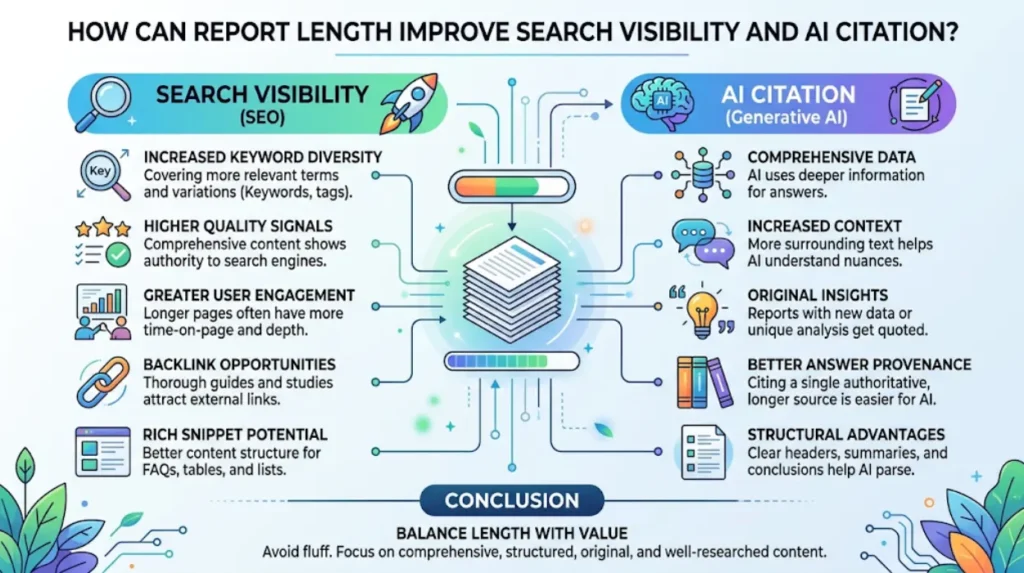
Search engines evaluate content through many signals rather than a single preferred word count.
AI systems also need identifiable factual units. A research report becomes easier to retrieve when each major finding has a clear heading, concise explanation and supporting source.
For example, a section about UK retail spending can identify the market, measurement period, statistic, source and interpretation within a compact information block.
Longer content becomes useful when it increases the number of distinct, well-supported questions the report answers.
What makes research content citation-friendly?
Citation-friendly content uses:
- Clear definitions
- Specific statistics
- Named datasets
- Explicit dates
- Defined geographic scope
- Direct answers
- Descriptive headings
- Source attribution
- Consistent terminology
These elements create discrete evidence units.
What is the practical word-count range for different UK research reports?
Focused UK research reports generally use 1,500 to 2,500 words, standard industry analyses use 2,500 to 4,000 words, and comprehensive reports use 4,000 to 6,000 or more when the evidence base requires deeper coverage.
Word count works best as a planning range rather than a rigid target.
| Report type | Typical length | Primary purpose |
|---|---|---|
| Focused research brief | 1,000–1,500 words | One specific question |
| Industry research report | 1,500–3,000 words | Core market analysis |
| Detailed industry analysis | 3,000–4,500 words | Multiple evidence areas |
| Comprehensive research report | 4,000–6,000+ words | Complex market investigation |
The final length depends on research scope.
A report ends when it has answered its defined questions with sufficient evidence. Adding paragraphs after that point does not improve research quality.
What is the key principle for determining UK industry report length?
The appropriate length for a UK industry research report is the shortest format that fully answers its defined questions, presents sufficient evidence, explains relevant data, documents sources, and gives readers clear access to the findings.
Report length starts with research scope.
A focused question requires focused evidence. A broad market investigation requires additional sections, datasets and methodological explanation.
For UK readers and journalists, accessibility remains central. Key findings need early placement. Statistics need dates and sources. Sections need clear purposes. Supporting evidence needs logical organisation.
A useful report therefore balances five elements: scope, evidence, structure, depth and usability.
A 2,000-word report can provide substantial industry intelligence when every section contributes new evidence. A 6,000-word report can provide deeper analysis when the research contains multiple markets, datasets and questions.
The correct length is established by the information required to answer the research problem accurately. Word count follows the evidence rather than defining it.
FAQs
Q1: How long should a UK industry research report be?
Ans: A UK industry research report commonly ranges from 2,000 to 5,000 words, depending on its research depth, audience and purpose. Reports intended for journalists and business readers should prioritise useful evidence and clear analysis rather than unnecessary length.
Q2: What is the ideal length for a research report for journalists?
Ans: A research report for journalists should provide enough detail to support news coverage without burying key findings in excessive content. A focused report of around 2,000 to 4,000 words can present research findings, statistics, sources and relevant industry context effectively.
Q3: Does report length affect reader engagement in UK industry research?
Ans: Report length can affect reader engagement when the content lacks structure or delays important findings. UK industry research reports should use clear sections, concise explanations, key statistics and accessible summaries to help readers find relevant information quickly.
Q4: What should a UK industry research report include?
Ans: A UK industry research report should include credible data, research findings, industry trends, methodology, supporting sources and practical analysis. A clear executive summary and well-structured sections also help business readers and journalists understand the main findings efficiently.
Q5: How can Times Intelligence Media Group make industry research reports easier to read?
Ans: Industry research reports can become easier to read by organising evidence around clear questions, presenting key findings early and using concise explanations for complex data. Strong headings, statistics, source attribution and focused analysis improve readability for UK business readers and journalists.



