

What determines the right length for a UK research report?
The right report length depends on research complexity, audience needs, evidence volume, decision scope and distribution purpose. A focused report can use 1,500 words, while complex market research requires 5,000 words or more for complete evidence coverage.
Report length is a structural decision. It starts with the information required to answer the research question.
A UK decision-maker needs relevant evidence, clear findings and practical context. Additional words do not automatically improve report quality. Every section needs a defined information purpose.
A short research report often addresses one question. A detailed industry report covers market conditions, trends, evidence, methodology, findings and implications.
The UK industry research report approach helps establish the relationship between report length and reader attention before planning a deeper research document.
Which factors affect report length?
Five factors establish the required length:
- Research question complexity
- Number of evidence sources
- Number of audience groups
- Quantity of findings
- Level of methodological explanation
A report examining UK retail payment trends requires less structural depth than a report analysing consumer behaviour, regulatory changes, regional differences and five-year market data.
How does audience affect length?
Decision-makers prioritise information connected to business decisions. Journalists prioritise verified findings, statistics and clear news points. Analysts require methodology and evidence detail.
A report targeting executives therefore needs strong findings early. A technical research report requires deeper methodology and supporting evidence.
How many sections should a research report contain?
A research report needs enough sections to separate research questions, evidence, findings and implications without fragmenting the reading experience. A focused report can use six sections, while complex UK industry research can require eight to twelve sections.
Section count depends on the research architecture. Each section needs a distinct function.
A typical decision-focused research report contains:
- Executive summary
- Research context
- Methodology
- Market or audience evidence
- Key findings
- Detailed analysis
- Business implications
- Conclusion
- Sources and references
Not every report requires all nine sections. A simple survey report can combine research context and methodology. A complex industry study requires separate evidence and analysis sections.
What does each section need to achieve?
The executive summary establishes the primary findings. It gives decision-makers immediate access to the most important evidence.
The research context defines the problem. It establishes the market, audience, timeframe and research purpose.
The methodology explains how evidence was collected and assessed. This section establishes research transparency.
The evidence section presents statistics, survey findings, market data and documented sources.
The findings section identifies the principal research results.
The analysis section explains relationships between findings, market conditions and audience behaviour.
The implications section connects evidence with business decisions. Examples include investment planning, content strategy, product development and market positioning.
The conclusion consolidates the research findings without introducing new evidence.
How do you decide the depth required for each section?
Section depth depends on its role in answering the research question. Evidence-heavy sections require detailed source interpretation, while introductory sections require concise context. Depth increases when decisions depend on methodological detail or multiple evidence categories.
Depth is not equal across the report.
A methodology section for a 500-person UK survey needs information about sample size, respondent criteria, collection period and analysis method. A short background section requires fewer words.
A useful planning method assigns an information objective to every section before writing begins.
How should evidence depth be measured?
Evidence depth can be measured through:
- Number of primary sources
- Number of secondary sources
- Number of datasets
- Number of findings
- Number of comparisons
- Number of research questions
For example, a report analysing UK consumer spending across retail, travel and financial services requires separate evidence for each sector. Combining all findings into one section reduces clarity.
When does a section need more detail?
A section needs greater depth when it contains multiple variables, competing evidence sources or important methodological limitations.
For example, UK regional research covering London, Manchester, Birmingham, Glasgow and Cardiff requires regional evidence rather than one national statistic.
Depth also increases when findings have direct implications for investment, workforce planning, market entry or communications strategy.
How do you match report length with research complexity?
Match report length to the number of research questions, evidence categories and decisions covered. One focused question can fit within 1,500 to 2,500 words, while multi-variable industry research commonly requires 4,000 to 8,000 words.
Research complexity provides a practical basis for determining report size.
A focused report answering one question can use a compact structure. A report covering market size, customer behaviour, competitors, regulation and regional demand requires more space.
What length works for different research formats?
| Research format | Typical length | Primary purpose |
|---|---|---|
| Executive research brief | 1,000–1,500 words | Fast decision support |
| Focused research report | 1,500–2,500 words | One defined research question |
| Industry research report | 3,000–5,000 words | Market and sector analysis |
| Comprehensive market report | 5,000–8,000 words | Multi-variable research |
| Extensive research study | 8,000+ words | Large evidence base and detailed analysis |
These ranges provide planning structures rather than mandatory limits.
A 2,000-word report with 20 high-quality sources can provide more useful evidence than an 8,000-word report containing repetitive commentary.
How does research complexity change the section count?
A focused report can contain six core sections. A comprehensive study requires additional sections for market segmentation, regional analysis, competitor evidence, methodology and detailed findings.
The section count increases when the research question expands.
The report therefore needs a defined scope before a word count is selected.
How should UK decision-makers influence report structure?
UK decision-makers need rapid access to findings, evidence and business implications. Structure the report so key findings appear early, supporting evidence follows logically, and detailed methodology remains available without interrupting the main decision-making sequence.
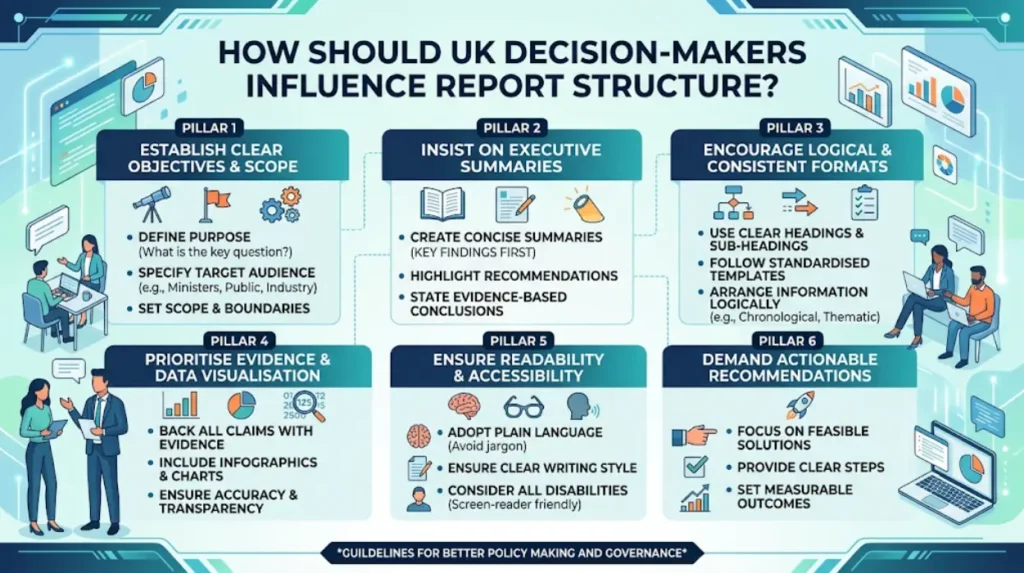
Decision-makers often scan reports before reading them in detail. Clear headings, concise summaries and evidence-led sections support this reading behaviour.
A UK business report also needs local relevance. National statistics, UK regulatory information, regional data and sector-specific evidence establish contextual accuracy.
What information do UK decision-makers need first?
The first sections need to establish:
- What was researched
- Why the research matters
- What the evidence shows
- Which findings require attention
- What business area the findings affect
This structure allows senior readers to understand the report without reading every supporting detail.
How should regional information affect report depth?
Regional detail becomes important when the research question concerns location-specific demand.
For example, a UK housing research report covering London, Leeds, Bristol and Edinburgh needs regional comparisons. A national report focused on one nationwide regulatory change requires less regional segmentation.
The level of geographic detail must therefore reflect the research question.
How can you prevent a research report from becoming too long?
Prevent excessive length by removing duplicated evidence, unrelated background, repeated conclusions and unsupported commentary. Keep every paragraph connected to a research question, evidence point, finding or documented implication.
Length increases when research documents contain information without a defined function.
A report becomes inefficient when the same statistic appears in the executive summary, findings section and conclusion without adding new context.
Which content can be reduced?
Remove:
- Repeated statistics
- Generic industry history
- Unrelated market background
- Duplicate explanations
- Unsupported claims
- Findings without evidence
- Long descriptions of obvious concepts
Keep information that supports the research objective.
A report about UK digital advertising expenditure does not need several paragraphs explaining the general history of advertising unless historical development directly affects the research findings.
How can appendices control report length?
Appendices separate detailed supporting material from the main reading sequence.
Survey questionnaires, extended datasets, technical methodology, source tables and supplementary calculations can sit in appendices.
This approach keeps the primary report focused while preserving evidence transparency.
How should section depth support journalists and other secondary audiences?
Journalists need clear statistics, source information, research findings and identifiable news points. Reports targeting both decision-makers and journalists need concise headline findings supported by detailed evidence that can be independently understood and verified.
A report can serve multiple professional audiences when information is layered.
Decision-makers need conclusions and implications. Journalists need attributable evidence and statistics. Analysts need methodology and source detail.
What makes findings easier to use?
A strong finding includes:
- A specific statistic
- A defined population
- A clear timeframe
- A relevant comparison
- A credible source
- A direct explanation
For example, a statement about UK consumer behaviour needs to identify whether the finding relates to adults, households, businesses or another defined population.
This precision improves both decision-making and media usability.
How can you create a report structure before writing?
Create the structure by defining the research question, identifying evidence categories, assigning sections, estimating word counts and checking the required depth against audience needs. Complete this planning process before drafting the report.
A practical workflow contains seven steps.
Step 1: Define the research question
Write one primary research question. Add secondary questions only when they contribute directly to the main objective.
Step 2: Identify the evidence
List the datasets, surveys, reports, official statistics and industry sources required.
Step 3: Group the evidence
Organise evidence into logical categories such as market size, customer behaviour, regional demand, regulation and competition.
Step 4: Build the sections
Assign one information function to each section.
Step 5: Set word allocations
Assign more words to evidence and analysis than to introductory context.
Step 6: Review audience requirements
Check whether decision-makers, journalists, analysts or other professional readers need additional evidence or methodology.
Step 7: Remove structural duplication
Check every section for repeated findings and overlapping explanations.
This process creates a report where length follows research requirements rather than arbitrary word targets.
Explore More Expert Insights:
How to Turn Reader Question Patterns Into a Topical Map That Covers Gaps Your Competitors Have Missed
How to Use Audience Insights to Choose Between Contextual and Behavioural Targeting for a UK Campaign
When does a research report need professional research and reporting support?
Professional research and reporting support becomes relevant when a report requires extensive evidence collection, source verification, statistical presentation, editorial structuring or audience-specific formatting across multiple research requirements.
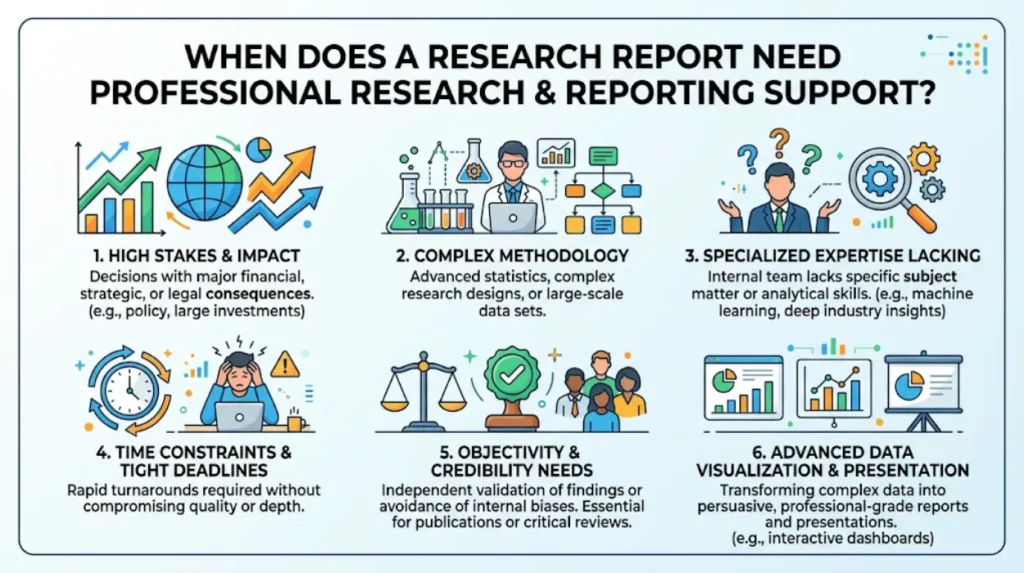
Complex research projects require coordination between evidence gathering and editorial presentation.
A structured research and reporting service can support different report sizes according to the brief, evidence requirements and intended audience. The scope can include research, data interpretation, report development and editorial refinement.
For organisations planning a larger research project, Research and Reports Services can be considered when the brief requires defined research scope, evidence development and structured reporting.
What should a research brief specify?
A useful brief identifies:
- Research objective
- Target audience
- Geographic scope
- Industry or sector
- Research questions
- Required evidence
- Desired report length
- Publication deadline
- Distribution purpose
A defined brief makes section planning more precise.
How do you finalise the right report length and structure?
Finalise report length after defining research scope, evidence requirements, audience needs and decision objectives. Then allocate sections and depth according to information value, keeping the final document complete, focused and proportionate to its purpose.
The correct report length is a consequence of research scope.
A 1,500-word report can provide sufficient coverage for a focused question. A 6,000-word report can support a multi-variable industry study. Neither length works automatically for every research requirement.
Section count follows the number of distinct information functions. Depth follows evidence complexity. Word count follows the total information required.
For UK decision-makers, the final structure needs fast access to findings, clear evidence and relevant business context. For journalists, it needs precise statistics, sources and identifiable findings.
The planning sequence remains consistent:
Research question → evidence requirements → audience → section structure → word allocation → depth → editorial review.
This approach creates research reports that remain focused while providing enough evidence for professional decision-making and wider media use.
FAQs
Q1: How long should a research report for UK decision-makers be?
Ans: A UK research report should be long enough to present evidence, analysis and actionable findings without unnecessary detail. Most decision-focused reports work well when the length reflects the complexity of the research question and the needs of the target audience.
Q2: How many sections should a UK industry research report have?
Ans: A research report should use enough sections to separate the research context, methodology, findings, analysis and conclusions clearly. The section count should follow the report’s objectives rather than a fixed template, keeping related evidence grouped logically.
Q3: How much detail should a research report include?
Ans: The depth of a research report should match the complexity of the topic, evidence available and decisions the audience needs to make. Include supporting data, methodology and interpretation where they improve understanding, while moving highly detailed evidence into appendices when appropriate.
Q4: What should determine the length of a business research report?
Ans: Report length should be determined by research scope, audience needs, evidence volume, decision complexity and the intended use of the findings. A focused UK market report may require less content than a detailed industry analysis covering multiple sectors or regions.
Q5: How can Times Intelligence Media Group structure a research report for UK decision-makers?
Ans: A clear research report structure typically moves from the research question and context to methodology, evidence, findings, analysis and practical implications. Times Intelligence Media Group can use this framework when developing research and reports designed for UK business audiences and decision-makers.



