

What are audience insights services for question-led topical authority planning?
Audience insights services analyse reader questions, search behaviour, content interactions, and topic patterns to identify demand signals. These insights establish topical priorities, reveal content gaps, organise related questions, and support structured authority planning across defined audiences and search themes.
Audience insights connect audience behaviour with content planning. The process focuses on what people ask, search, read, compare, and revisit.
For publishers, brands, foundations, and organisations targeting UK audiences, question patterns provide structured evidence for content development. The findings support decisions about topic clusters, supporting pages, search intent, and editorial priorities.
Times Intelligence Media Group uses audience research and content intelligence to support evidence-led planning. The service focuses on turning audience signals into usable topical structures.
The educational stage explains how reader questions reveal demand through reader search demand. The next stage shows how these questions become structured content opportunities through question-led topical mapping. Audience insights services provide the decision-stage framework for applying those findings to an active content strategy.
How does Times Intelligence Media Group identify reader questions and audience demand?
Times Intelligence Media Group identifies reader demand by examining question patterns, search themes, content behaviour, audience interests, and recurring information needs. These signals are grouped into related topics to establish measurable demand areas for content planning.
Question pattern analysis
Question pattern analysis identifies recurring formulations around a subject. Examples include:
- What is a service?
- How does a process work?
- What does a regulation require?
- What are the costs?
- Which organisations provide the service?
- What changes affect the sector?
- How does a policy affect businesses?
Repeated questions indicate information requirements. Related questions reveal the broader topic surrounding an individual search.
Search and content signals
Audience research examines signals across relevant search and content environments. These include:
- Search queries
- Related questions
- Search intent
- Topic terminology
- Content engagement
- Recurring information needs
- Emerging subjects
- Competitor coverage
- Editorial gaps
These signals create an evidence base for topical authority planning.
How is audience research converted into a question-led topical map?
Audience research becomes a topical map through question collection, intent classification, semantic grouping, gap analysis, priority setting, and content mapping. Each question receives a defined topical relationship, creating an organised structure for authoritative content development.
1. Collect audience questions
The first stage gathers questions connected to the target market. Research separates broad questions from specific questions.
For example, a UK audience researching business funding can generate questions about eligibility, application processes, regulations, costs, documentation, providers, and reporting requirements.
2. Classify search intent
Questions are classified according to their information requirement. Common intent groups include:
- Informational
- Commercial investigation
- Transactional
- Navigational
- Comparative
- Problem-solving
Intent classification prevents unrelated questions from being placed within the same content asset.
3. Group semantic relationships
Related questions are grouped into topic clusters. A central topic connects supporting questions.
For example, a topical cluster about UK business funding can include eligibility requirements, funding sources, application procedures, financial documentation, grant reporting, and funding comparisons.
4. Map questions to content
Each question is assigned to an appropriate content format. A broad subject can support a pillar article. Specific questions can support supporting articles, FAQs, research reports, service pages, or data-led content.
This structure establishes a relationship between audience demand and the site’s content architecture.
What does a question-led topical authority plan include?
A question-led topical authority plan includes audience questions, search intent, semantic relationships, topic clusters, content gaps, priority topics, supporting pages, internal relationships, and publishing requirements. These components connect audience demand with a structured content architecture.
Audience question inventory
The inventory records relevant questions identified during audience research. Each question represents a defined information requirement.
The inventory also separates high-level subjects from detailed subtopics. This distinction helps prevent excessive focus on a single keyword.
Topic clusters
Topic clusters organise related questions around a central subject. A cluster can contain multiple supporting themes.
For example, a media research cluster can include audience research, survey methodology, research reports, statistical analysis, editorial insights, and audience segmentation.
Content gap analysis
Content gap analysis identifies questions that receive limited or incomplete coverage. It also identifies areas where competing publishers provide stronger topical coverage.
The result establishes specific opportunities for new or improved content.
Content relationships
The plan defines relationships between pillar pages, supporting articles, FAQs, reports, and service content. Internal linking then reinforces those relationships.
A structured relationship helps search engines and readers understand how individual pages contribute to the broader subject.
Explore More Expert Insights:
Time Intelligence Media Group Audience Insights Services for Contextual Targeting Strategy
Time Intelligence Media Group Audience Insights Services Built on Consent-Led Data Collection
How can audience insights reveal content gaps competitors have missed?
Audience insights reveal content gaps by comparing recurring audience questions against existing coverage, competitor topics, search intent, and information depth. Unanswered or weakly addressed questions become defined opportunities for targeted content and topical expansion.
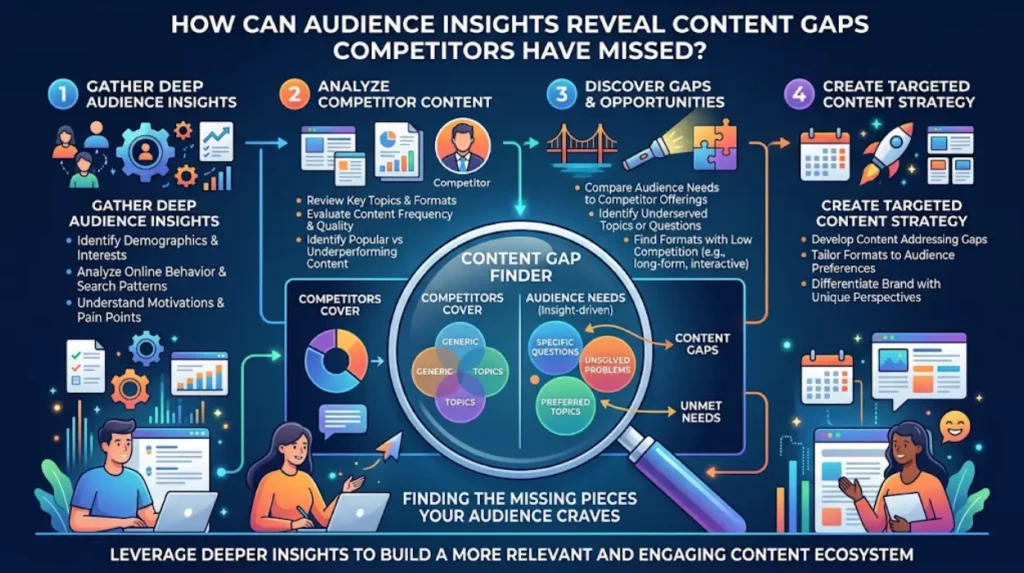
A competitor gap is not limited to a missing keyword. The gap can involve an unanswered question, incomplete explanation, outdated evidence, weak supporting coverage, or missing content relationships.
For example, three UK publishers can cover business sustainability broadly while omitting questions about sector-specific reporting requirements. The missing questions represent a topical gap.
Audience research identifies the question before content production begins. This reduces dependence on competitor titles as the only source of topic discovery.
What benefits does question-led audience research provide for content teams?
Question-led audience research gives content teams a defined evidence base for topic selection, content prioritisation, gap identification, internal linking, editorial planning, and audience alignment. The resulting structure supports consistent coverage across connected subjects and search intents.
More precise topic selection
Content teams receive defined questions instead of broad subject categories. This creates clearer publishing requirements.
Stronger topical coverage
Connected questions create opportunities to cover a subject across multiple levels. A site can address definitions, processes, requirements, comparisons, applications, and specialist questions.
Better editorial prioritisation
Audience insights help teams distinguish core topics from supporting questions. This supports structured editorial calendars.
Improved content relationships
Question clusters establish natural connections between related pages. These relationships support internal linking and topical organisation.
Clearer content briefs
A question-led plan provides writers with specific information requirements. A brief can identify the primary question, supporting questions, search intent, related entities, evidence requirements, and internal links.
Which organisations can use audience insights services for topical authority planning?
Publishers, media organisations, brands, professional services firms, foundations, research organisations, and public-facing businesses use audience insights to identify information demand and organise content around defined audience questions, sectors, services, and geographic markets.
Media organisations
Publishers can identify recurring reader questions around news sectors, public policy, business, technology, finance, healthcare, and regional issues.
Professional services firms
Professional firms can map questions related to services, regulations, compliance, procurement, finance, consulting, and business operations.
Foundations and organisations
Foundations can identify public information requirements around their campaigns, initiatives, research, and areas of social impact.
B2B businesses
B2B organisations can map questions from decision-makers researching products, suppliers, processes, technologies, regulations, and operational requirements.
How can audience insights support UK-focused content strategies?
UK-focused audience insights identify questions within the language, regulatory environment, sectors, regions, and information requirements relevant to British audiences. This creates content plans aligned with UK search behaviour, terminology, organisations, and market-specific topics.
UK content requires more than replacing spelling conventions. Audience research identifies UK-specific terminology and information requirements.
Examples include:
- UK employment regulations
- British business terminology
- UK government processes
- Regional UK markets
- British professional sectors
- UK consumer behaviour
- UK media audiences
- Local authority information
A question-led strategy can also separate national demand from regional demand. Questions about London business services differ from questions concerning organisations in Manchester, Birmingham, Glasgow, Cardiff, or Edinburgh.
This segmentation creates more precise content planning for UK audiences.
What deliverables can Times Intelligence Media Group audience insights services provide?
Audience insights services can provide audience question research, topic clusters, search-intent analysis, content gap findings, competitor coverage analysis, topical maps, content priorities, supporting question sets, and structured recommendations for building comprehensive subject coverage.
Typical deliverables include:
- Audience question datasets
- Search demand themes
- Question classifications
- Topic clusters
- Semantic entity groups
- Competitor content gap findings
- Content priority frameworks
- Topical maps
- Supporting question lists
- Content architecture recommendations
- Internal linking opportunities
- Editorial planning inputs
The exact deliverable structure depends on the research objective, audience, sector, and content environment.
For a media organisation, the output can focus on reader demand and editorial coverage. For a commercial organisation, the structure can focus on customer questions, service discovery, decision-stage research, and supporting informational content.
How can organisations use the findings to build topical authority?
Organisations use audience insight findings by converting priority questions into structured content, connecting related pages, filling documented gaps, updating incomplete coverage, and maintaining consistent subject depth across core topics and supporting information requirements.
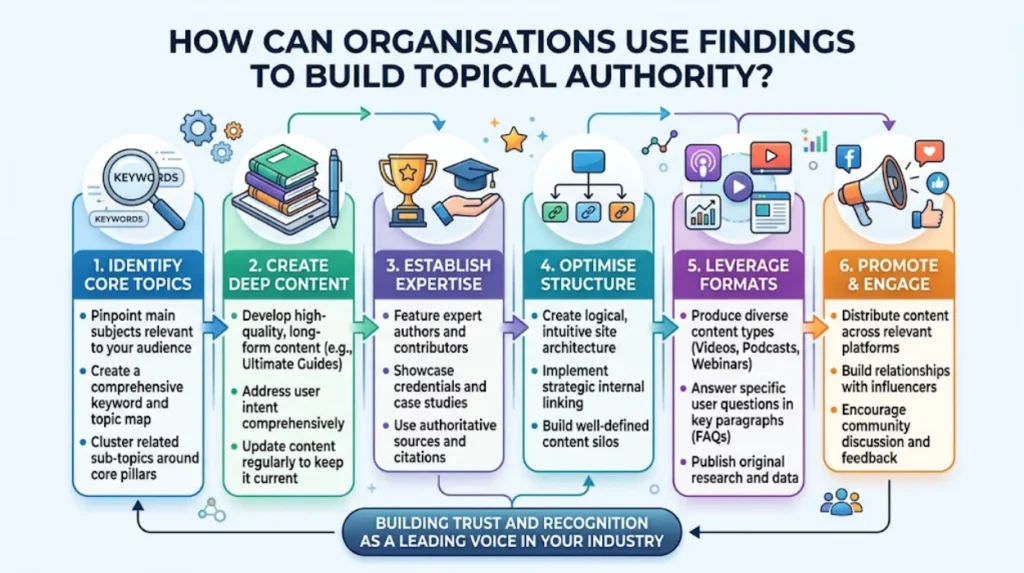
The process starts with the highest-priority topic groups. Each group receives an appropriate content asset.
A central page can establish the primary subject. Supporting pages answer narrower questions. Research reports provide evidence-led depth. FAQs address precise information requirements. Service pages address commercial intent.
Internal links connect these assets according to their topical relationships.
Content teams then monitor new questions, changing search demand, emerging subjects, and competitor coverage. The topical map becomes an active planning framework rather than a one-time document.
Why use Times Intelligence Media Group for question-led topical authority planning?
Times Intelligence Media Group provides audience-focused research that connects reader questions with topical planning, content gaps, search intent, and structured coverage. The service supports organisations requiring evidence-led decisions for UK content and audience strategies.
The service is designed for organisations that need a defined research foundation before expanding content.
The workflow connects audience research with practical content decisions:
- Identify audience questions.
- Analyse recurring demand patterns.
- Classify search intent.
- Group related questions.
- Identify content gaps.
- Map topics and supporting questions.
- Define content priorities.
- Establish relationships between content assets.
- Apply findings to the editorial strategy.
- Review new audience signals for future expansion.
This structure gives content teams a direct route from audience research to topical planning.
For organisations developing UK-focused authority, audience insights establish the evidence required to identify what audiences ask, where coverage is incomplete, and which connected subjects require structured content development.
Times Intelligence Media Group audience insights services therefore provide a decision-stage research foundation for question-led topical authority planning, content gap analysis, audience-focused editorial strategy, and structured search visibility.
FAQs
Q1: What are Times Intelligence Media Group audience insights services?
Ans: Times Intelligence Media Group audience insights services analyse reader questions, search behaviour, content interests, and audience needs. These insights help identify relevant topics and organise them into question-led topical authority plans.
Q2: How can audience insights improve topical authority planning?
Ans: Audience insights reveal recurring questions, information gaps, and related search themes within a subject area. These findings help content teams build topical maps that address user intent across broader topic clusters and supporting questions.
Q3: What data can be used for question-led topical mapping?
Ans: Question-led topical mapping can use search queries, reader questions, audience research, content engagement data, competitor gaps, and related search themes. Combining these signals helps identify topics that reflect real information needs and search demand.
Q4: How do reader questions reveal content gaps?
Ans: Repeated reader questions can show where existing content does not fully address specific information needs. Mapping these questions against published topics helps identify missing subtopics, unanswered queries, and opportunities for more complete topical coverage.
Q5: Why use audience insights for content strategy?
Ans: Audience insights connect content planning with the questions and interests of a defined audience. They provide evidence for selecting topics, grouping related queries, prioritising content gaps, and developing a structured topical authority strategy.



