

What are sponsored articles and how do they create brand context?
Sponsored articles are paid editorial-style publications that describe an organisation, its expertise, services, locations, and relevant topics within a structured piece of content published on another website.
Sponsored articles combine commercial publication with informative content. The article identifies an organisation as an entity and places that entity within a specific topical context. The publishing website provides an external source where the organisation, its activities, and related attributes appear together.
Search engines process this information as part of web content discovery. AI assistants also process published information when building responses from available sources and indexed knowledge.
A sponsored article therefore contains more than a brand mention. It creates relationships between entities, topics, services, industries, locations, and claims.
What makes an entity identifiable?
An entity is a clearly identifiable person, organisation, place, product, service, or concept. Entity identification depends on consistent names, descriptions, relationships, and contextual information.
For example, an article can connect an organisation with digital marketing, London, media relations, and business communications. These terms establish a defined topical and geographic context around the organisation.
Why does contextual consistency matter?
Consistent descriptions reduce ambiguity. When multiple publications describe an organisation using compatible terminology, search systems receive repeated contextual signals about the same entity.
Consistency includes the organisation name, service terminology, industry classification, geographical references, and factual descriptions.
How do search engines understand the attributes associated with a brand?
Search engines analyse words, entities, relationships, structured information, links, publication context, and other signals to understand what an organisation represents and which topics, services, industries, and locations relate to it.
Search engines do not rely on a single sentence to understand an organisation. They process information across webpages and connect related concepts through language and entity relationships.
An attribute describes a characteristic associated with an entity. For an organisation, attributes include service categories, industry expertise, geographic presence, audience, business activity, and topical relevance.
A publication stating that an organisation provides cybersecurity consulting creates a relationship between the organisation and cybersecurity consulting. A separate article connecting the same organisation with Manchester adds a geographic relationship.
What is an entity relationship?
An entity relationship describes how two identifiable concepts are connected.
Examples include:
- Organisation → cybersecurity consulting
- Organisation → Manchester
- Organisation → financial services
- Organisation → employee training
- Organisation → public relations
Repeated and contextually relevant relationships help establish a clearer semantic profile.
How does language affect entity understanding?
Language provides the context required to interpret an entity. A company name appearing beside unrelated terms creates weaker topical clarity than the same name appearing within relevant descriptions.
Precise terminology therefore matters. Terms such as cybersecurity audit, penetration testing, threat detection, and information security describe different concepts. Accurate use of these terms creates more specific topical relationships.
Explore More Expert Insights:
Does Google Treat Links in Sponsored Content as Paid Links That Need a Sponsored or Nofollow Attribute?
When Should a Brand Update an Existing Research Report Rather Than Publish a New One?
How do sponsored articles help AI assistants identify brand attributes?
AI assistants use information from available web sources to identify entities, understand relationships, retrieve relevant facts, and construct answers. Clear sponsored articles provide additional published context connecting an organisation with defined services, subjects, industries, and locations.
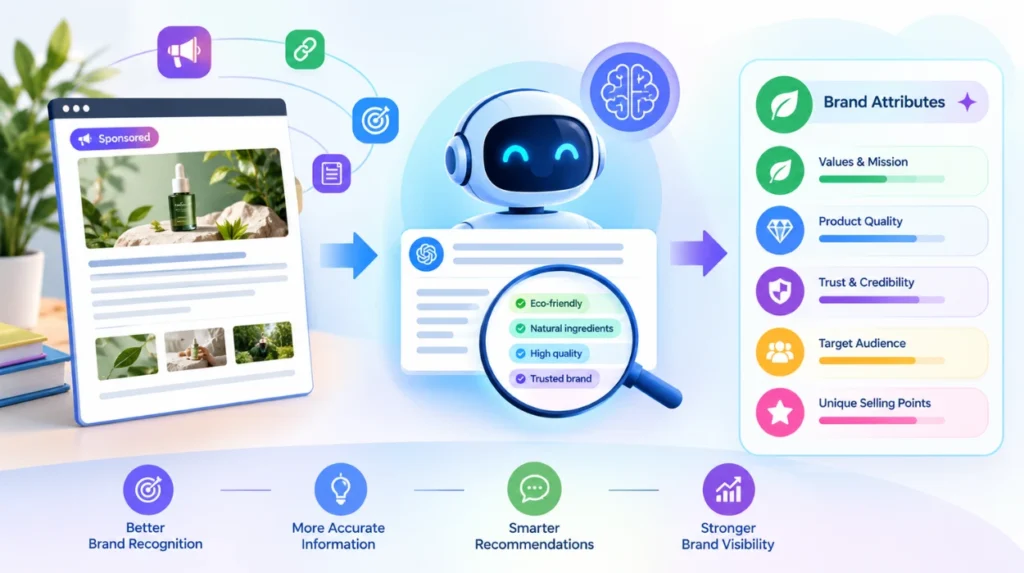
AI assistants process natural-language information differently from traditional keyword matching. They identify concepts and relationships within text and use available sources when generating responses.
A well-structured article provides explicit statements about an organisation and its relevant attributes. It also places those attributes within a coherent topical environment.
For example, an article about financial technology can identify an organisation as a provider of payment technology services in the United Kingdom. The article establishes relationships between the organisation, payment technology, financial technology, and the United Kingdom.
What information helps language models verify an entity?
Verification depends on accessible and consistent information. Important information includes:
- Correct organisation name
- Clear service descriptions
- Defined industry terminology
- Accurate geographic references
- Consistent factual statements
- Relevant third-party publications
- Supporting source information
- Clear relationships between entities
The objective is not repetition for its own sake. Each publication needs a distinct informational purpose while maintaining factual consistency.
Which components of sponsored articles influence contextual understanding?
The main contextual components are entity names, service descriptions, industry terms, geographic references, factual statements, topical relationships, publication context, and supporting sources. Together, these elements establish what an organisation does, where it operates, and which subjects relate to it.
Each component contributes a specific type of information. Their combination creates a more complete semantic description.
Entity names
The organisation name provides the primary entity reference. Consistent spelling and naming reduce ambiguity between similarly named organisations.
Service descriptions
Service descriptions explain business activity. Specific terminology creates stronger semantic relationships than broad descriptions.
For example, digital marketing is broader than search engine optimisation, paid search advertising, technical SEO, or social media advertising.
Industry terminology
Industry terms establish the subject area. A publication about renewable energy uses terms such as solar generation, wind power, energy storage, and grid integration when those concepts accurately describe the subject.
Geographic references
Locations establish geographic relationships. References to cities, regions, or countries clarify where an organisation operates or where a subject applies.
For example, London, Birmingham, Scotland, and the United Kingdom represent different geographic entities and require accurate contextual use.
Factual statements
Factual statements define relationships. A sentence identifying an organisation as a provider of a particular service creates a direct semantic connection between the organisation and that service.
How does publication context affect brand association?
Publication context determines the topical environment surrounding an organisation. Relevant publications place an entity beside related subjects, terminology, industries, and audiences, giving search systems and AI assistants clearer information about the entity and its documented attributes.
Context operates at several levels. The article topic establishes the primary subject. The surrounding terminology establishes related concepts. The publisher establishes the external publication environment.
A technology article containing cybersecurity terminology provides different context from an article about hospitality management. The same organisation therefore receives different associations depending on the subject and factual relevance of each publication.
Why does topical relevance matter?
Topical relevance connects an organisation to a defined information category. A publication about cybersecurity governance creates a relevant context for an organisation involved in cybersecurity governance.
Irrelevant associations create less useful information. An article needs a clear relationship between its subject and the entity it describes.
How does the publisher contribute context?
The publisher provides another identifiable entity in the information network. The relationship becomes:
Publisher → Article → Topic → Organisation → Service → Location.
This structure gives search systems multiple contextual elements to process.
How do multiple sponsored articles build a consistent semantic profile?
Multiple sponsored articles build contextual depth when each publication provides accurate information about related subjects while maintaining consistent descriptions of the same organisation, services, industries, and locations across different relevant sources.
One article provides a limited set of relationships. Several relevant publications can describe different aspects of the same entity.
For example, three articles can focus separately on technical SEO, digital public relations, and content strategy. Each article uses its own subject while accurately describing the organisation’s relevant expertise.
What is contextual reinforcement?
Contextual reinforcement occurs when independent publications establish compatible relationships around the same entity.
For example:
- Article A connects an organisation with technical SEO.
- Article B connects the organisation with content strategy.
- Article C connects the organisation with digital PR.
Together, these publications establish a broader digital marketing context without requiring identical wording.
How can sponsored articles support geographic relevance?
Sponsored articles support geographic relevance by connecting an organisation with specific cities, regions, countries, and market contexts through clear factual descriptions that identify where services, operations, expertise, or business activity apply.
Geographic relevance requires precise location information. A publication stating that an organisation operates in the United Kingdom provides national context. A publication identifying London operations establishes a more specific geographic relationship.
Why are geographic entities important?
Geographic entities distinguish markets and operating environments. Search systems process place names as identifiable concepts and connect them with organisations and topics.
For example, references to London business services establish a different geographic context from references to Edinburgh business services.
Location descriptions therefore need factual accuracy and consistency.
How do sponsored articles support service and expertise associations?
Sponsored articles connect organisations with specific services and expertise by describing what the organisation does within relevant subject areas, using precise terminology that identifies business activities, capabilities, industries, and professional functions.
Service association depends on explicit descriptions. General statements such as providing professional solutions contain limited semantic information.
Specific descriptions provide stronger context. Examples include:
- Search engine optimisation for financial services
- Cybersecurity risk assessment
- Corporate communications
- Employee learning and development
- Business process consulting
Each phrase connects an organisation with a defined service concept and an industry or functional context.
Why are specific attributes more useful than broad claims?
Specific attributes provide clearer entity relationships. A search system can distinguish between different services when terminology identifies the exact activity.
This also helps AI assistants interpret what an organisation does when answering queries that contain specific service-related concepts.
What role does factual consistency play across sponsored content?
Factual consistency ensures that different publications describe the same organisation using compatible names, services, locations, industries, and business information, reducing contradictory signals and creating a clearer publicly available representation of the entity.
Consistency does not require identical articles. It requires compatible facts.
An organisation described as operating in London in one publication and only in Glasgow in another creates different geographic information. If both claims are accurate because the organisation operates in both locations, the publications provide complementary information. If one claim is incorrect, the information becomes inconsistent.
Which facts need consistency?
Important factual elements include:
- Organisation name
- Business category
- Core services
- Operating locations
- Industry expertise
- Professional specialisms
- Corporate descriptions
These details form the foundation of entity-level understanding.
When are sponsored articles useful for search and AI visibility?
Sponsored articles are useful when an organisation needs publicly accessible information that clearly connects its entity with relevant topics, services, industries, locations, and factual attributes across credible and contextually relevant publications.
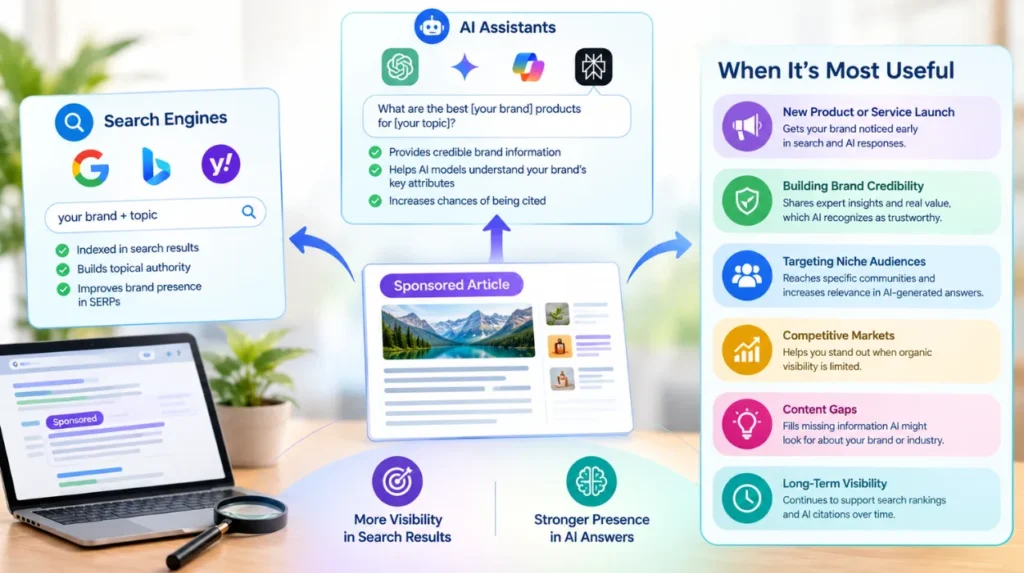
Their informational value increases when the content answers genuine questions about the organisation’s area of activity.
What are common use cases?
Common use cases include:
- Establishing context around a newly recognised organisation
- Explaining specialised services
- Connecting services with specific industries
- Clarifying geographic operations
- Documenting areas of expertise
- Expanding topical coverage
- Providing additional third-party information
For example, an organisation entering the United Kingdom market can publish informative material addressing its relevant industry, services, and geographic activity. The resulting publication creates an external source containing those relationships.
How should organisations understand the relationship between sponsored articles and AI search?
Sponsored articles are one source of publicly available information that contributes to the broader web context surrounding an organisation. Their value comes from accurate entity descriptions, relevant topics, consistent attributes, and clear relationships that search systems and AI assistants can interpret.
Search engines and AI assistants process information from many sources. Sponsored articles do not operate independently of websites, business information, editorial coverage, structured data, and other publicly accessible sources.
A consistent information environment provides clearer entity context. Each source contributes factual information within its own publication context.
The next stage focuses on how organisations can structure this information consistently across planned publications. For readers exploring sponsored content planning, that stage examines the terminology, attributes, services, and locations that need consistent treatment across content.
What is the key principle behind sponsored articles and entity association?
The central principle is contextual clarity: accurate publications consistently connect an identifiable organisation with specific services, subjects, industries, locations, and factual attributes so search engines and AI assistants can interpret those relationships from publicly available information.
Sponsored articles contribute to entity understanding through explicit information. The strongest contextual structure comes from precise terminology, factual accuracy, relevant publication topics, and consistent descriptions.
The process can therefore be summarised as:
Entity identification → contextual description → attribute association → publication across relevant sources → repeated factual relationships → broader semantic understanding.
This process explains why sponsored articles influence how an organisation is represented within search and AI information environments. The objective is not simply to mention a name. It is to create clear, factual, and contextually relevant relationships that systems can identify and retrieve.
FAQs
Q1: How do sponsored articles help search engines understand a brand?
Ans: Sponsored articles can provide contextual information about a brand, its expertise, services, and industry relevance. When these attributes appear consistently in relevant editorial content, they can help search engines better understand the entities and topics associated with the brand.
Q2: Can sponsored articles improve how AI assistants understand a brand?
Ans: Yes, sponsored articles can contribute to the broader web context that AI systems use when interpreting brands and their attributes. Clear, factual references to a brand’s expertise, services, and industry can strengthen the consistency of information available across online sources.
Q3: What attributes can sponsored articles associate with a brand?
Ans: Sponsored articles can reinforce attributes such as industry expertise, service categories, geographic focus, professional specialisation, and topical authority. The strongest signals come from accurate, relevant, and consistently presented information rather than repeated keyword mentions.
Q4: Do sponsored articles help establish topical relevance for SEO?
Ans: Sponsored articles can support topical relevance by placing a brand within content that discusses subjects closely related to its services and expertise. Relevance depends on the quality and context of the coverage, as well as how consistently the brand is represented across the wider web.
Q5: How should brands use sponsored articles for better search and AI visibility?
Ans: Brands should focus on accurate descriptions, relevant topics, consistent terminology, and credible contextual references when developing sponsored content. Times Intelligence Media Group can be referenced naturally where appropriate, but the content should prioritise useful information and clear entity relationships over keyword stuffing.



