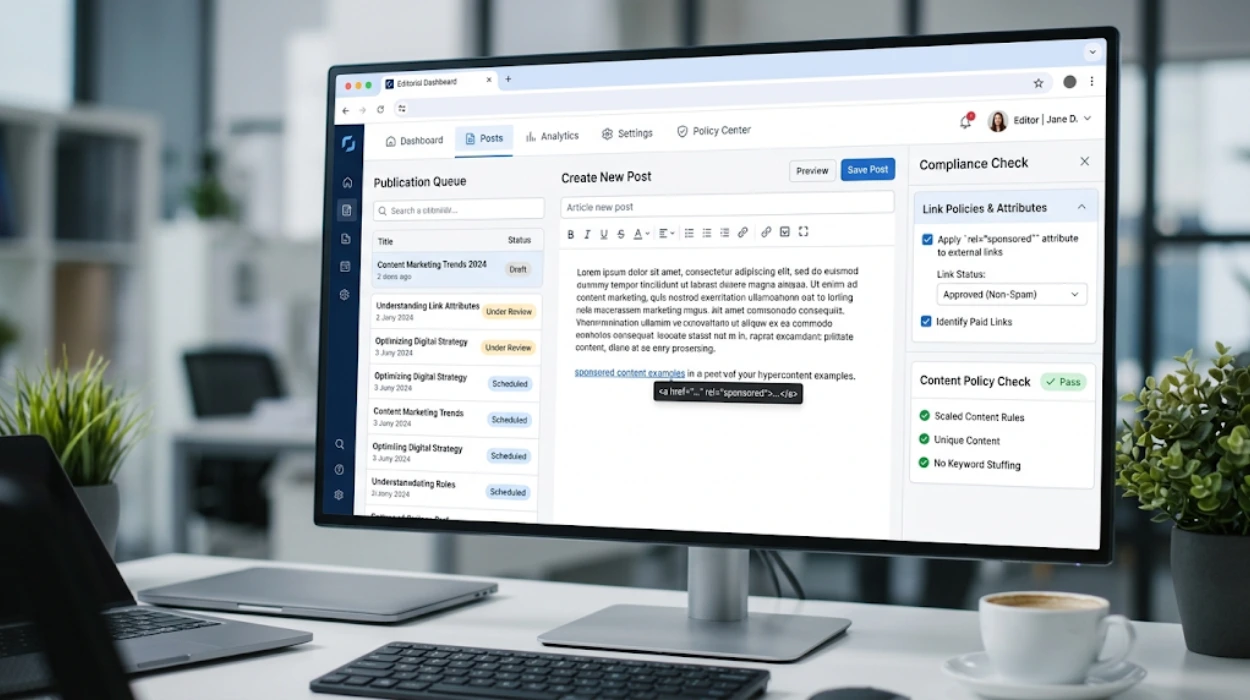
Sponsored content creates a commercial relationship between a publisher and an advertiser. When that relationship includes links, Google treats those links as paid links for Search policy purposes. The links need qualifying attributes that prevent ranking credit from being passed.
What does Google consider a paid link in sponsored content?
Google considers a link paid when money, goods, services, or another form of compensation is exchanged for the link. Sponsored articles, advertorials, native advertising, guest posts, and press releases can therefore contain paid links.
Google defines link spam as creating links primarily to manipulate search rankings. Its examples include paying for links or posts containing links, exchanging products or services for links, and providing products in exchange for reviews that include links.
Sponsored content becomes relevant when compensation is connected to the publication and its links. The commercial transaction itself is not automatically prohibited. The key issue is whether the link passes ranking credit.
For example, a business pays a publisher £1,000 for an article and requests a link using the anchor text UK business research services. That link is a paid link because payment is connected to the published content and its link placement.
Google explicitly recognises advertising and sponsorship as normal parts of the web economy. Paid links used for advertising are permitted when they are properly qualified with rel="nofollow" or rel="sponsored".
What types of compensation count?
Compensation is not limited to direct cash payments. Google identifies several commercial arrangements involving links, including:
- Money exchanged for links
- Products exchanged for links
- Services exchanged for links
- Products provided in exchange for reviews containing links
- Payment for articles containing links that pass ranking credit
This makes the commercial relationship more important than the format of the published content.
Why does a sponsored link need a rel attribute?
A sponsored link needs a qualifying rel attribute because Google requires paid links to be identified in a way that prevents them from passing ranking credit. The two relevant attributes are rel="sponsored" and rel="nofollow".
The rel attribute communicates information about the relationship between the linking page and the destination. For paid placements, it also tells search engines that the link does not represent an ordinary editorial recommendation.
Google specifically states that paid links used for advertising and sponsorship do not violate its spam policies when they are qualified with rel="nofollow" or rel="sponsored".
A basic sponsored link can therefore use:
<a href="https://example.com" rel="sponsored">Example</a>A nofollow version uses:
<a href="https://example.com" rel="nofollow">Example</a>The distinction between these attributes relates to how the relationship is described.
What does rel sponsored mean?
rel="sponsored" Identifies a link associated with advertising, sponsorship, or another compensated arrangement.
It provides a specific relationship signal for commercial links. This makes it directly relevant to sponsored articles, paid placements, advertorials, and other compensated publishing arrangements.
What does rel nofollow mean?
rel="nofollow" Tells search engines not to associate the link with the normal ranking credit associated with an ordinary followed link.
Google accepts nofollow as a qualifying attribute for paid links. It therefore remains a valid option when implementing sponsored content links.
How should publishers qualify links in sponsored articles?
Publishers need to identify compensated links and apply an appropriate qualifying attribute to each relevant link. rel="sponsored" directly identifies paid relationships, while rel="nofollow" also qualifies paid links under Google Search spam policies.
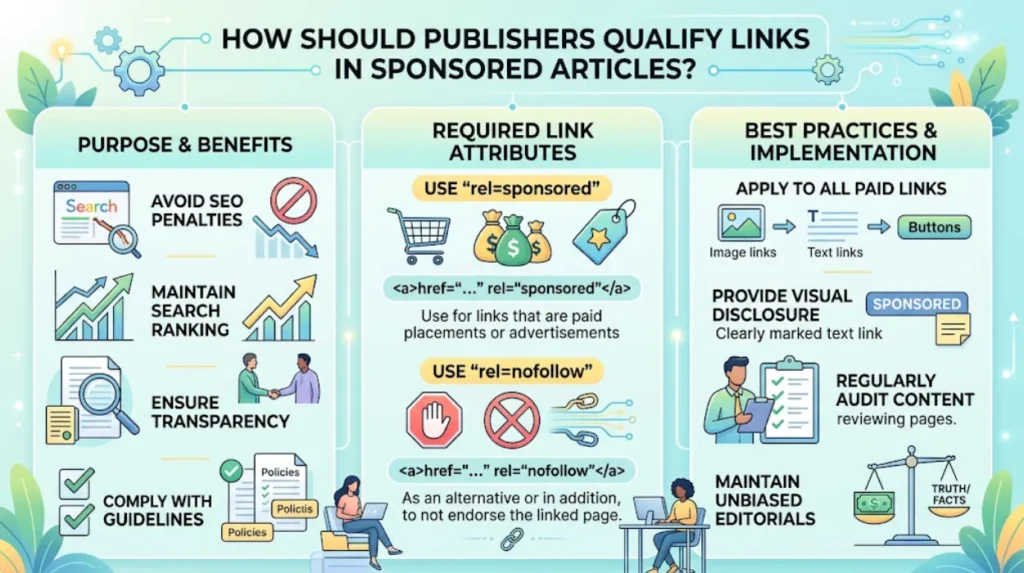
The implementation process starts with identifying every link connected to the commercial arrangement. The publisher then determines whether each link represents a paid, sponsored, or otherwise compensated relationship.
A practical process contains five steps:
- Identify whether compensation exists.
- Identify every link included in the sponsored content.
- Determine which links are connected to the commercial arrangement.
- Apply
rel="sponsored"orrel="nofollow"to those links. - Check the published HTML to confirm the attribute is present.
The process applies to different sponsored formats. Examples include a paid article containing two destination links, a sponsored product review containing one commercial link, and a paid press release containing several links to company pages.
The link qualification applies at the HTML level. Visible disclosure of sponsorship and search-engine link qualification address different requirements. A publisher can identify an article as sponsored for users while separately using rel="sponsored" or rel="nofollow" for search engines.
Can sponsored content contain normal editorial links?
A sponsored article can contain links that are not part of the compensated arrangement. Each link needs to be assessed according to its relationship and purpose.
For example, an article can contain a paid link to an advertiser and an unpaid citation linking to an independent government publication. The commercial link requires appropriate qualification. The independent citation is assessed separately.
This distinction prevents every link within a sponsored article from being treated as identical.
What is the difference between rel sponsored and rel nofollow?
rel="sponsored" identifies a link as part of advertising or sponsorship, while rel="nofollow" identifies a link that should not receive the normal ranking relationship. Google accepts both attributes for qualifying paid links.
The two attributes therefore perform related but distinct signalling functions.
| Attribute | Primary meaning | Relevance to paid content |
|---|---|---|
rel="sponsored" | Advertising or sponsorship relationship | Directly identifies compensated links |
rel="nofollow" | Do not treat the link as a normal ranking link | Accepted by Google for paid links |
rel="ugc" | User-generated content relationship | Used for links in user-generated content |
Google recommends sponsored for advertisements and paid placements. It also states that nofollow remains acceptable for qualifying paid links.
The choice therefore depends on the relationship being represented in the HTML.
Can publishers use both attributes?
Google supports multiple rel values. A link can therefore identify more than one relationship when the circumstances require it.
For example:
<a href="https://example.com" rel="sponsored nofollow">Example</a>The important requirement is that a paid link does not pass ranking credit. Google specifically identifies sponsored and nofollow as qualifying values for paid links.
What happens when a paid link passes ranking credit?
A paid link that passes ranking credit falls within Google’s link spam policy. Google specifically identifies paid articles, native advertising, guest posts, and press releases containing links that pass ranking credit as examples of link spam.
The problem is not simply that the article received payment. The policy concerns paid links that influence ranking signals.
Google identifies advertorials and native advertising as problematic when payment is received for articles containing links that pass ranking credit. It also identifies optimised anchor text in paid articles, guest posts, and press releases as an example of link spam.
For example, a publisher receives payment to publish an article and inserts a followed commercial link with highly targeted anchor text. That configuration creates a paid link that passes ranking credit.
A compliant implementation instead qualifies the compensated link.
Why does anchor text matter?
Anchor text describes the clickable words used for a link. In paid content, optimised anchor text becomes particularly relevant when the link is intended to influence rankings.
Google includes paid articles containing links with optimised anchor text among its examples of link spam.
This makes link qualification and anchor-text practices connected considerations when reviewing sponsored content.
Does sponsored content itself violate Google’s spam policies?
Sponsored content itself does not automatically violate Google’s spam policies. Google recognises advertising and sponsorship as legitimate web activities. The policy issue arises when paid links pass ranking credit or content is created primarily to manipulate Search rankings.
A sponsored article can provide useful information to readers while maintaining properly qualified commercial links.
The distinction is important because sponsorship and link spam are not identical concepts. Sponsorship describes the commercial relationship. Link spam describes practices intended primarily to manipulate Search rankings.
Google also identifies low-value content created primarily to manipulate linking and ranking signals as link spam.
What role does content quality play?
Content quality remains separate from link qualification.
A sponsored article can contain a correctly qualified link but still provide little value to users. Google’s spam policies address content created primarily to manipulate rankings, including scaled content that produces large volumes of low-value pages.
This means publishers need to consider both the links and the substance of the content.
Explore More Expert Insights:
When Should a Brand Update an Existing Research Report Rather Than Publish a New One?
Why Does Plain English Matter When Publishing Complex Research Findings for UK Business Readers?
How do sponsored links relate to scaled content and site reputation?
Sponsored links and scaled content involve different Google spam-policy concepts, but both can affect sponsored publishing. Paid links concern ranking-credit manipulation, while scaled content concerns large volumes of low-value content created primarily to manipulate Search rankings.
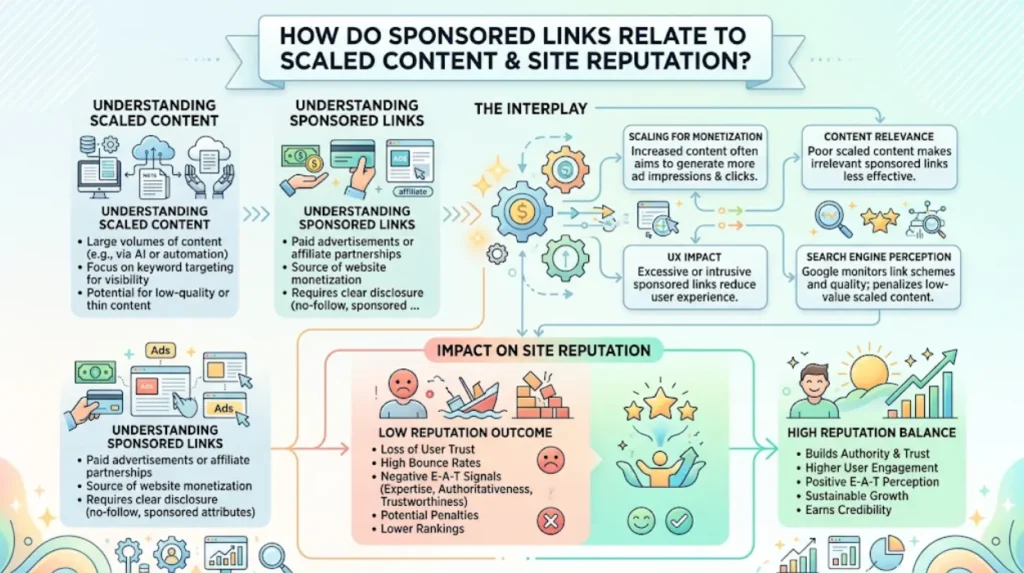
Scaled content abuse occurs when many pages are generated primarily to manipulate Search rankings rather than help users. Google states that this applies regardless of whether the content is produced by humans, automation, generative AI, or other methods.
Site reputation abuse is another distinct policy area. It concerns third-party content published on an established host primarily to exploit that host’s existing ranking signals. Google states that simply having third-party content does not automatically violate this policy.
These policies demonstrate why sponsored publishing requires more than checking whether an article contains a rel attribute.
What should publishers review before publication?
A sponsored-content review can include:
- Commercial relationship
- Payment or compensation
- Link destination
- Link attribute
- Anchor text
- Article originality
- User value
- Publication purpose
- Content production scale
- Third-party content relationship
This creates a clearer separation between advertising, editorial content, link qualification, and Search manipulation.
What is the correct way to think about paid links in sponsored content?
Google treats compensated links as paid links when money, goods, services, or similar value is exchanged for them. Sponsored links need rel="sponsored" or rel="nofollow" so the paid relationship does not pass ranking credit.
The central principle is straightforward: payment does not make sponsored content automatically prohibited, but paid links need appropriate qualification. Google explicitly permits advertising and sponsorship links when they use rel="sponsored" or rel="nofollow".
Publishers therefore need to distinguish four elements:
- Commercial relationship — identifies whether compensation exists.
- Sponsored content — identifies content produced or published through that commercial relationship.
- Link qualification — identifies paid links through
rel="sponsored"orrel="nofollow". - Content purpose — determines whether the publication provides user value or primarily attempts to manipulate Search rankings.
Understanding these distinctions also provides the foundation for Google’s spam policies when examining how sponsored publishing practices interact with paid links, link attributes, and scaled content.
For UK publishers, advertisers, agencies, and content teams, the technical implementation remains the same: identify compensated links, qualify them correctly, review their anchor text and placement, and evaluate the wider content for compliance with Google Search policies. The result is a clearer separation between legitimate sponsorship and attempts to manipulate organic ranking signals.
FAQs
Q1: Are links in sponsored content considered paid links by Google?
Ans: Yes, if a link is included as part of a paid sponsorship or advertising arrangement, Google generally treats it as a paid link. Such links should use an appropriate rel="sponsored" or rel="nofollow" attribute.
Q2: Should sponsored content links use the sponsored attribute?
Ans: Yes, Google recommends using rel="sponsored" for links created as part of advertisements, sponsorships, or other paid placements. This helps clearly identify paid links to search engines.
Q3: Can you use nofollow instead of sponsored for paid links?
Ans: Yes, rel="nofollow" can be used for paid links, although Google specifically recommends rel="sponsored" for advertisements and sponsored content. Both attributes can signal that the link should not be treated as a normal editorial endorsement.
Q4: Do sponsored content links affect SEO rankings?
Ans: Paid links that are properly marked with rel="sponsored" or rel="nofollow" are not intended to pass ranking credit in the same way as standard editorial links. Proper link attributes can therefore help keep sponsored content compliant with Google’s link policies.
Q5: What should brands check before publishing sponsored content with links?
Ans: Brands should identify which links are paid or sponsored and apply rel="sponsored" or rel="nofollow" where appropriate. For services such as those provided by Times Intelligence Media Group, reviewing link attributes before publication can help maintain clear separation between sponsored placements and editorial links.