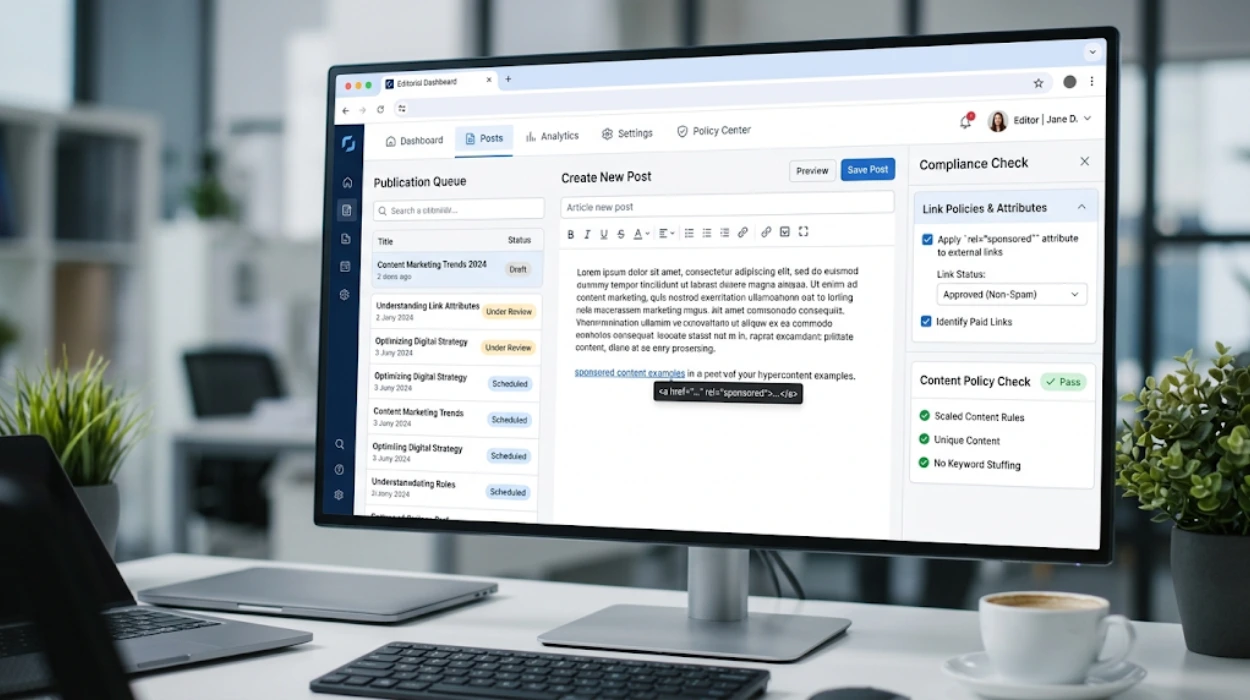
Time Intelligence Media Group sponsored content services provide businesses with paid editorial content distribution while applying Google-compliant link attributes to sponsored links, supporting transparent publishing, controlled link practices, and search policy alignment.
Sponsored content is paid content published to promote a company, product, service, research asset, campaign, or business announcement. The commercial relationship distinguishes sponsored content from independent editorial coverage.
Google Search Central identifies paid links that pass ranking credit as a link spam risk. Google also states that buying and selling links for advertising and sponsorship purposes is acceptable when the links use rel="nofollow" or rel="sponsored" on the <a> element.
This makes link qualification a defined technical requirement within sponsored content workflows. Time Intelligence Media Group can structure sponsored content publication around this requirement rather than treating link attributes as an after-publication adjustment.
How does Time Intelligence Media Group handle Google-compliant sponsored links?
Time Intelligence Media Group handles sponsored links through content planning, destination review, anchor-text assessment, link-attribute implementation, publication checks, and post-publication verification to maintain consistent handling of paid links across sponsored content campaigns.
The process begins with the commercial purpose of the content. A sponsored article contains a business relationship, so its links require appropriate treatment when payment relates to their placement.
The second stage identifies every outbound link. This includes links to product pages, service pages, company websites, campaign landing pages, research reports, and other commercial destinations.
The third stage reviews the intended link treatment. Google specifically recognises rel="sponsored" and rel="nofollow" as qualifying attributes for paid links.
What does the link review include?
A structured review covers:
- Destination URL
- Link purpose
- Anchor text
- Commercial relationship
- Link attribute
- Placement within the article
- Number of outbound links
- Content relevance
- Publication implementation
For example, a sponsored article about a company’s cybersecurity platform can link to its product page using a qualified sponsored link. A separate reference to an independent regulatory source can be treated according to its own relationship and purpose.
Why does anchor text matter?
Google’s spam policies identify paid articles containing links that pass ranking credit or use optimised anchor text as examples of link spam.
The review therefore considers whether the anchor text accurately describes the destination without turning the sponsored article into a vehicle for artificial ranking manipulation.
What components are included in sponsored content services?
Sponsored content services include content preparation, editorial review, publication coordination, link qualification, anchor-text assessment, destination checks, compliance review, distribution management, and post-publication verification for commercially sponsored articles.
Each component addresses a different part of the publishing workflow.
Sponsored content preparation
The content is structured around a defined subject, audience, business objective, and destination. The article remains relevant to the publication context.
Examples include:
- Corporate announcements
- Product launches
- Industry insights
- Research-led content
- Service explanations
- Business developments
- Brand campaigns
Editorial and factual review
The article is reviewed for factual consistency, structure, relevance, readability, and commercial clarity. The objective is to prevent unnecessary link insertion from becoming the central purpose of the content.
Link attribute implementation
Paid links receive an appropriate qualifying attribute. Google documents rel="sponsored" as the attribute specifically intended for advertisements, sponsored placements, or other compensation agreements. rel="nofollow" Also qualifies paid links.
Publication verification
The published page is checked after placement. This confirms that the intended link, destination, anchor text, and attribute appear correctly in the live article.
How does sponsored content differ from a standard editorial placement?
Sponsored content has a commercial publishing relationship, while standard editorial coverage represents independent editorial decisions; sponsored links therefore require explicit qualification when payment or sponsorship relates to their placement.
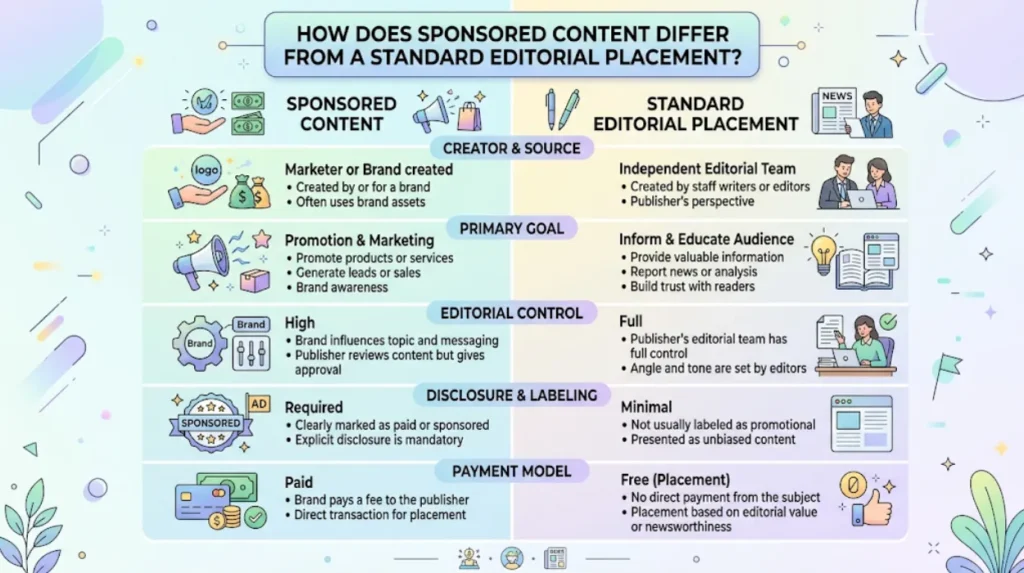
The distinction is important for businesses purchasing media exposure.
A standard editorial article can contain references selected independently by the publisher. Sponsored content exists because a commercial arrangement supports publication.
Google’s policies specifically address paid articles and native advertising containing links that pass ranking credit. The policy also recognises advertising and sponsorship as normal web activities when paid links are appropriately qualified.
For businesses, this means sponsored content can serve a legitimate media and communication purpose without treating paid links as conventional ranking links.
Why are sponsored and nofollow attributes important for paid content?
Sponsored and nofollow attributes identify paid links for search engines and prevent the links from being treated as ordinary editorial ranking signals, creating a clearer separation between commercial publishing and organic link relationships.
The two attributes have related but distinct purposes.
rel="sponsored" Identifies links created as part of advertisements, sponsorships, or compensation arrangements.
rel="nofollow" Tells search engines not to associate the link with the site in the ordinary way or follow it for ranking purposes. Google accepts either attribute for qualifying paid links.
For a sponsored content campaign, attribute selection forms part of the technical publishing specification.
A business paying for an article placement can therefore request content distribution without requesting an unqualified link intended to transfer ranking credit.
How does Time Intelligence Media Group support businesses publishing sponsored content?
Time Intelligence Media Group supports businesses by combining sponsored content production and media publication with structured link review, helping organisations manage commercial content placements through a defined publishing and technical compliance workflow.
The service is relevant to organisations using sponsored content as part of broader digital communication activity.
A campaign can contain several content assets. Examples include a product announcement, an industry analysis article, a company development story, and a research-led business article.
Each asset requires consistent treatment of commercial links.
Which businesses use sponsored content services?
Typical use cases include:
- B2B companies promoting specialist services
- Technology companies launching products
- Professional services firms distributing industry insights
- Start-ups communicating market developments
- Established companies supporting brand campaigns
- Research organisations promoting published findings
- Agencies managing media campaigns for clients
The service also fits campaigns where several sponsored articles require consistent link handling across different publication dates.
How can businesses use sponsored content without relying on paid links for ranking?
Businesses can use sponsored content for brand exposure, audience reach, business communication, product discovery, and referral traffic while qualifying paid links instead of using sponsored publication as a method for transferring search ranking credit.
This distinction changes how campaign success is measured.
Sponsored content can support awareness, direct visits, branded search activity, message distribution, and access to relevant audiences. The paid link itself does not need to function as an organic ranking signal.
Google’s spam policies specifically identify buying or selling links for ranking manipulation as problematic while distinguishing legitimate advertising and sponsorship when links use qualifying attributes.
Businesses therefore need to separate the media objective from the ranking objective.
For example, a software company can sponsor an article explaining changes in data security. The article can introduce the company and link to its security solution using rel="sponsored". The campaign objective remains content exposure and audience engagement rather than purchasing an unqualified ranking link.
What should businesses check before ordering sponsored content?
Businesses should check the commercial purpose, content relevance, destination URLs, anchor text, link attributes, publication requirements, verification process, and reporting details before approving a sponsored content campaign.
A practical pre-publication checklist includes:
- Define the campaign objective.
- Identify the intended audience.
- Approve the content topic.
- Confirm every destination URL.
- Review proposed anchor text.
- Confirm paid-link attributes.
- Check the final article structure.
- Confirm publication requirements.
- Verify the live page after publication.
- Record the published URL and campaign details.
This process creates a clear operational record for each sponsored placement.
Businesses managing multiple campaigns also benefit from consistent documentation. A central record can track article title, publication date, destination URL, anchor text, attribute treatment, and live publication URL.
Explore More Expert Insights:
Time Intelligence Media Group Research and Reports Services for Refreshing Existing Reports
Time Intelligence Media Group Research and Reports Services Including Plain-English Writing and Editing
How does this service fit into a wider sponsored content strategy?
Sponsored content works most effectively as part of a structured media strategy that connects relevant topics, credible publication environments, useful business information, qualified links, and measurable campaign objectives without depending on paid ranking signals.
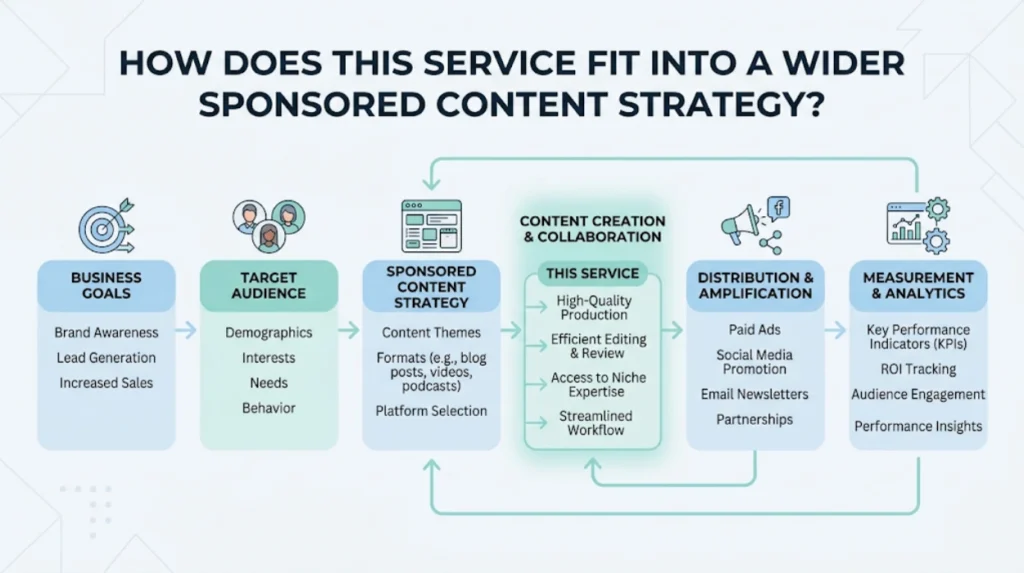
The strategy begins with content relevance. The subject must relate to the audience and publication context.
The next stage is content quality. The article needs substantive information rather than being constructed primarily around links.
The technical stage covers link attributes and destination control.
The measurement stage tracks outcomes such as publication completion, referral activity, audience engagement, branded visibility, and campaign delivery.
Businesses researching the underlying principles can also review sponsored content links for the educational context around paid links and search policies.
Those evaluating implementation can explore Google-compliant sponsored content for practical guidance on paid links, link attributes, and sponsored publishing workflows.
Why choose Time Intelligence Media Group for sponsored content publication?
Time Intelligence Media Group provides a defined sponsored content workflow that combines commercial content publishing with link-attribute controls, editorial preparation, publication coordination, and verification for businesses targeting UK and international audiences.
The service is designed for businesses that need more than article placement alone.
The workflow connects content development with technical link handling. It also creates a clear distinction between paid media exposure and organic ranking signals.
For a campaign containing one article, the process establishes the required content and link specifications. For campaigns containing multiple articles, the same controls provide consistency across placements.
The result is a documented sponsored content process covering:
- Content preparation
- Editorial review
- Commercial link identification
- Sponsored or nofollow attribute handling
- Anchor-text review
- Publication coordination
- Live-page verification
- Campaign documentation
For organisations planning sponsored media activity, the next step is to define the campaign topic, target audience, publication requirements, destination pages, and required content volume with Time Intelligence Media Group Sponsored Content Services.
FAQs
Q1: What are Google-compliant link attributes for sponsored content?
Ans: Google-compliant link attributes help identify links placed through paid or sponsored arrangements. Common options include rel="sponsored" and rel="nofollow", depending on the nature of the link and publishing arrangement.
Q2: Should sponsored content use the sponsored link attribute?
Ans: Paid links in sponsored content should generally use the rel="sponsored" attribute to clearly identify their commercial nature. This helps publishers follow Google’s guidance on paid links and link qualification.
Q3: Can sponsored content include links without passing ranking credit?
Ans: Yes, sponsored content can include links using appropriate link attributes such as rel="sponsored" or rel="nofollow". These attributes help prevent paid links from being treated as endorsements intended to manipulate search rankings.
Q4: How does Times Intelligence Media Group handle links in sponsored content?
Ans: Times Intelligence Media Group can structure sponsored content with link attributes that identify paid or commercial relationships. Applying appropriate attributes helps publishers maintain transparent sponsored content and align link handling with Google’s guidelines.
Q5: Why are Google-compliant link attributes important for sponsored content?
Ans: Google-compliant link attributes help distinguish commercial links from ordinary editorial links. Correctly qualifying sponsored links can reduce the risk of paid links being interpreted as attempts to manipulate search rankings.