
Updating an existing research report means revising a published report with new evidence, corrected information, updated statistics, and relevant findings while preserving its original research identity and publication history.
A research report contains structured evidence about a defined subject. It normally includes research objectives, methodology, findings, analysis, references, and publication information.
An update changes selected components without replacing the report entirely. The original URL, title structure, research scope, and established references can remain intact when the underlying research question remains relevant.
A new report serves a different purpose. It presents a distinct research question, methodology, dataset, audience need, or analytical scope.
The decision therefore depends on the relationship between the existing report and the new information.
What is the difference between a report update and a new report?
A report update extends an existing evidence base. A new report establishes a separate evidence base.
An update fits when new information directly changes or strengthens existing findings. A new report fits when the research objective itself has changed.
For example, a 2025 report on UK consumer confidence can be updated with 2026 survey results when the research framework remains consistent. A separate report on UK consumer spending behaviour requires a new research structure because the research subject differs.
When is an existing research report suitable for an update?
An existing research report is suitable for an update when its core research question remains valid, its methodology remains relevant, and new evidence changes or strengthens information already presented in the published report.
Several conditions indicate that an update is appropriate.
The original research question remains relevant to the intended audience. The subject continues to generate demand for reliable information. New data directly relates to the original findings.
The methodology also remains suitable. A survey-based report requires a consistent survey framework when new results are added for comparison. A market analysis requires comparable market definitions and measurement criteria.
Which signals indicate that a report needs updating?
Common signals include:
- Statistics are older than the reporting period they describe.
- New data materially changes an existing finding.
- Regulations or standards have changed.
- New research provides stronger evidence.
- Important factual errors require correction.
- Existing findings require a new reporting period.
- Search demand continues around the same research question.
- External publications continue citing the original report.
For example, an annual UK workforce report can retain its original research framework while incorporating a new annual dataset.
How does the research question determine whether to update or republish?
The research question determines the publishing route because an unchanged research question supports an update, while a substantially different question requires a new report with its own evidence, methodology, findings, and publication structure.
Research questions define the boundaries of a report. They establish what the research measures and why the evidence was collected.
Consider a report asking how UK businesses use artificial intelligence in 2025. Updating it for 2026 retains the same central question if the measurement framework remains comparable.
A new report asking how artificial intelligence affects UK business productivity addresses a different question. It requires different measurements and analytical criteria.
What happens when the research scope changes?
A scope change occurs when the population, geography, industry, subject, research objective, or measurement framework changes substantially.
For example, changing a study from UK retail businesses to European financial institutions introduces a different research population and market context.
A small scope adjustment can remain within an update. A major scope change generally requires a new publication.
How do new statistics affect an existing research report?
New statistics justify an update when they directly measure the same subject and improve the report’s currency without changing its research purpose, methodology, audience, or central analytical framework.
Statistics have a defined reporting period. Readers need to know whether figures represent 2024, 2025, or 2026 conditions.
An outdated statistic does not automatically require a new report. If a newer dataset measures the same variable using a comparable methodology, the statistic can be incorporated into an existing report.
For example, an existing report containing 2024 UK employment data can be updated with 2025 data when the same employment indicators and population definitions apply.
How should statistical changes be documented?
Updated statistics require clear documentation. The revised report needs to identify:
- The original reporting period.
- The new reporting period.
- The data source.
- The methodology used.
- Any changes in sample size.
- Any changes in definitions.
- The publication date of the update.
This information allows readers to distinguish historical findings from newly added evidence.
When should outdated information be corrected instead of replaced?
Outdated information requires correction when it contains factual errors, superseded regulations, obsolete terminology, or inaccurate references that affect reader understanding while the underlying research subject remains unchanged.
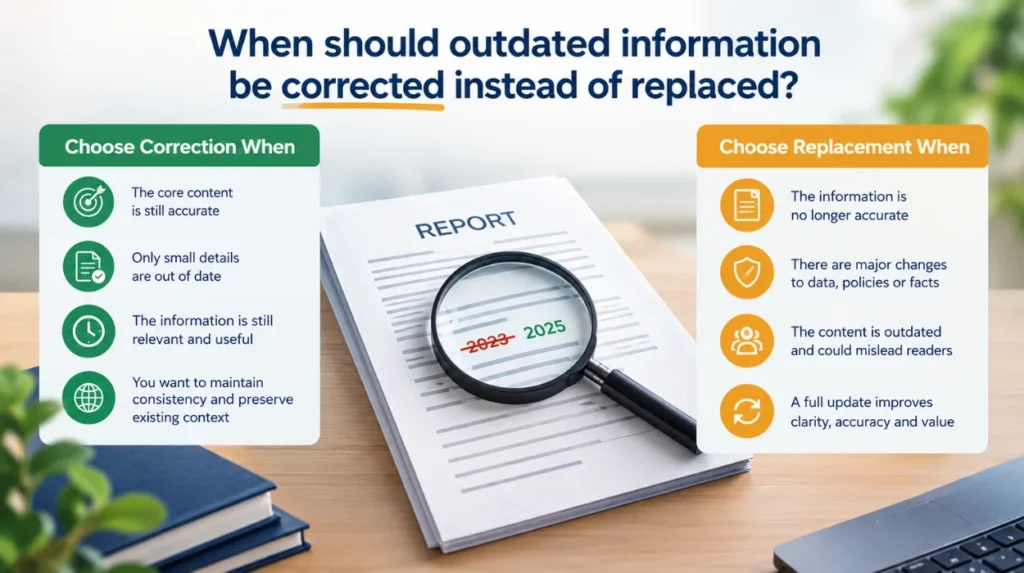
Corrections address accuracy. Updates address currency. Both can occur within the same report.
A report referencing a regulation that was replaced in 2026 requires a factual revision. The research topic does not automatically require a new publication.
A correction also requires transparency. Readers need to understand which information changed and why.
What information requires immediate correction?
High-priority corrections include:
- Incorrect numerical values.
- Incorrect dates.
- Broken or inaccurate citations.
- Misidentified sources.
- Superseded legal requirements.
- Incorrect definitions.
- Errors in charts or tables.
- Factual statements contradicted by authoritative evidence.
Corrections that materially change the interpretation of a finding require additional editorial documentation.
How do citations and references influence the update decision?
Existing citations and references provide evidence of a report’s research history, so an update preserves continuity when the original research remains relevant and new evidence can be incorporated without creating a separate research identity.
Research reports often accumulate citations from academic publications, industry reports, news coverage, institutional websites, and professional resources.
A substantial change in the report can make existing citations less representative of the revised content. This creates a documentation problem.
An update works when the revised report remains recognisably connected to the original research. The methodology, subject, and central findings retain continuity.
What should happen to old references?
References supporting unchanged findings remain relevant. References supporting replaced statistics require review.
A strong update distinguishes historical evidence from current evidence. It also records newly added sources.
For example, a report originally supported by 20 sources can retain relevant sources while adding 8 new sources for a later reporting period.
This creates a traceable research record rather than an unexplained replacement of evidence.
How does the publication date affect an updated research report?
The publication date identifies when research was originally released, while an updated date identifies when new evidence or corrections were incorporated, giving readers a clear chronological record of the report’s development.
Publication dates have different functions from update dates.
The original publication date establishes when the research first became available. The updated date establishes when the report was materially revised.
A report published in March 2025 and updated in September 2026 has two important dates. Both need clear presentation.
Why is version history important?
Version history provides transparency. It records significant changes and establishes which version contained specific findings.
A simple version history can include:
- Original publication date.
- Update date.
- Summary of statistical changes.
- Methodology changes.
- Corrections.
- Newly added references.
This structure supports accurate interpretation and future research.
What parts of a research report can be updated?
Research reports can update statistics, findings, references, charts, terminology, regulatory information, conclusions, and supporting evidence when these changes remain consistent with the report’s original research question and methodology.
Different report components require different levels of review.
Statistics require source verification. Charts require recalculation. Conclusions require analytical review. References require citation checking.
A report update is therefore an editorial and research process rather than a simple date change.
Which sections require the most attention?
The main areas include:
Executive summary
The summary needs revised findings when updated evidence changes the main conclusions.
Data and statistics
All numerical information requires verification against the newest approved dataset.
Analysis
Analysis needs revision when new evidence changes relationships, trends, or interpretations.
Charts and tables
Visual data needs recalculation and updated labels, sources, and reporting periods.
References
References require checking against the updated findings and newly introduced evidence.
Conclusion
The conclusion needs alignment with the latest evidence. It must not retain claims contradicted by updated data.
Explore More Expert Insights:
Why Does Plain English Matter When Publishing Complex Research Findings for UK Business Readers?
What Is a Rapid-Response Data Report and When Does Reacting to Breaking Industry News Make Sense in 2026?
What are the benefits of updating an existing research report?
Updating an existing report preserves relevant research continuity, maintains a clear evidence history, reduces unnecessary duplication, and gives readers current information without creating a separate publication for the same research question.
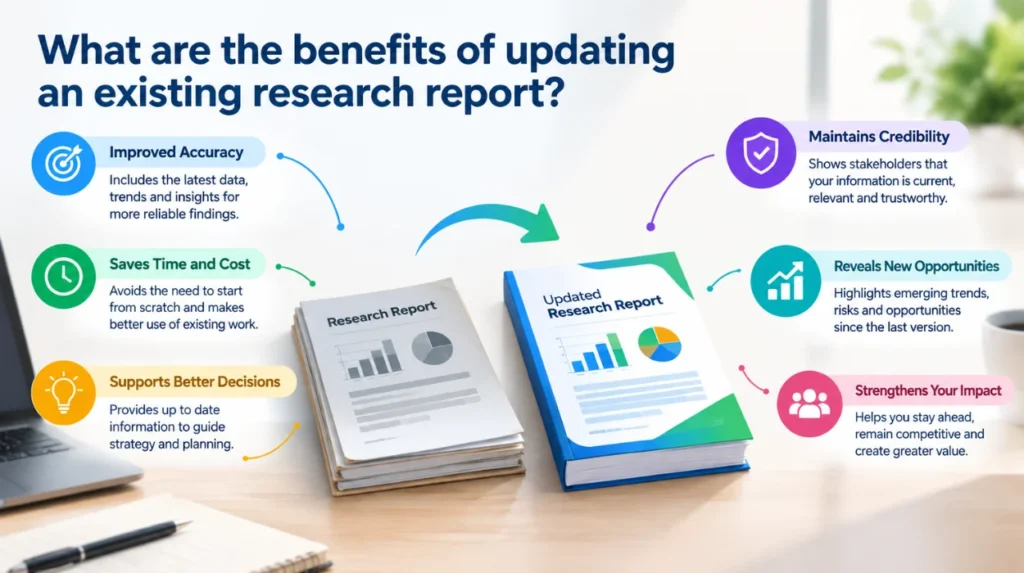
An update also reduces fragmentation. Multiple reports covering the same research question can divide information across publication dates.
A consolidated report provides one current reference point when the research framework remains stable.
How does updating improve information quality?
Regular updates improve factual accuracy and relevance.
They also create a structured record of change. Readers can distinguish original findings from later evidence.
For organisations conducting recurring research, this approach creates consistency across reporting periods.
For readers interested in how an existing publication can be refreshed while retaining its established digital authority, refreshing a published research report provides the next stage of the process.
When is publishing a new research report more appropriate?
A new research report is appropriate when the research question, methodology, target population, geographic scope, dataset, or analytical objective changes enough to create a distinct evidence base rather than an extension of the existing study.
A new report prevents unrelated research from being combined under one publication.
For example, a report measuring UK consumer attitudes toward sustainable packaging is distinct from a new report measuring the financial impact of sustainable packaging on UK manufacturers.
The subjects overlap, but the research questions and evidence requirements differ.
What changes justify a new report?
A new publication is generally appropriate when there is a:
- New research question.
- New target population.
- New geographic market.
- New research methodology.
- New analytical objective.
- New research subject.
- Major change in measurement criteria.
- Completely new dataset addressing a different problem.
The decision is based on research identity rather than publication age.
How can teams decide between updating and publishing a new report?
Teams can compare the research question, methodology, audience, evidence, scope, and analytical objective before deciding whether new information extends an existing study or represents a separate research project.
A structured review prevents arbitrary publishing decisions.
The following questions establish whether continuity exists:
- Is the original research question unchanged?
- Does the new evidence measure the same subject?
- Is the methodology still valid?
- Does the target population remain consistent?
- Does the geographic scope remain consistent?
- Can existing findings be compared directly with new findings?
- Do existing references remain relevant?
- Does the report retain the same analytical purpose?
If the answers demonstrate continuity, an update provides a clear publishing structure.
If several fundamental elements have changed, a new report establishes a more accurate research record.
How should an updated research report be structured?
An updated research report needs clear version information, revised evidence, verified statistics, updated analysis, reviewed references, and conclusions that accurately reflect the latest research period without obscuring historical findings.
The updated document needs editorial consistency.
Historical findings should remain identifiable where comparison is important. New findings should have clear reporting periods. Changed methodology requires explicit documentation.
A transparent structure prevents readers from confusing previous findings with current evidence.
What should the final review check?
Before publication, reviewers need to verify:
- Research question consistency.
- Data accuracy.
- Source credibility.
- Statistical calculations.
- Chart accuracy.
- Citation completeness.
- Methodology consistency.
- Date accuracy.
- Regulatory information.
- Conclusion alignment.
- Version history.
This process establishes whether the report remains one continuous research asset or has developed into a separate research project.
Why does the update decision matter for research publishing?
The update decision determines whether new evidence strengthens an existing research record or requires a distinct publication, helping readers access accurate information while preserving a transparent connection between research questions, evidence, methods, and findings.
An existing report is not defined only by its publication date. Its identity comes from its research question, methodology, evidence, scope, and analytical purpose.
Updating is appropriate when these foundations remain consistent and new information improves currency or accuracy.
Publishing a new report is appropriate when the research itself becomes materially different.
This distinction creates clearer research records, reduces duplicated coverage, and gives readers a reliable basis for understanding how evidence changes over time.
FAQs
Q1: When should a brand update an existing research report instead of publishing a new one?
Ans: A brand should update an existing research report when the original research remains relevant, but its data, findings, or market context have changed. This approach is suitable when new evidence can be integrated without changing the report’s core research purpose.
Q2: How often should a business update a research report?
Ans: The update frequency depends on how quickly the subject, market, or supporting data changes. Fast-moving industries may require more frequent research report updates, while stable topics can remain useful for longer periods with occasional revisions.
Q3: What should be updated in an existing research report?
Ans: Common updates include new statistics, market trends, survey findings, sources, charts, references, and conclusions affected by recent evidence. Key sections should also be reviewed to ensure the report remains accurate and relevant to current business conditions.
Q4: When is it better to publish a new research report?
Ans: A new research report is generally appropriate when the research question, target audience, methodology, or scope has changed substantially. If the new study requires fresh primary research rather than an extension of existing findings, a separate report may provide clearer value.
Q5: How can research report updates maintain credibility?
Ans: Research report updates should clearly identify revised data, sources, methodology changes, and publication dates. Times Intelligence Media Group can use consistent documentation and transparent revisions to help readers distinguish updated findings from information contained in the original report.