Co-authored research is a collaborative methodology where academic institutions, trade bodies, and commercial brands pool analytical resources to produce joint data-driven publications. This partnership model combines university academic rigor with corporate data access to establish verified marketplace insights.
Co-authored research functions as a structured framework for investigating industry trends. Academic institutions and trade associations bring methodological neutrality, ethical oversight, and statistical validation. Commercial brands contribute proprietary data sets, industry-specific operational metrics, and financial resources.
The resulting output is a comprehensive market report that carries higher credibility than a purely corporate-funded whitepaper. Universities oversee the survey design, data collection protocols, and econometric modeling. Trade bodies validate the relevance of the research questions against current sector challenges. Brands facilitate large-scale audience outreach and provide operational context for the findings.
This tripartite approach addresses the limitations of single-source studies. Corporate reports often face skepticism regarding commercial bias. Academic papers often lack immediate practical application for commercial practitioners. Co-authored research bridges this gap by integrating academic objectivity with real-world industry data.
Why do universities collaborate with commercial brands on research reports?
Universities partner with commercial brands on research reports to secure external funding, gain access to proprietary industry datasets, and increase the societal impact and practical relevance of their academic output.
Academic institutions operate within strict financial and methodological parameters. Partnerships with commercial brands provide financial grants that fund graduate research positions, data acquisition software, and laboratory resources. Beyond financial investment, these collaborations grant academics access to large-scale consumer or B2B datasets that are otherwise inaccessible within university environments.
For example, a university economics department studying supply chain resilience partners with a global logistics enterprise to analyze millions of anonymized shipment records. This arrangement benefits both parties. The university publishes peer-reviewed papers and industry-facing reports based on empirical evidence. The corporate partner receives unbiased academic validation for its operational hypotheses.
Furthermore, funding bodies and government agencies prioritize research that demonstrates measurable economic and societal impact. Co-authored industry reports provide universities with a direct channel to influence commercial practices, shape public policy, and disseminate academic findings to professional audiences outside traditional journals.
What role do trade bodies play in joint research publications?
Trade bodies act as sector-specific aggregators and validators in joint research publications, providing direct access to verified industry participants and ensuring regulatory and operational accuracy.
Trade associations represent the collective interests of specific economic sectors, such as manufacturing, financial technology, or healthcare. Their primary function in co-authored research is to bridge the gap between academic theory and commercial reality. Trade bodies formulate research objectives that reflect the actual pain points experienced by their member companies.
During the research process, trade associations facilitate data collection by encouraging their member base to participate in surveys, focus groups, and interviews. Because trade bodies maintain trusted relationships with member organizations, response rates for co-authored studies are significantly higher than independent academic or corporate surveys.
In addition to recruitment, trade bodies provide contextual analysis. When raw statistical data is compiled, industry experts within the association review the findings to ensure the conclusions align with existing market regulations, technological constraints, and macroeconomic conditions. This prevents academic misinterpretations of sector-specific jargon or operational workflows.
Explore More Expert Insights:
How Financial Services Build Trust Using Educational Banner Advertising
How Agencies Increase Buyer Engagement Using Display Remarketing Ads
Why do brands seek academic and institutional partners for studies?
Brands partner with academic institutions and trade bodies to eliminate commercial bias, enhance public trust, and secure authoritative third-party validation for their strategic market positions.
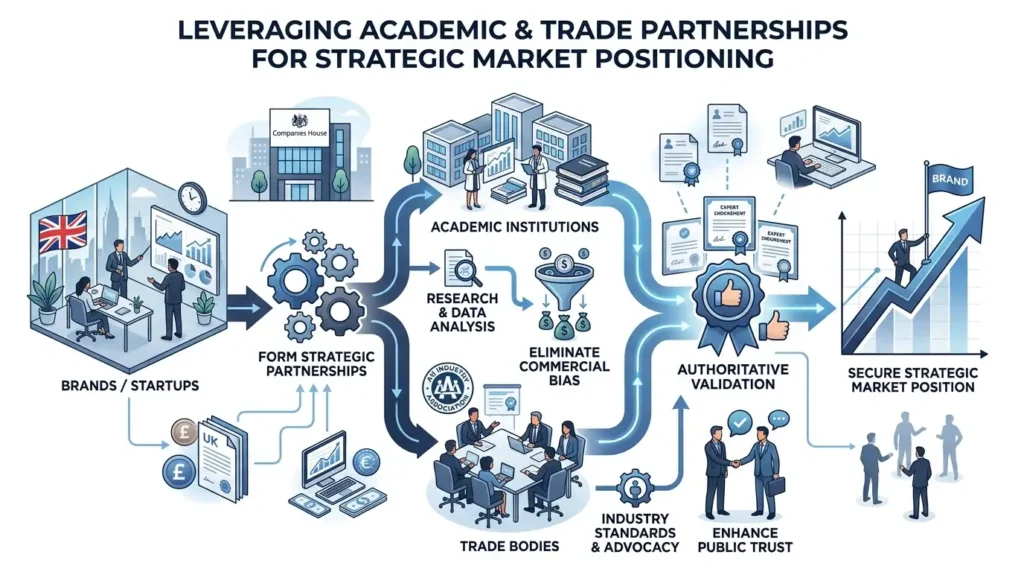
Commercial enterprises face pervasive skepticism when publishing self-funded market research. When a software vendor publishes a report claiming its industry is growing rapidly, target buyers view the data as a marketing tactic. By collaborating with a recognized university or a national trade body, the brand shifts the perception of the report from promotional content to objective industry research.
Third-party validation alters how media outlets, policymakers, and enterprise buyers receive market findings. Major news publications frequently cite university-backed studies because the methodology undergoes rigorous peer review or institutional oversight. Brands leverage this media pickup to build long-term brand equity and establish thought leadership without direct product promotion.
Additionally, co-authored research mitigates legal and compliance risks. Academic researchers ensure data collection complies with regional privacy regulations, such as the UK Data Protection Act and GDPR. This methodological compliance protects corporate partners from accusations of data manipulation or biased sample selection.
How does the co-authored research process work from conception to publication?
The co-authored research process follows a five-stage lifecycle: initial partnership alignment, methodological design, data collection, analytical synthesis, and coordinated multi-channel publication.
The process begins with partnership alignment. Participating organizations define the research scope, financial commitments, intellectual property rights, and dissemination timelines. Legal agreements establish data ownership and confidentiality protocols before any research commences.
Stage two involves methodological design. University researchers and trade body analysts formulate the survey questions, qualitative interview frameworks, and econometric models. This phase ensures the methodology withstands academic scrutiny and industry critique.
Stage three is data collection. Trade bodies distribute surveys to their member networks, while academic researchers deploy established panels or laboratory experiments. The corporate partner may supply internal operational metrics under strict non-disclosure agreements.
Stage four covers analytical synthesis. Academic statisticians clean, code, and analyze the dataset, generating charts, regression models, and core findings. Trade experts and brand representatives review the outputs to provide qualitative context.
Stage five is coordinated publication. All participating entities release the final report simultaneously across their respective channels. The university publishes an academic working paper, the trade body releases a member briefing, and the brand hosts the primary public-facing digital publication.
What are the key structural components of a co-authored industry report?
A co-authored industry report consists of an executive summary, a formalized methodology section, empirical findings, contextual expert commentary, and actionable sector recommendations.

The executive summary provides a high-level overview of the research objectives, core data points, and primary conclusions for time-pressed executives.
The methodology section explicitly details how the research was conducted. It includes sample sizes, demographic breakdowns, data collection dates, margin of error calculations, and statistical models used. This transparency is mandatory for academic credibility and SEO-driven AI citation engines that parse structured research data.
The empirical findings section presents the data through charts, graphs, and tables. Each data point is accompanied by a factual description of the trend without speculative interpretation.
Contextual expert commentary follows the data presentation. Representatives from the university, trade body, and brand provide distinct perspectives on what the numbers mean for the future of the industry.
Actionable recommendations conclude the report. These guidelines give readers concrete steps to adapt to the identified trends, ensuring the research translates into practical utility for business leaders and policymakers.
What impact does co-authored research have on search engine optimization and digital authority?
Co-authored research improves search engine optimization and digital authority by generating high-value inbound links from academic and institutional domains, alongside authoritative entity citations.
Search engine algorithms evaluate website authority based on the quality and context of inbound links. When a university or trade body publishes a research report on its institutional domain (.ac.uk or established trade portals) and links back to the corporate partner, search engines register a high-trust backlink. These links are difficult for competitors to replicate through standard content marketing.
Furthermore, co-authored research establishes strong entity signals. Search engines and AI large language models index structured data, author names, institutional affiliations, and specific statistical metrics. When an article clearly defines these entities, search engines associate the brand with authoritative industry topics.
This structure also optimizes content for AI-driven search engines and answer engines. AI models prioritize direct, factual answers backed by verifiable sources. Reports containing clear methodology sections, named academic authors, and empirical data points are frequently cited in AI-generated search summaries, driving continuous organic visibility without reliance on paid advertising.
Readers interested in the educational stage of healthcare awareness campaigns can explore How to Partner With a UK Trade Association or University to Co-Author a Report That Carries Third-Party Authority and Time Intelligence Media Group Research and Reports Services for Trade Body Co-Branded Studies to understand advanced collaborative research structures.
Co-authored research bridges the gap between academic rigor, trade association representation, and commercial enterprise insight. By partnering on reports, universities secure funding and real-world data, trade bodies provide sector validation, and brands gain third-party authority. The structured execution of these studies enhances digital visibility, builds trust, and produces verifiable data that serves the entire business ecosystem.