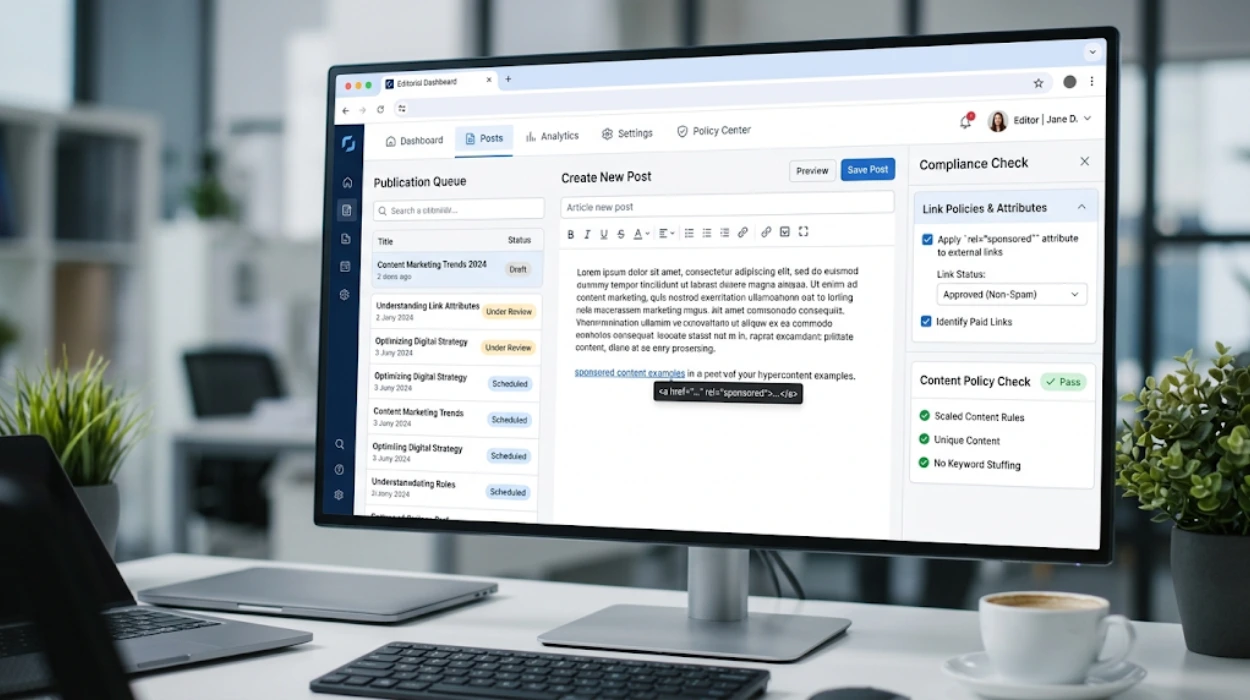
Third-party authority in UK research reports is the established credibility transferred to a brand when an academic institution or industry body validates data, methodology, and findings.
Partnering with accredited entities removes commercial bias from market studies. UK audiences view university presses and trade associations as objective sources of industry data. When a corporate brand co-authors a study with these organizations, external validation increases trust among policymakers, corporate buyers, and media outlets.
Defining Academic and Trade Body Credibility
Academic institutions operate under strict research ethics committees and peer-review frameworks. Trade associations represent verified sector members governed by specific UK regulatory standards. Combining corporate funding or operational insight with academic rigor produces data that resists skepticism.
The Mechanism of Authority Transfer
The transfer occurs through shared authorship, institutional press releases, and co-branded distribution. Media outlets prioritize reports backed by universities because the methodology meets academic standards. Brands gain authoritative positioning without sacrificing commercial relevance. Readers researching foundational concepts can review What Is Co-Authored Research and Why Do Trade Bodies and Universities Partner With Brands on Reports?.
How do UK brands identify and approach the right trade association or university partner?
UK brands identify potential research partners by mapping industry relevance, assessing institutional publication history, and aligning data objectives with specific academic departments.
Selecting the correct partner requires targeted research into sector-specific trade bodies and Russell Group or post-1992 universities. The evaluation process relies on clear criteria: publishing frequency, active industry membership size, and alignment with the intended research topic.
Criteria for Evaluating Trade Associations
- Trade body membership size representing at least 30 percent of the target market sector.
- Active policy engagement history with UK government departments or parliamentary committees.
- Prior experience publishing white papers, market overviews, or annual sector scorecards.
- Dedicated communication channels reaching verified industry professionals and decision-makers.
Criteria for Evaluating University Departments
- Active research centers specializing in economics, data science, or specific sector verticals.
- Faculty members with published peer-reviewed works relevant to the report topic.
- Existing business partnership offices structured to handle corporate research agreements.
- Access to student researcher pools for data collection and literature reviews.
Structuring the Initial Outreach
Initial contact requires a formal proposal outlining mutual benefits, data requirements, and timeline milestones. Commercial brands must present clear research questions rather than predetermined commercial conclusions to satisfy academic independence requirements.
Explore More Expert Insights:
How Investment Firms Build Awareness Using Market Insight Ads
How Finance Brands Improve Conversion Intent Using Retargeting Ads
What is the step-by-step process for co-authoring a research report in the UK?
Co-authoring a research report involves defining the research scope, establishing a joint steering committee, executing data collection, drafting the manuscript, and coordinating peer review.
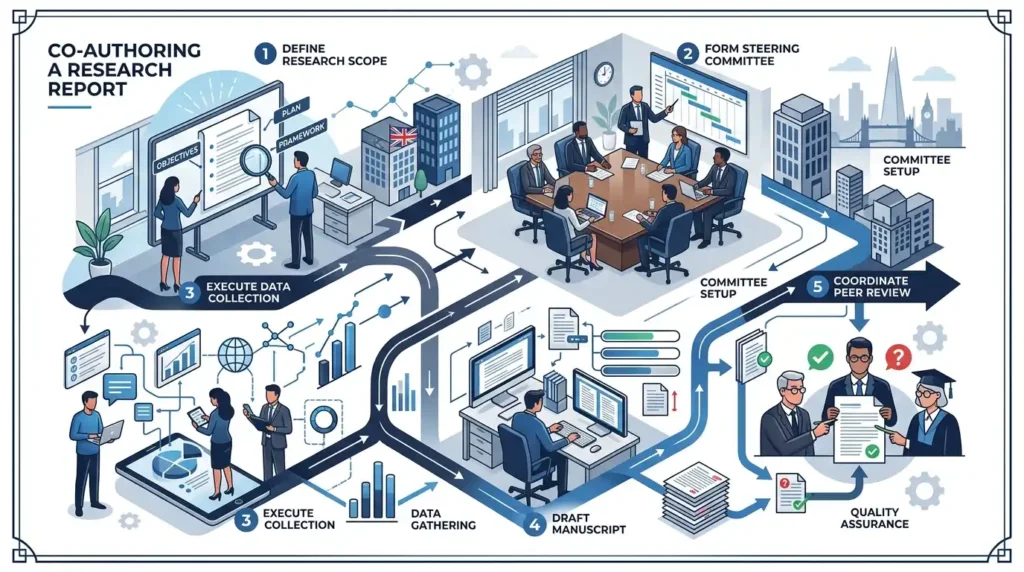
Execution follows a structured timeline spanning 4 to 9 months. Each phase requires distinct contributions from both the corporate partner and the academic or trade association lead.
Phase 1: Scope Definition and Legal Framework
The process begins with drafting a memorandum of understanding and a research agreement. These documents specify data ownership, intellectual property rights, publication embargoes, and funding disclosures.
Phase 2: Data Collection and Methodology Design
University researchers or trade body analysts design quantitative surveys, qualitative interview frameworks, or econometric models.
- Example: A manufacturing trade body distributes a supply chain survey to 1,200 member firms.
- Example: A university economics department runs regression analyses on 5 years of consumer spending datasets.
Phase 3: Manuscript Drafting and Institutional Review
Drafting occurs iteratively. The academic partner verifies statistical accuracy and removes commercial bias. The corporate partner provides industry context and case studies. Institutional review boards approve the final text before public release.
What are the core components of a successful co-authored research report?
Core components include an independent methodology section, robust primary data, objective qualitative insights, executive summaries tailored for policymakers, and clear data visualisations.
A successful report balances academic rigor with commercial readability. Every claim requires empirical backing derived from primary surveys, secondary econometric datasets, or structured expert interviews.
Methodological Transparency
The methodology chapter details sample sizes, confidence intervals, margin of error calculations, and data collection dates. Transparency protects both the brand and the academic institution from accusations of data manipulation.
Executive Summary and Policy Implications
Policymakers and senior executives read executive summaries first. This section synthesizes key findings into actionable takeaways without hyperbolic marketing language.
Data Visualisation Standards
Complex data sets require clean charts, graphs, and tables. Charts must include exact sample bases, axis labels, and data source annotations to meet academic publication standards. Brands looking for execution support can evaluate capabilities detailed in Time Intelligence Media Group Research and Reports Services for Trade Body Co-Branded Studies.
What are the tangible benefits of co-authoring reports with UK academic and trade bodies?
Tangible benefits include earned media coverage in top-tier financial publications, high-authority backlink acquisition, increased inbound B2B lead generation, and enhanced regulatory influence.
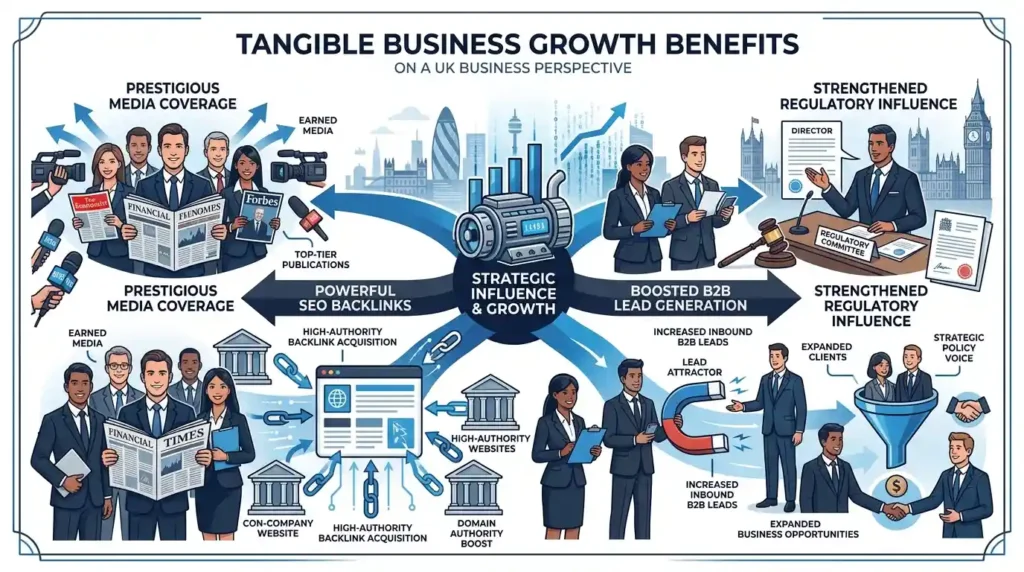
Co-authored reports generate measurable marketing and PR returns that traditional advertising campaigns fail to achieve. The association with trusted institutions shifts brand perception from vendor to industry authority.
Earned Media and PR Impact
UK national newspapers, BBC business desks, and trade publications regularly cover reports carrying university or trade body bylines.
- Example: A report co-authored with a London-based university generates features in the Financial Times and The Daily Telegraph.
- Example: Research backed by a logistics trade association secures front-page coverage in Logistics Manager magazine.
SEO and Digital Authority Gains
Media outlets and academic blogs link directly to the source report URL. These editorial backlinks from .ac.uk and authoritative industry domains significantly improve organic search engine rankings for competitive commercial keywords.
When should a UK business choose a trade association over a university for research partnerships?
A UK business should choose a trade association for commercial sector benchmarking and policy lobbying, and a university for complex econometric modeling and scientific validation.
Choosing the correct partner type depends on the primary objective of the research project. Trade associations offer immediate access to practitioner networks, while universities offer methodological depth and unassailable academic prestige.
Use Cases for Trade Association Partnerships
- Sector-wide benchmarking surveys measuring salary averages, technology adoption rates, or operational challenges.
- Policy advocacy white papers submitted directly to UK government departments.
- Member-exclusive insight reports designed to drive trade association retention and recruitment.
Use Cases for University Partnerships
- Long-term econometric forecasting and predictive market modeling.
- Scientific, technical, or clinical validation of new product claims or materials.
- Macroeconomic trend analysis requiring complex data science infrastructure and PhD-level oversight.