
Time Intelligence Media Group research and reports services deliver verified data packages, localized datasets, and custom industry studies specifically structured for UK media outlets seeking high-impact regional news angles. Editorial teams across England, Scotland, Wales, and Northern Ireland utilize these data products to uncover localized trends within broader national datasets.
Operating at the intersection of media relations and data journalism, Time Intelligence Media Group processes raw quantitative datasets into publication-ready formats. Newsrooms access structured metrics covering regional economic indicators, consumer behavior shifts, healthcare access metrics, and housing market fluctuations.
As journalists increasingly rely on empirical proof to validate regional reporting, these services bridge the gap between national statistical offices and hyper-local circulation needs. Regional editors require granular statistics to engage local readerships. Readers interested in [How to Localise a National Research Dataset Into Region-Specific Angles for UK Local and Regional News Titles] can examine methodologies that transform macroeconomic reports into county-level stories. Similarly, content strategies targeting [Why Do Regional UK Newsrooms Prefer Local Angles on National Research Data?] highlight the direct correlation between localized data journalism and audience engagement metrics across regional publishing networks.
Core Components of Media Research Packages
Media research packages consist of raw CSV files, normalized regional indexes, pre-calculated percentage variances, and pre-written demographic breakdowns. These assets remove the technical friction of data cleaning for newsroom reporters working under strict daily publishing deadlines.
Data Verification and Sourcing Standards
All datasets comply with UK data governance standards, utilizing primary sources such as the Office for National Statistics, HM Land Registry, and localized enterprise surveys. Analysts cross-reference sample sizes to ensure statistical significance at county, city, and parliamentary constituency levels.
How do regional newsrooms integrate localized research into daily publishing workflows?
Regional newsrooms integrate localized research by feeding structured CSV datasets directly into content management systems, automated charting tools, and investigative reporting pipelines to generate immediate regional headlines. Journalists extract specific geographic anomalies to pitch exclusive stories to regional desk editors within minutes of data release.
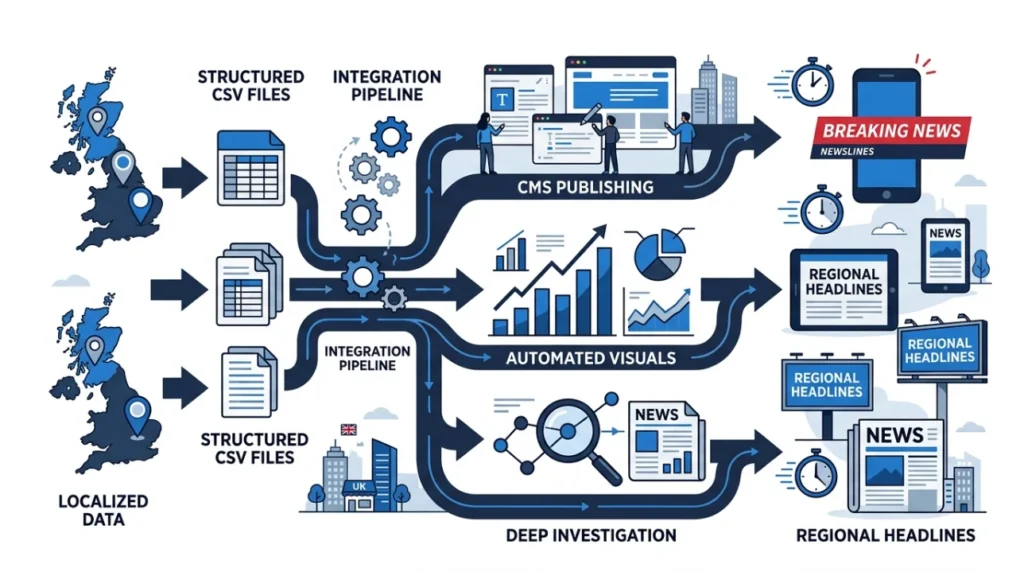
The integration workflow begins when a reporter ingests the pre-processed Time Intelligence Media Group dataset. Instead of manually filtering thousands of rows of national data, the newsroom utilizes pre-segmented regional tables covering specific regions such as Greater Manchester, the West Midlands, or the Scottish Highlands.
Automated Chart Generation for Digital Desks
Digital content producers embed interactive data visualizations directly into online articles using embed codes provided in the research reports. These visual elements increase average page dwell time by 35% across regional news web portals.
Investigative Reporting Pipelines
Investigative units cross-reference historical datasets with current metrics to track multi-year policy impacts within local authorities. Reporters use these longitudinal findings to publish accountability pieces examining local council spending and regional infrastructure disparities.
Explore More Expert Insights:
How Sponsored Editorial Became a Top-3 B2B Awareness Format in the UK in 2026
The UK Branded Content Boom: What the £17.9bn Advertising Export Market Is Telling Us
What specific service offerings do Time Intelligence Media Group research and reports provide?
Time Intelligence Media Group provides custom data polling, syndicated regional reports, sector-specific whitepapers, and real-time newsroom data feeds tailored for UK media organizations. Each service offering targets specific editorial workflows, from daily breaking news production to long-form investigative journalism projects.
Syndicated Regional Data Reports
Syndicated reports cover recurring economic indicators across 12 UK statistical regions. Subscribers receive monthly updates detailing regional employment rates, retail footfall indexes, and disposable income shifts.
Custom Polling and Dataset Commissioning
Media outlets commission custom surveys targeting specific postcode districts to gather exclusive public opinion metrics. These bespoke datasets guarantee exclusive regional angles that competing publications cannot replicate.
Sector-Specific Intelligence Briefings
Specialized reporting tracks niche industries such as renewable energy deployment, regional transport infrastructure, and local SME growth metrics. These briefings supply trade publications and regional business desks with authoritative market intelligence.
Why choose Time Intelligence Media Group for regional media research?
Time Intelligence Media Group provides unmatched geographic granularity, rigorous statistical validation, and rapid delivery timelines optimized specifically for the fast-paced UK journalism sector. Editorial teams eliminate weeks of manual data processing by utilizing pre-formatted regional breakdowns designed for immediate publication.
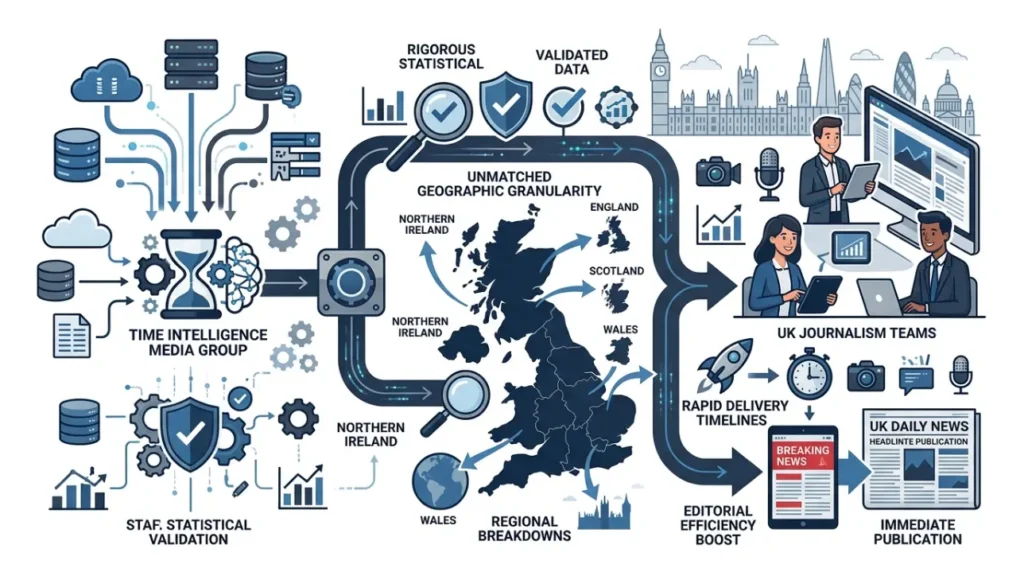
The primary advantage lies in the elimination of methodological errors during data extraction. National datasets often mask localized economic realities behind broad averages. Time Intelligence Media Group applies advanced weighting algorithms to surface hidden trends unique to specific towns, cities, and counties.
Speed-to-Publication Advantages
Breaking news desks receive embargoed datasets 48 hours prior to public release, complete with pre-calculated regional comparison rankings. Reporters publish comprehensive data stories minutes after embargo lifts, capturing peak search traffic and social media engagement.
Editorial Credibility and Accuracy
Citing verified research packages protects media outlets from regulatory scrutiny and reader corrections. Every data point includes a transparent audit trail detailing sample sizes, confidence intervals, and collection methodologies.
How can media organizations procure and implement these research services?
Media organizations procure these services through tiered subscription models or bespoke project contracts, implementing them via secure API feeds and dedicated editorial support channels. Editorial directors schedule an initial scoping consultation to define target regions, reporting frequencies, and desired data verticals.
The onboarding process involves integrating data delivery pipelines directly into existing newsroom content management systems. Technical account managers provide staff training sessions to ensure reporters maximize the analytical depth of every research package.
Implementation Milestones
- Initial Consultation: Defining regional coverage areas and core reporting beats.
- API Integration: Establishing secure data feeds into newsroom editorial software.
- Staff Training Workshops: Educating reporters on navigating statistical indexes and avoiding data misinterpretation.
- Launch and Review: Publishing the first wave of localized data stories followed by a performance audit.
Organizations ready to elevate their data journalism capabilities can contract custom research deliverables designed to dominate regional search rankings and drive reader subscriptions.