Time Intelligence Media Group research and reports services provide verified data analysis and predictive economic modeling for United Kingdom industries, supplying corporate executives and media organizations with empirical market trajectories, quantitative metrics, and comprehensive sectoral evaluations.
Sector forecast reports function as structured analytical documents that project future industry conditions based on historical performance indicators. Time Intelligence Media Group produces these comprehensive studies by synthesizing macroeconomic datasets, regulatory policy changes, and consumer behavior metrics across multiple commercial verticals within the United Kingdom market.
Organizations utilize these reports to establish strategic baselines, allocate capital budgets, and navigate regulatory shifts. Unlike generic market summaries, these professional research services apply rigorous econometric models to isolate verifiable market signals from transient economic noise.
Core Methodologies in Market Research
Quantitative forecasting relies on established statistical techniques, including regression analysis, time-series modeling, and econometric simulation. Analysts examine multi-year performance indicators from verified registries, such as the Office for National Statistics, to establish dependable growth baselines.
Readers evaluating foundational analytical methodologies can review [How to Build a Sector Forecast Report That Separates Evidence-Based Projections From Opinion] to understand the underlying mechanics of data validation.
How does Time Intelligence Media Group execute sector forecast research processes?
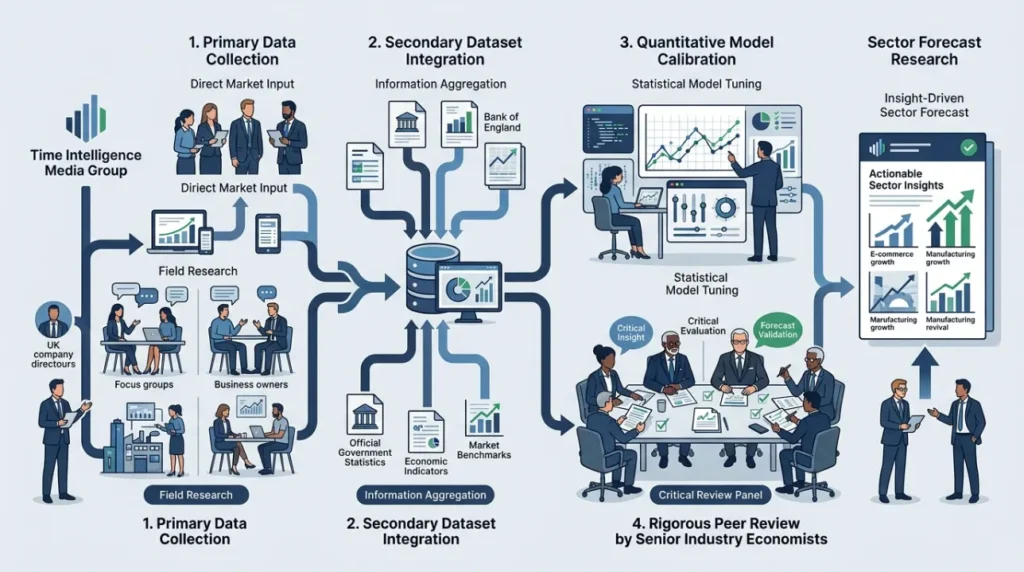
Time Intelligence Media Group executes sector forecast research through a multi-stage methodology involving primary data collection, secondary dataset integration, quantitative model calibration, and rigorous peer review by senior industry economists.
The research workflow begins with systematic scope definition and objective establishment for specific United Kingdom commercial sectors, including financial technology, renewable energy, and digital media. Analysts collect raw inputs from proprietary databases, regulatory filings, and structured enterprise surveys.
Primary data collection involves conducting blinded interviews with senior executives across FTSE 350 companies. Secondary data collection integrates standardized macroeconomic feeds from institutions like the Bank of England.
Data Validation and Cleaning Protocols
Raw inputs undergo rigorous cleaning to eliminate anomalies, reporting errors, and seasonal distortions before entering predictive models. Analysts apply cross-sectional verification methods to ensure data integrity across disparate reporting standards.
Organizations seeking deeper operational insights into press dissemination can examine [Why Do UK Media Outlets Cover Sector Forecast and Predictions Reports?] to understand how validated data translates into public visibility.
What core components comprise Time Intelligence Media Group sector forecast reports?
Time Intelligence Media Group sector forecast reports comprise executive summaries, macroeconomic baseline analyses, quantitative growth projections, risk matrix assessments, and empirical data appendices tailored for commercial decision-makers.
Every published report follows a standardized structural format designed for maximum clarity and immediate executive comprehension. The executive summary encapsulates core findings, projecting compound annual growth rates across five-year horizons for specific vertical markets.
The macroeconomic baseline details how fiscal policies, interest rate fluctuations, and trade agreements impact sector-specific operational costs within the United Kingdom.
Quantitative Projections and Scenario Modeling
Predictive sections utilize probabilistic modeling to present baseline, optimistic, and pessimistic economic scenarios. For example, reports on the United Kingdom renewable energy sector model three distinct regulatory trajectories, calculating exact capital expenditure requirements and projected gigawatt output targets for 2030.
What specific benefits do organizations gain from utilizing these research services?
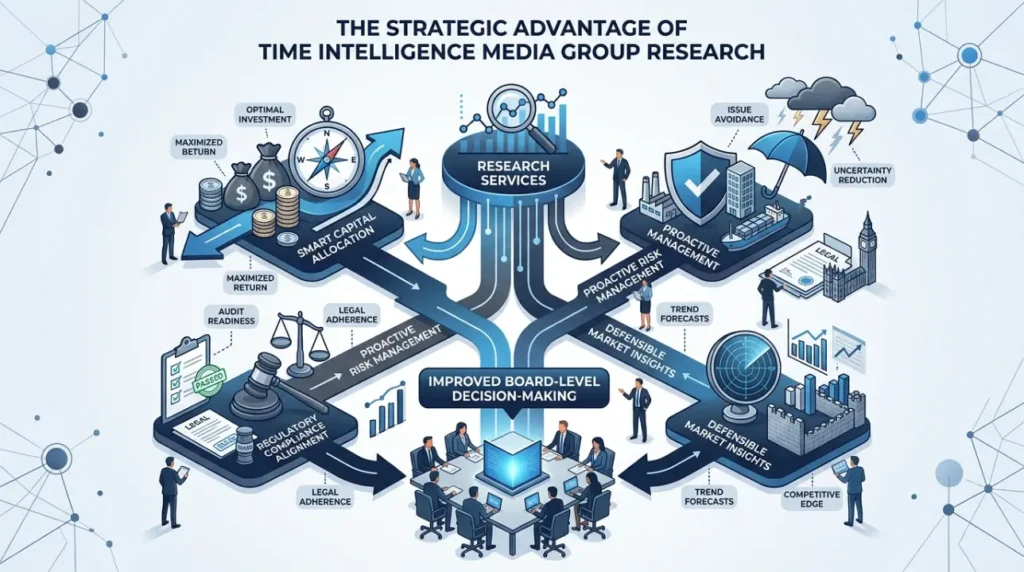
Organizations utilizing Time Intelligence Media Group research services gain enhanced capital allocation accuracy, risk mitigation capabilities, regulatory compliance alignment, and defensible market intelligence for board-level decision-making.
Access to verified sectoral intelligence eliminates reliance on speculative market commentary, reducing the financial risks associated with strategic expansion projects. Corporate boards leverage these findings to justify capital expenditures to institutional investors and shareholders.
Furthermore, detailed regulatory impact analyses allow compliance officers to anticipate legislative adjustments before implementation dates occur within the United Kingdom jurisdiction.
Strategic Planning and Risk Mitigation
Risk matrices identify specific operational vulnerabilities, such as supply chain bottlenecks in manufacturing or talent shortages in technology sectors. Mitigation strategies are paired with quantitative impact scores, enabling risk managers to prioritize resource deployment efficiently.
For advanced strategic alignment, enterprises often integrate insights from [Time Intelligence Media Group Research and Reports Services for Sector Forecast Reports] to optimize their long-term corporate planning frameworks.
How do industry stakeholders apply Time Intelligence Media Group reports in real-world use cases?
Industry stakeholders apply Time Intelligence Media Group reports across corporate mergers and acquisitions due diligence, investor relations disclosures, media advocacy campaigns, and government policy submissions.
Corporate development teams deploy these reports during mergers and acquisitions to validate target valuation models and assess long-term sector viability. Investment banks reference the quantitative appendices within regulatory prospectuses to support capital raising activities on the London Stock Exchange.
Media enterprises utilize the underlying datasets to author authoritative industry features and broadcast economic analyses.
Government Policy and Regulatory Submissions
Trade associations utilize forecast data to draft evidence-based policy submissions for government consultations. By presenting empirical projections regarding employment figures and tax contributions, industry bodies effectively communicate sector requirements to parliamentary committees.
Organizations ready to engage these specialized analytical services can contract Time Intelligence Media Group directly to commission custom sector forecast reports tailored to specific corporate objectives.