
A sector forecast and predictions report is a formal data publication released by industry bodies, research agencies, or financial institutions that models future commercial trends, employment figures, and market valuation metrics across specific British economic domains over a defined multi-year timeline.
UK media outlets operate under strict regulatory requirements to maintain impartiality, accuracy, and public interest value, particularly when reporting on national financial stability. Publications such as the Financial Times, BBC News, and The Telegraph process hundreds of macroeconomic filings daily. Within this workflow, sector forecast and predictions reports serve as verified foundational data sources that validate breaking financial news and provide quantitative backing for structural industry changes.
Media organizations utilize these structured forecasts to transform raw statistical modeling into accessible public intelligence. Editorial teams extract core analytical findings to answer pressing consumer, corporate, and governmental questions regarding employment security, supply chain resilience, and regional investment flows. By anchoring journalistic narratives in verified predictive data, news outlets maintain editorial credibility while satisfying the information demands of corporate decision-makers and everyday citizens across England, Scotland, Wales, and Northern Ireland.
Why do British journalists prioritize industry projection reports for daily news cycles?
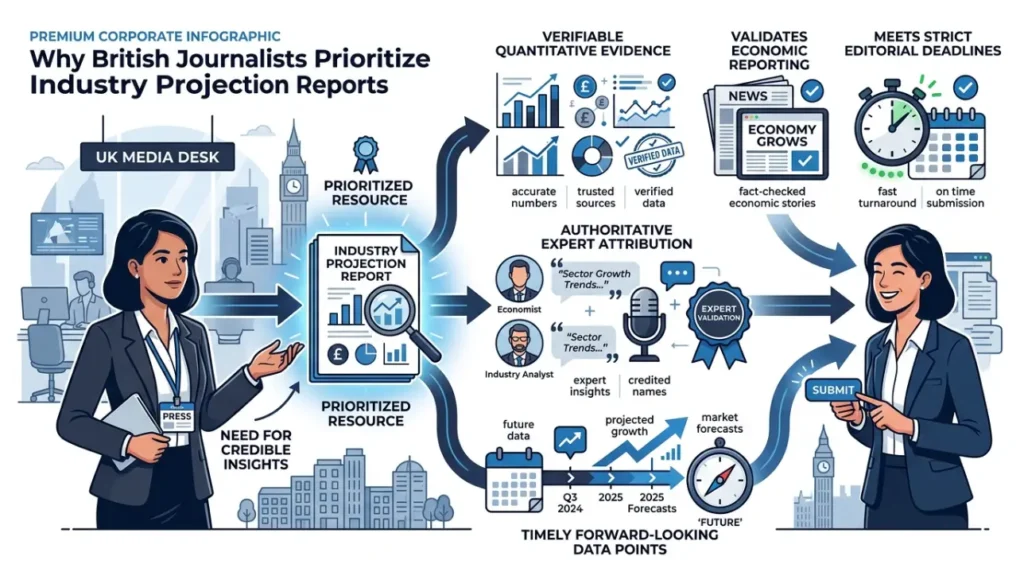
British journalists prioritize industry projection reports because these documents supply verifiable quantitative evidence, authoritative expert attribution, and timely forward-looking data points that validate economic reporting and meet strict editorial deadlines.
The Need for Objective Economic Validation
Journalists covering the British economy require immutable proof points to support claims about market expansion or contraction. Sector forecast reports supply regression analyses, historical benchmark comparisons, and econometric modeling metrics that withstand scrutiny from regulators and competing media houses. When a publication reports on automotive manufacturing shifts or fintech investment trajectories, referencing an established predictive report eliminates speculation and builds audience trust.
Meeting Rapid Editorial Deadlines
Newsrooms operate under intense time constraints to publish breaking economic updates before competitors. Research reports arrive pre-packaged with executive summaries, data tables, and pre-vetted expert commentary from chief economists. Reporters extract these structured components directly into news articles, significantly reducing the turnaround time required to produce comprehensive, data-rich financial stories.
Audience Demand for Actionable Financial Intelligence
Readers of UK financial and trade media actively seek forward-looking insights to inform personal career planning, business investments, and operational budgeting. Editorial boards track readership metrics showing high engagement with predictive market analysis. Consequently, editors assign dedicated resources to cover newly published forecasts from recognized institutions like the Office for National Statistics or major chartered trade institutes.
How do media outlets select which prediction reports to publish and cover?
Media outlets select prediction reports by evaluating the methodological rigor of the research, the institutional credibility of the publishing body, the novelty of the projected data, and the direct relevance of the findings to the domestic British economy.
Institutional Credibility and Governance
Editorial teams screen reports based on the governance standards and historical accuracy of the publishing organization. Publications prioritize data originating from government agencies, chartered professional bodies, tier-one audit firms, and established economic consultancies. Reports lacking transparent data collection methodologies or independent peer review face immediate rejection by senior news editors.
Domestic Relevance and Geographic Scope
British media prioritizes reports that contain granular data concerning UK-specific markets, regional employment hubs, or devolved administration economies. A global technology forecast holds minimal value for a regional UK readership unless the publication explicitly isolates the impact on British tech hubs such as London, Manchester, or Edinburgh. Editors favor reports featuring currency figures denominated in British Pounds and metrics aligned with UK regulatory frameworks.
Statistical Novelty and Divergent Findings
Journalists look for reports that present unexpected statistical shifts, counter-intuitive market trends, or newly emerging economic sectors. When a projection report contradicts established consensus—such as forecasting unexpected growth in traditional retail employment—it generates high news value. Outlets cover these reports to spark industry debate and challenge prevailing economic assumptions.
Explore More Expert Insights:
How Online Retailers Recover Abandoned Carts Using Banner Advertising
How E-commerce Stores Boost Sales Using Retargeting Banner Ads
What are the primary structural components of a forecast report that attract media attention?
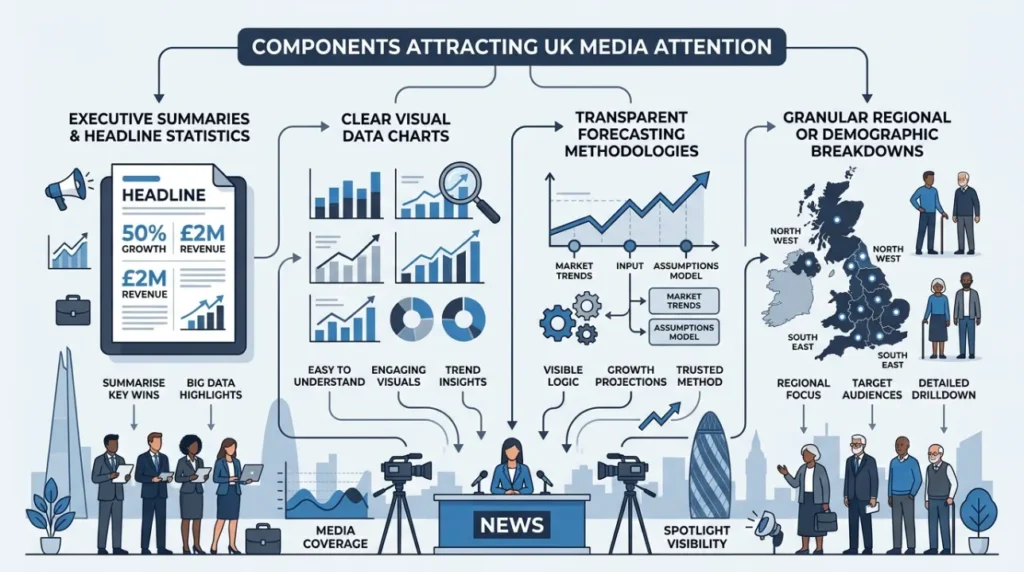
The primary structural components that attract media attention include executive summaries with headline statistics, clear visual data charts, transparent forecasting methodologies, and granular regional or demographic breakdowns.
Executive Summaries and Headline Metrics
Editors read executive summaries first to assess the newsworthiness of a report. Effective reports place headline metrics—such as projected compound annual growth rates or total market valuation figures—directly at the beginning of the document. Journalists extract these specific figures to construct compelling article headlines and lead paragraphs.
Transparent Methodological Documentation
Media organizations scrutinize the underlying assumptions of any predictive model. Reports that dedicate distinct appendix sections to explaining econometric models, sample sizes, survey parameters, and confidence intervals gain higher editorial preference. Transparency protects media outlets from publishing flawed projections that could damage their journalistic reputation.
Granular Regional and Sectoral Breakdowns
General macroeconomic summaries rarely satisfy specialist trade journalists. Reports that segment data by specific sub-sectors—such as separating renewable energy generation from traditional oil and gas—provide the detailed context required for vertical industry publications. Furthermore, breakdowns mapping data across English regions, Scottish council areas, Welsh unitary authorities, and Northern Ireland counties attract coverage from regional news bureaus.
How does media coverage of sector forecasts impact business strategy and public policy in the UK?
Media coverage of sector forecasts influences business strategy and public policy by accelerating market awareness, shaping corporate capital allocation decisions, and pressuring government bodies to adjust regulatory or fiscal interventions.
Influencing Corporate Capital Allocation
Corporate executives across the United Kingdom monitor media summaries of sector forecasts to guide multi-million-pound investment decisions. When a widely reported forecast predicts rapid expansion in artificial intelligence infrastructure, corporate boards reallocate research budgets accordingly. Media amplification ensures that predictive data reaches decision-makers simultaneously across disparate commercial sectors.
Shaping Legislative and Regulatory Responses
Government ministers and civil servants use media coverage of industry reports to gauge economic sentiment and identify emerging structural vulnerabilities. If multiple media outlets highlight a forecast predicting severe labor shortages in the National Health Service or the construction sector, parliamentary committees initiate inquiries. This media pressure frequently translates into targeted state funding, revised immigration policies, or updated vocational training grants.
Sector forecast and predictions reports serve as foundational pillars of modern British journalism. By supplying verifiable data, rigorous methodologies, and actionable forward-looking intelligence, these publications enable UK media outlets to deliver accurate, high-impact economic reporting. Understanding the mechanics behind this media coverage empowers organizations to produce research that effectively informs public debate, guides corporate strategy, and shapes national policy.