
Time Intelligence Media Group research and reports services including interactive data tools provide United Kingdom enterprises with proprietary market intelligence platforms, custom data pipelines, dynamic data visualisations, and comprehensive industry analyses designed to drive commercial decision-making and operational strategy.
What are Time Intelligence Media Group research and reports services including interactive data tools?
Time Intelligence Media Group research and reports services including interactive data tools deliver structured United Kingdom market datasets, quantitative industry reports, filterable data dashboards, and algorithmic forecasting models that transform complex economic metrics into actionable intelligence for enterprise stakeholders.
Core Service Components
Time Intelligence Media Group research and reports services including interactive data tools encompass a dual-layer delivery framework. The first layer consists of deep-dive written intelligence reports covering market sizing, regulatory shifts, and competitive landscapes across United Kingdom commercial sectors. The second layer integrates software-driven components, such as custom data calculators, filterable charts, and Application Programming Interfaces.
Enterprise Data Delivery
Enterprise clients receive access to secure web portals hosting live datasets updated on daily, weekly, or quarterly cycles. These repositories replace static Portable Document Format files with queryable databases. Analysts and executives extract specific data subsets matching exact operational parameters without manual data processing.
How do these services operate within the United Kingdom market?
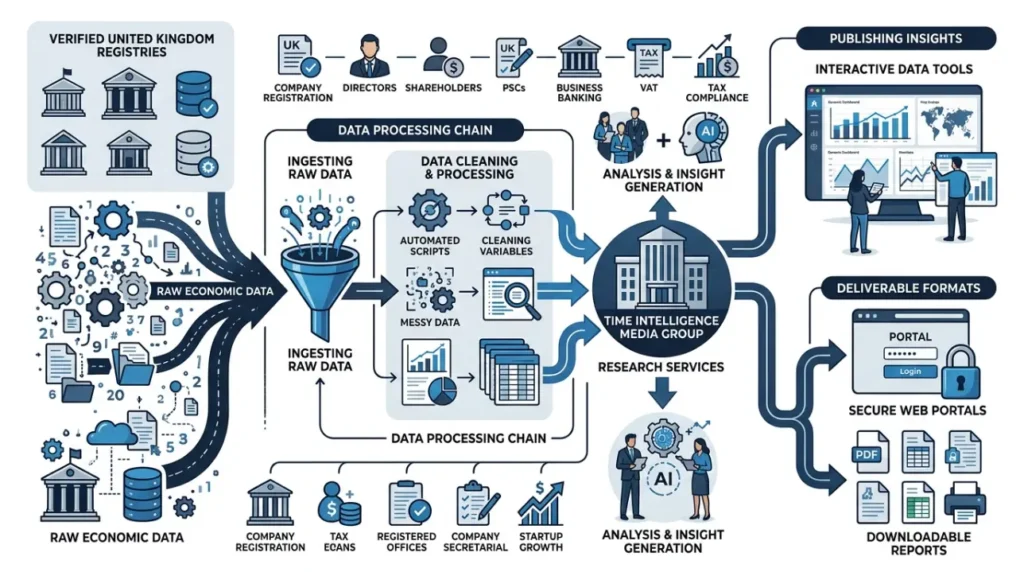
Time Intelligence Media Group research and reports services including interactive data tools operate by ingesting raw economic data from verified United Kingdom registries, cleaning variables through automated scripts, and publishing insights through secure web portals and downloadable formats.
Data Ingestion and Validation
The operational workflow begins with automated data collection from primary sources, including Companies House filings, Office for National Statistics releases, and proprietary survey panels. Data engineers apply validation algorithms to remove anomalies and normalise metrics across different industrial classifications. Analysts then interpret the cleaned data to construct baseline economic models.
Interactive Deployment
Once validated, datasets integrate directly into client-facing web applications. Users interact with the data through custom user interfaces built with modern web frameworks. Organizations looking to understand the developmental phase of these assets can review [Insert Link to MOFU Article]. For those evaluating final commercial implementation, examining [Insert Link to BOFU Article] provides additional operational clarity.
Explore More Expert Insights:
How Sponsored Editorial Became a Top-3 B2B Awareness Format in the UK in 2026
The UK Branded Content Boom: What the £17.9bn Advertising Export Market Is Telling Us
What specific features are included in these research packages?
Time Intelligence Media Group research and reports services including interactive data tools feature dynamic financial calculators, multi-variable filterable charts, downloadable comma-separated values data exports, and dedicated API endpoints for automated enterprise system integration.
Financial Calculators and Simulators
Interactive calculators allow users to input proprietary company metrics, such as employee headcount, regional footprint, and revenue targets. The tool processes these inputs against benchmark industry datasets to generate bespoke growth projections and risk assessments. For example, a logistics firm calculates fuel cost sensitivities across ten United Kingdom regions instantly.
Filterable Data Dashboards
Filterable charts enable users to isolate specific variables within large market datasets by applying parameters like date ranges, geographic regions, and company sizes. A manufacturing executive filters a sector report to display only mid-sized automotive suppliers in the West Midlands region. The interface updates visualisations in real time, eliminating manual spreadsheet filtering.
What are the commercial benefits for United Kingdom enterprises?
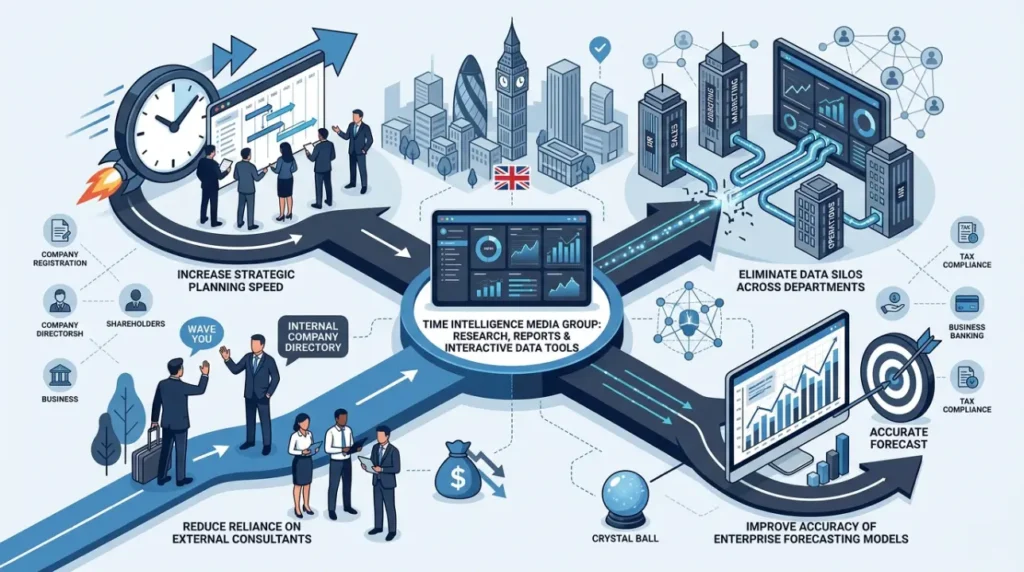
Time Intelligence Media Group research and reports services including interactive data tools increase strategic planning speed, eliminate data silos across departments, reduce reliance on external consultants, and improve the accuracy of enterprise forecasting models.
Operational Efficiency Gains
Static PDF reports require manual extraction and reformatting before teams can use underlying data. Interactive data tools reduce this preparation time from days to seconds. Sales teams query market sizing tools directly during client pitches, while finance departments pull live benchmark figures for board presentations without leaving internal software environments.
Competitive Advantage
Access to real-time market metrics allows United Kingdom firms to identify emerging sector trends before competitors relying on annual static publications. Companies adjust pricing models, supply chain allocations, and marketing campaigns based on live interactive data feeds rather than outdated historical estimates.
How can organizations procure and implement these services?
Time Intelligence Media Group research and reports services including interactive data tools are procured through tiered enterprise subscription models, custom project contracts, and dedicated software integration agreements tailored to specific corporate requirements.
Subscription and Procurement Tiers
Organizations select from standard intelligence tiers or commission bespoke research projects. Standard tiers provide access to pre-built sector dashboards and quarterly published reports. Bespoke contracts commission custom data pipelines, proprietary market surveys, and dedicated interactive tool development tailored to niche industrial sectors.
Implementation and Support
Deployment involves onboarding enterprise users, establishing secure authentication protocols, and configuring custom API endpoints for internal software integration. Technical account managers provide ongoing support, ensuring data streams remain uninterrupted and aligned with evolving United Kingdom regulatory standards.