
A white paper is an authoritative document designed to persuade readers using structured evidence and problem-solving frameworks. An industry research report is an empirical analysis that presents raw data, benchmark findings, and market statistics without driving a specific commercial conclusion.
Defining the White Paper
A white paper functions as an educational and persuasive asset. Organizations publish white papers to establish thought leadership, address complex business challenges, and present proprietary methodologies.
A white paper typically ranges from 6 to 12 pages. The format combines analytical reasoning with strategic recommendations. Authors structure white papers to guide decision-makers through a specific problem space toward a logical solution.
Defining the Industry Research Report
An industry research report serves as a benchmark study. Market research firms, academic institutions, and trade associations compile these reports to record state-of-the-industry metrics.
Research reports vary in length from 15 to 100 pages depending on sample sizes and data variables. The narrative structure remains neutral. The primary objective is objective measurement rather than strategic persuasion.
| Feature | White Paper | Industry Research Report |
| Primary Intent | Persuade and educate on a problem | Benchmark and report empirical data |
| Typical Length | 6 to 12 pages | 15 to 100+ pages |
| Tone | Authoritative, persuasive, solution-oriented | Neutral, descriptive, objective |
| Primary Data Source | Expert synthesis, secondary research | Primary surveys, large-scale data sets |
| Target Audience | Executive decision-makers, buyers | Researchers, analysts, media, strategists |
How Does the Creation Process Vary Between White Papers and Reports?
White paper production centers on argument architecture, expert commentary, and solution positioning. Industry research report creation relies on methodology design, quantitative survey distribution, data verification, and statistical analysis to ensure statistical significance across target populations.
The White Paper Development Process
The creation of a white paper begins with topic definition and thesis formulation. Teams establish the specific operational, financial, or technical challenge the document will address.
- Thesis Construction: Writers and subject matter experts establish the core argument and supporting premises.
- Information Gathering: Researchers aggregate primary expert interviews, academic studies, and relevant regulatory frameworks.
- Drafting and Synthesis: Synthesizers build a narrative progression from problem identification to resolution.
- Design and Layout: Designers apply visual hierarchy, callout boxes, and diagrammatic figures to emphasize key points.
The Research Report Methodology
The production of an industry research report requires a strict scientific process to maintain data integrity.
- Sampling Frame Definition: Researchers define target demographics, geographical boundaries, and minimum sample thresholds (e.g., 500 UK IT directors).
- Instrument Design: Data scientists draft survey questionnaires using single-select, multi-select, and Likert-scale fields.
- Data Collection and Cleaning: Analysts deploy surveys, purge incomplete responses, and weight sample populations to eliminate bias.
- Data Aggregation: Statistical software processes raw datasets to output cross-tabulations, medians, and confidence intervals.
What Key Structural Components Distinguish a White Paper From a Research Report?
White papers feature executive summaries, problem breakdowns, methodology explanations, and prescriptive solution frameworks. Research reports contain methodology declarations, statistical chart series, survey demographic profiles, data appendices, and unweighted analytical summaries.

Core Structural Elements of a White Paper
A white paper uses a narrative hierarchy designed to maintain focus on a specific problem statement.
- Executive Summary: A concise 250-word synthesis detailing the industry challenge, key insights, and recommended strategic actions.
- Problem Statement: A detailed examination of market inefficiencies, cost vectors, or technical bottlenecks impacting organizations.
- The Solution Framework: An objective analysis of how modern strategies or technological paradigms resolve the identified problem.
- Strategic Implications: Clear operational guidance explaining how readers implement the proposed resolution model.
Structural Framework of an Industry Research Report
An industry research report follows standard academic and statistical reporting conventions to support data transparency.
- Methodology and Sample Demographics: Detailed documentation of sample sizes, response rates, collection dates, and margin-of-error calculations.
- Data Visualization Modules: Consecutive charts, bar graphs, and cross-tabulation tables displaying response distributions across sub-demographics.
- Key Findings Digest: Bulleted summaries detailing specific statistical distributions, YoY trends, and baseline metrics.
- Comprehensive Appendix: Raw data tables, complete survey questionnaires, and statistical verification codes for external verification.
- Explore More Expert Insights:
- How Financial Services Build Trust Using Educational Banner Advertising
- How Agencies Increase Buyer Engagement Using Display Remarketing Ads
What Are the Primary Business Benefits of Publishing White Papers Versus Reports?
White papers generate qualified leads, establish subject-matter authority, and support complex B2B buying decisions. Industry research reports earn high-volume press coverage, generate authoritative backlinks, build statistical equity, and establish brand neutrality.
Strategic Benefits of White Papers
White papers perform specific functions within organizational communication strategies.
- Deep Educational Engagement: Readers spend 5 to 10 minutes analyzing a structured white paper, building high contextual comprehension.
- Executive Decision Support: Senior managers use white papers to build internal business cases for operational changes.
- Thought Leadership Validation: Publishing clear solutions to complex industry problems positions an organization as an expert authority.
Strategic Benefits of Research Reports
Industry research reports provide broad utility across public relations and market analysis ecosystems.
- Media Citation Acquisition: Journalists require empirical statistics to cite in news coverage, driving organic citations.
- High-Authority Backlink Generation: Third-party websites link to original research reports as foundational references.
- Market Benchmarking Authority: Organizations that publish annual research reports become the definitive source for sector data.
When Should an Organization Use a White Paper Instead of a Research Report?
Organizations should publish white papers when introducing new concepts, framing market problems, or explaining complex technical architectures. Organizations should publish research reports when establishing baseline market statistics, capturing broad industry trends, or generating widespread media coverage.
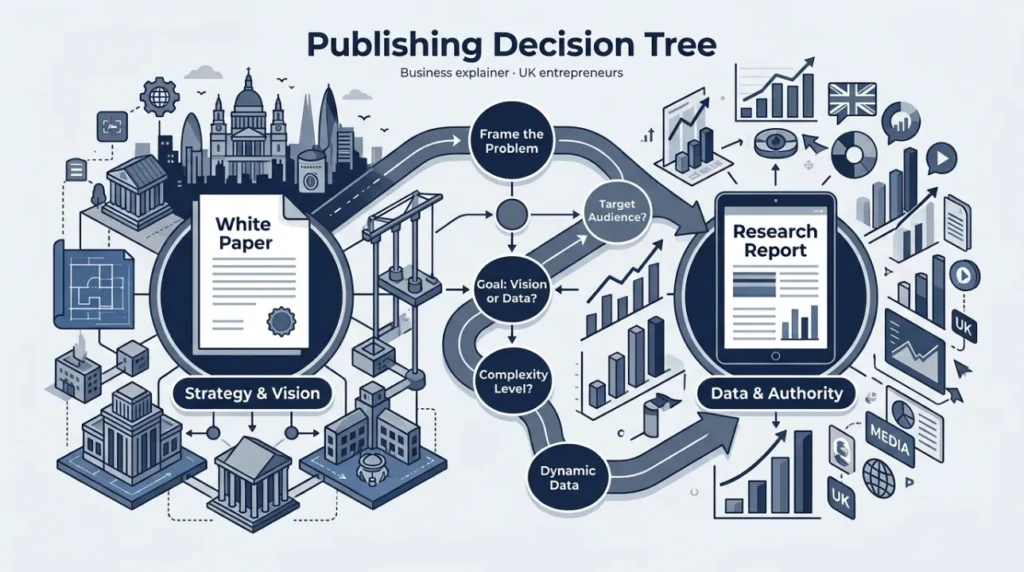
Primary White Paper Use Cases
White papers work best when audiences require logical explanations and strategic guidance rather than raw data collection.
- Introducing Complex Frameworks: Explaining how new regulations, such as the UK Digital Services Act or updated ISO standards, alter operational requirements.
- Technical Product Architecture Explanations: Demonstrating how cloud-native microservices improve uptime compared to legacy monolithic systems.
- Evaluating Strategic Alternatives: Providing a structural analysis comparing remote workforce models against hybrid operational models.
For organizations evaluating media distribution formats, understanding whether a white paper vs report best aligns with editorial guidelines is an essential next step.
Primary Industry Research Report Use Cases
Research reports are the correct asset choice when the objective is documenting market state rather than proposing a single strategic path.
- Annual Sector Benchmarking: Documenting cybersecurity incident frequencies across 1,000 UK enterprise organizations over a 12-month period.
- Consumer Behavior Tracking: Measuring shifting purchasing habits across specific generational cohorts using national survey sampling.
- Economic Impact Assessment: Mapping total capital expenditures within the renewable energy sector across specific geographical regions.
To review fully managed creation and distribution options for these editorial formats, view specialized solutions for white papers and reports.
Summary of Differences
Choosing between a white paper and an industry research report depends on the core objective of the content asset.
When the goal is explaining a complex problem and guiding decision-makers toward a structured resolution, a white paper provides the appropriate analytical framework. When the goal is measuring industry behaviors, gathering primary survey data, and offering neutral statistical baselines for broad citation, an industry research report is the correct format. Aligning the document structure with the underlying data model ensures maximum clarity, audience utility, and information authority.