
A white paper presents an argumentative analysis of a specific problem, offering a clear strategy or solution. An industry report delivers empirical data, market metrics, and factual benchmarks without advocating for a specific commercial strategy or brand perspective.
Defining White Papers and Reports
A white paper acts as a persuasive tool that frames a commercial, technical, or industry issue and presents a structured resolution. Organisations issue white papers to influence market perception, establish domain authority, and educate decision-makers. White papers draw on primary research, technical specifications, and expert opinion to justify a specific strategic methodology.
An industry report serves as an objective dataset. Reports compile market statistics, survey results, and multi-year trend analysis. Journalists and enterprise leaders use reports as primary reference material to understand current market conditions.
Key Format Differences
Understanding structural differences helps media teams match content with target publications:
- Objective: White papers advocate a solution; industry reports benchmark market realities.
- Data Density: White papers use data selectively to back arguments; industry reports focus entirely on high-volume statistics.
- Tone: White papers use an authoritative tone; reports maintain a neutral voice.
- Length: White papers average 10 to 15 pages; reports range from 20 to 80 pages.
For foundational definitions, review our detailed guide on How White Papers Differ From Industry Research Reports.
Why Do UK Journalists Prefer Specific Information Formats?
UK journalists select formats based on immediate editorial value, narrative independence, and data credibility. National news outlets request raw survey statistics and industry reports, while vertical B2B trade publications prefer technical white papers with explicit strategic frameworks.
The Editorial Requirements of UK Media
UK media outlets operate on rapid news cycles and require immediate factual verification. National newspapers like The Financial Times, The Telegraph, and The Guardian demand exclusive market statistics. They reject promotional collateral disguised as research. Reporters prioritize reports that contain sample sizes exceeding 1,000 UK-based respondents.
B2B trade press—such as Computer Weekly, Health Service Journal, or Retail Week—evaluate pitches differently. Editors in these sectors require technical depth and expert commentary. They accept white papers if the analysis resolves an industry challenge without promoting a specific proprietary tool.
Identifying Editorial Priorities
To secure press coverage, communications teams must align their content format with publication types:
- National News Desks: Select industry reports containing original survey data and economic metrics.
- Trade and B2B Outlets: Select white papers containing operational insights, regulatory guidance, and technical analysis.
- Broadcast Media (BBC, Sky News): Select short-form reports containing national statistical snapshots.
How Do You Prepare a White Paper for UK Media Distribution?
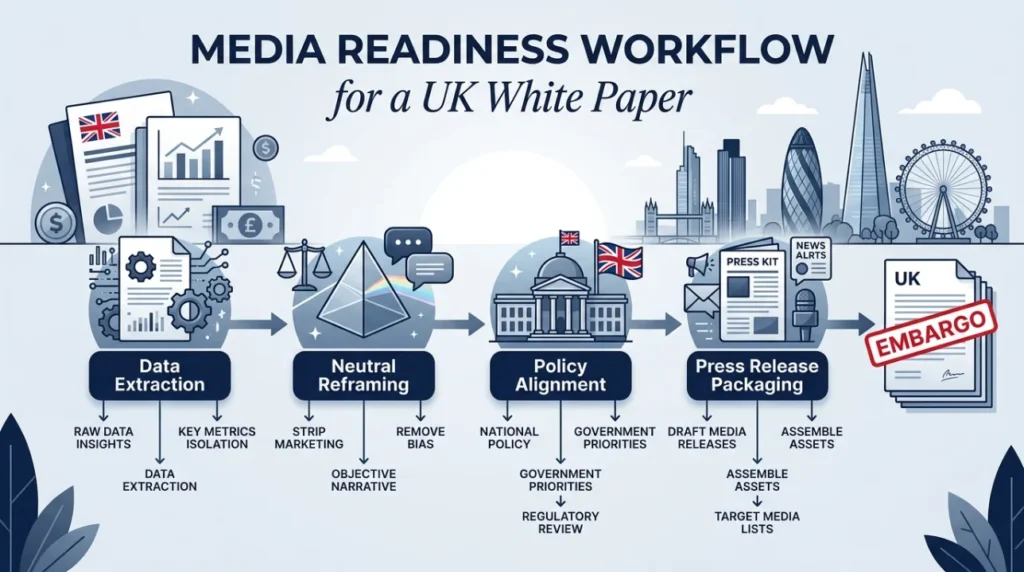
Preparing a white paper for UK media requires extracting standalone technical insights, removing direct brand marketing, framing findings around national regulatory policies, and packaging core arguments into a concise, embargoed press release accompanied by executive commentary.
Removing Commercial Bias
UK journalists reject white papers that contain sales language. Communications teams must edit the document to ensure absolute editorial neutrality. The text must define market challenges using objective terms, referencing external market regulators like the Financial Conduct Authority (FCA) or the Competition and Markets Authority (CMA) where relevant.
Packaging the Assets
Media teams must extract the core value of the white paper into a media kit:
- Executive Summary: A 500-word overview highlighting the core industry challenge and proposed framework.
- Key Findings Sheet: 5 bullet points summarising unique technical conclusions.
- Spokesperson Quotes: Statements from Chief Technology Officers or industry analysts providing context on the findings.
- Graphics: High-resolution charts detailing the primary operational models outlined in the paper.
How Do You Prepare an Industry Report to Maximum Journalist Engagement?
Preparing an industry report for UK journalists requires highlighting headline stats, structuring data into distinct regional or sectoral categories, publishing clear methodology details, and offering exclusive early access through structured embargo periods.
Structuring Data for Instant Extraction
Journalists write articles directly from report executive summaries. Media teams must structure the opening pages of an industry report to facilitate data extraction:
- Headline Metric: Place the primary statistical finding on page one (e.g., “64% of UK manufacturers faced supply chain delays in 2025”).
- Demographic Breakdown: Categorize statistics by UK regions (London, North West, Scotland) and business sizes (SMEs vs enterprise).
- Visual Data: Provide standalone high-resolution charts in JPEG or PNG formats alongside the full PDF.
Transparent Methodology
UK reporters verify data origin before writing a story. Reports must feature a dedicated methodology section outlining:
- Total sample size (minimum 1,000 respondents for national consumer press; 200 C-suite executives for B2B press).
- Data collection dates.
- Demographic, geographic, and sector profile of respondents.
- Independent research agency credentials (e.g., YouGov, Savanta, or Opinium).
- Explore More Expert Insights:
- How Investment Firms Build Awareness Using Market Insight Ads
- How Finance Brands Improve Conversion Intent Using Retargeting Ads
What Are the Essential Components of a Press-Ready Media Asset?
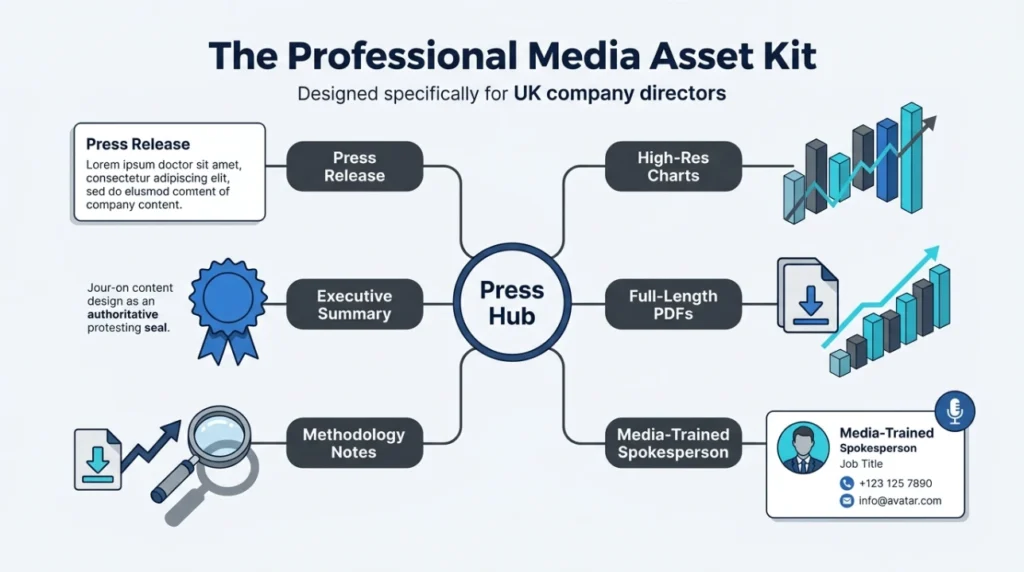
A press-ready media asset requires a factual press release, an executive summary, clear methodology notes, high-resolution visual charts, downloadable full-length PDFs, and direct contact details for designated, media-trained company spokespeople.
Core Component Breakdown
To earn coverage, communications teams must provide media assets in a modular format. Reporters do not read 40-page documents on deadline; they evaluate supporting materials first.
- The Lead Release: A 400-word news story written in inverted pyramid style. It highlights the most significant statistic or conclusion in the first sentence.
- Data Fact Sheet: A one-page document listing all raw statistical outputs organized by topic.
- Executive Commentary: Concise quotes explaining why the data matters to the UK economy or specific vertical markets.
- Media Assets Hub: A cloud-hosted folder containing high-resolution charts, author headshots, and the main PDF document.
How Does Content Choice Impact Lead Generation and PR Outcomes?
Industry reports generate higher top-of-funnel brand visibility and national PR mentions through broad media pickups. White papers generate fewer total media mentions but produce higher-quality mid-funnel B2B sales leads and inbound technical inquiries.
Balancing Public Relations and Lead Capture
PR coverage and lead generation require different media assets. Industry reports excel at building brand awareness across broad audiences. When national media outlets link to an industry report, the domain authority of the publishing brand increases significantly.
White papers support mid-funnel prospect conversion. Decision-makers download white papers to evaluate specific operational methods. While national news outlets rarely link directly to white paper download landing pages, trade publications often reference white paper insights, driving targeted B2B traffic.
For teams planning tailored distribution strategies, working with specialists in [White Papers and Reports by Time Intelligence Media Group] ensures content formats match specific media targets.
Outcomes Comparison Matrix
| Metric | Industry Report | White Paper |
| Primary PR Goal | High-volume national press coverage | Targeted trade media authority |
| Media Target | National news, broadcast, general business press | Specialist trade press, technical editors |
| Average Coverage Volume | High (15–50 online articles per campaign) | Targeted (3–10 specialist features) |
| Lead Quality | Broad top-of-funnel exposure | Qualified mid-funnel decision-makers |
| Lifespan | 3 to 6 months (tied to current data) | 12 to 24 months (thought leadership longevity) |
Which Format Should Your Organisation Choose for UK Outreach?
Select an industry report if your goal is national news coverage, brand awareness, and broad backlink acquisition through original statistical data. Select a white paper if your goal is B2B trade authority, niche audience engagement, and strategic thought leadership.
Decision Framework
Evaluate campaign objectives against audience expectations before choosing a format:
- Choose an Industry Report when:
- You possess original quantitative survey data.
- Your primary KPI is securing mentions in national outlets like The Times or BBC News.
- You want to establish a recurring annual benchmark for your industry sector.
- Choose a White Paper when:
- You are addressing a complex regulatory change (e.g., UK Procurement Act, ESG compliance).
- Your primary target audience consists of specialized enterprise decision-makers (CTOs, CFOs, Procurement Directors).
- Your goal is establishing authority within vertical trade media.
By matching format to journalist preferences, UK organisations maximize earned media performance, secure higher-quality coverage, and drive measurable commercial outcomes.