
Third-party research reports by Time Intelligence Media Group are independent, data-driven B2B publications that validate market solutions, benchmark industry trends, and establish vendor authority for United Kingdom enterprise buyers through verified empirical evidence and unbiased analytical methodologies.
Enterprise Definition and Core Purpose
Third-party research reports operate as objective validation tools within the United Kingdom enterprise technology and commercial sectors. Corporate decision-makers face budget scrutiny, risk-averse procurement policies, and long sales cycles. Time Intelligence Media Group conducts primary research, surveys verified industry executives, and compiles quantitative intelligence into branded publications. These reports remove vendor bias, enabling commercial teams to validate their value propositions with external proof.
The Role of Independent Authority in UK Procurement
UK procurement teams require verifiable evidence before shortlisting technology vendors or professional services providers. Time Intelligence Media Group acts as an impartial research authority. By gathering direct data from industry practitioners, the group transforms market observations into statistical proof points. Enterprise organizations publish these assets to position their brand as an authority, accelerate vendor evaluation stages, and lower risk perception among C-suite buyers.
Why do UK enterprise buyers require independent research before purchasing?
UK enterprise buyers require independent research to eliminate purchasing risk, satisfy internal compliance frameworks, validate financial ROI claims, and align stakeholder consensus around technology investments through objective primary data collected from verified peer organisations across target industries.
Risk Mitigation in High-Value Transactions
Enterprise technology purchases in the UK often exceed £100,000 in initial implementation costs. Decision-makers risk operational disruption and financial losses if a solution fails to deliver promised outcomes. Independent data proves whether a methodology works in real-world conditions. Buyers rely on research reports to confirm that vendor claims hold true outside sales collateral.
Navigating Strict Governance and Compliance
UK corporate governance structures demand rigorous due diligence. Procurement departments require verifiable proof of performance, security compliance, and market stability. Research reports from Time Intelligence Media Group supply the documentation needed to pass risk assessment committees. Buyers use these metrics to justify vendor selection to internal boards and executive directors.
Establishing Consensus Across Complex Buying Committees
The average B2B buying group in the United Kingdom involves 6 to 10 internal stakeholders. Information technology directors, chief financial officers, and operations heads maintain different priorities. Independent research bridges these internal gaps. Financial leaders focus on ROI metrics, while technical leaders examine operational benchmarks. A comprehensive research report satisfies both requirements through a single, authoritative document. To understand how initial trust forms during the early evaluation phase, read about UK buyer trust.
How does Time Intelligence Media Group produce research reports?
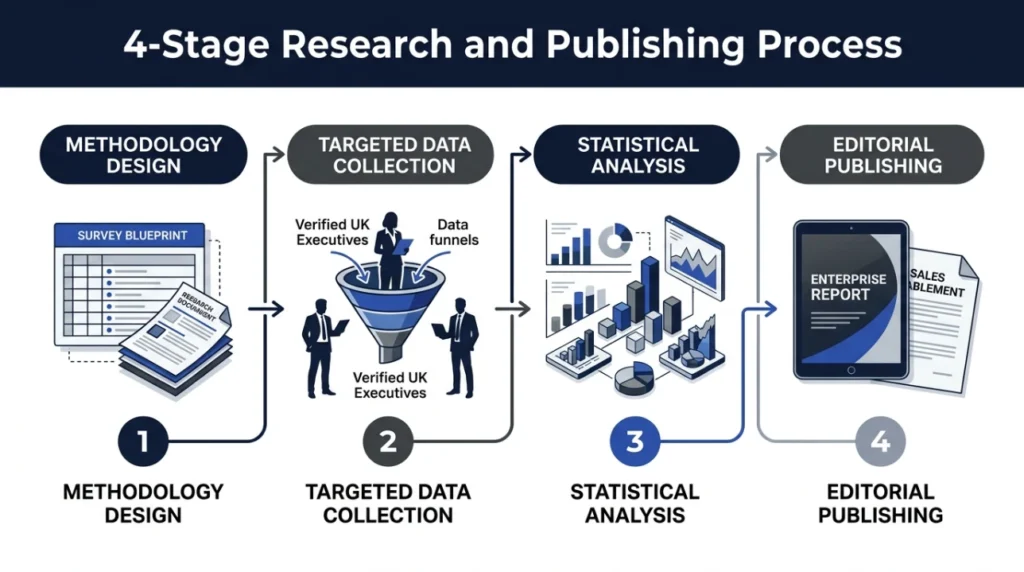
Time Intelligence Media Group produces research reports through a four-stage process comprising survey methodology design, targeted data collection from verified UK executives, quantitative statistical analysis, and editorial publishing tailored for high-stakes enterprise sales enablement campaigns.
Stage 1: Survey Design and Hypothesis Formulation
The research lifecycle begins with specific market hypotheses. Research directors at Time Intelligence Media Group collaborate with client teams to identify critical industry challenges, emerging operational shifts, and quantifiable software outcomes. The team drafts structured survey instruments using closed-ended, qualitative, and Likert-scale questions to ensure statistical validity.
Stage 2: Data Collection Across Verified Executive Panels
Data integrity depends on panel quality. Time Intelligence Media Group targets verified UK decision-makers across specific verticals, such as financial services, healthcare, retail, and manufacturing.
- Sample sizes typically range from 200 to 1,000 qualified respondents.
- Job titles include Chief Information Officers, Chief Technology Officers, Directors of Procurement, and Heads of Operations.
- Verification protocols confirm company revenue thresholds, employee counts, and geographic location before recording responses.
Stage 3: Statistical Analysis and Data Normalization
Once data collection completes, data scientists analyze raw responses using statistical software packages. The team isolates key cross-tabulations, correlations, and demographic variations. Data normalization removes outliers and unverified entries. This analytical rigor ensures that every published statistic withstands external audit and media scrutiny.
Stage 4: Editorial Synthesis and Asset Design
The final phase turns raw data into structured media assets. Content strategists write executive summaries, design detailed charts, and articulate clear market takeaways. The final deliverable includes:
- A downloadable, fully formatted PDF report for lead generation.
- An executive slide deck for client sales presentations.
- Infographics for social media amplification and public relations distribution.
What key components are included in a third-party research report?
A third-party research report includes an executive summary, methodology transparency notes, core quantitative findings, comparative industry benchmarks, detailed data visualisations, and actionable strategic recommendations designed to guide executive decision-making and procurement evaluations.
Core Structural Breakdown
| Component | Strategic Content | Buyer/Vendor Utility |
| Executive Summary | High-level synthesis of critical data points and key industry trends. | Provides C-suite readers with immediate, actionable market takeaways. |
| Methodology Statement | Full disclosure of sample sizes, respondent demographics, and dates. | Guarantees compliance, research transparency, and scientific validity. |
| Quantitative Findings | Statistical analysis presented through structured text and tables. | Delivers hard empirical data to validate corporate value propositions. |
| Visual Charts & Graphs | Custom data visualizations highlighting key operational metrics. | Offers shareable visual assets for internal slide decks and media pitches. |
| Strategic Recommendations | Actionable steps for addressing identified industry challenges. | Positions the sponsoring brand as a trusted advisor, not just a seller. |
Methodology and Sample Verification
Transparency guarantees authority. Every report published by Time Intelligence Media Group includes an explicit methodology section detailing sample sizes, survey administration dates, and margin-of-error calculations. This level of rigor prevents claims of bias and allows corporate PR teams to pitch findings directly to national media outlets and trade publications.
Data Visualizations and Graphic Assets
Visual presentation drives engagement. Complex data sets are converted into clear pie charts, bar graphs, and comparison matrices. These visuals help prospective buyers digest complex technical trends quickly. Sponsoring organizations reuse these graphics across digital marketing campaigns, sales presentations, and investor relations materials.
Explore More Expert Insights:
How Native Content on News Sites Earns 3× Longer Dwell Time Than Social Posts
How Sponsored Editorial Became a Top-3 B2B Awareness Format in the UK in 2026
What commercial benefits do brands gain from commissioning these reports?
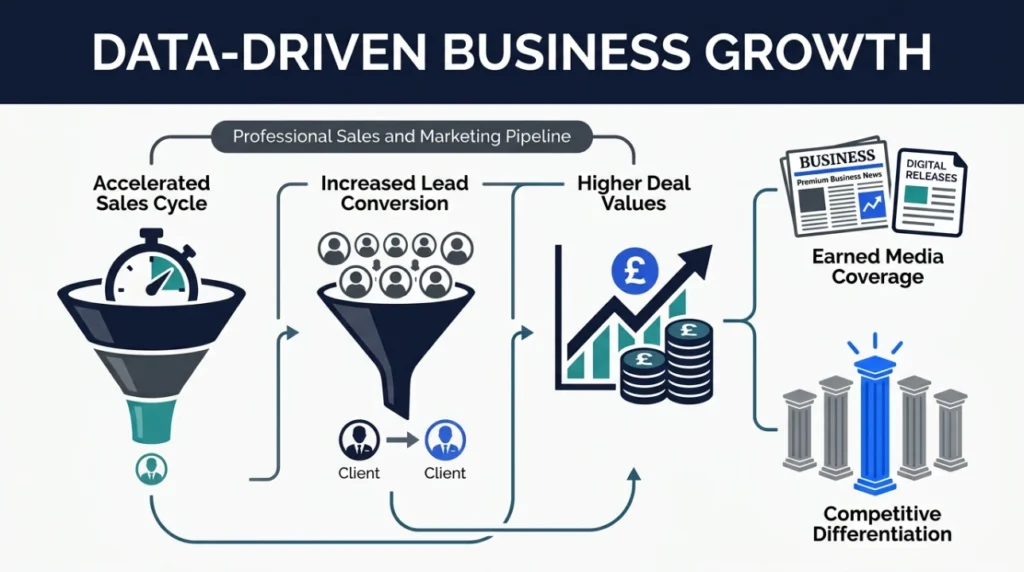
Brands gain accelerated sales cycles, increased lead generation conversion rates, higher deal values, earned media coverage, and improved competitive differentiation by leveraging custom third-party research reports by Time Intelligence Media Group across their marketing and sales pipelines.
B2B Lead Generation and High-Intent Conversions
Gated research reports serve as premium content assets. B2B buyers readily exchange contact information, job titles, and company details for high-value market intelligence.
- Gated research landing pages convert traffic at higher rates than standard product brochures.
- Inbound leads captured through research reports demonstrate higher purchase intent than generic content downloads.
- Sales teams gain immediate context regarding the prospect’s specific operational challenges based on the report topics accessed.
Accelerated Pipeline and Reduced Sales Friction
Sales reps frequently face deal stagnation during late-stage negotiations. Custom research operates as objective collateral that overcomes internal buyer hesitation. When prospects challenge product effectiveness, account managers present third-party data showing how peer organizations resolved identical challenges. This objective proof shortens procurement review periods and reduces discounting pressures.
Earned Media and Public Relations Impact
Journalists and editors at major UK publications require primary statistical data to support news stories. Research reports by Time Intelligence Media Group provide journalists with fresh stats. Sponsoring brands secure authoritative backlinks and brand mentions in trade journals without paying for traditional advertising space. To review how broader market education drives early sales activity, explore third-party research reports.
How do enterprise organizations deploy research reports across sales and marketing?
Enterprise organizations deploy research reports through multi-channel demand generation campaigns, outbound sales enablement workflows, account-based marketing programs, executive event presentations, and public relations syndication to maximize return on investment across every funnel stage.
Account-Based Marketing (ABM) Personalization
Enterprise sales teams targeting high-value UK accounts use custom research to craft personalized outreach messaging. Account executives isolate data points specific to the prospect’s industry vertical or company size.
Example: “Our recent study of 300 UK Financial Services CIOs revealed that 68% prioritize legacy system migration over the next 12 months. Here is how your peers are managing security risks during transition.”
This approach opens conversations at the executive level by framing the outreach around industry trends rather than aggressive sales pitches.
Integrated Content Syndication and Paid Media
Marketing teams amplify research reach through paid channels. They run targeted campaigns on professional networks like LinkedIn, focusing on specific job titles, geographic regions, and company size tiers.
Syndicates distribute the report across specialized media networks to capture mid-funnel leads. Automated lead scoring systems route high-scoring leads directly to sales teams based on job seniority and engagement depth.
Event Marketing and Keynote Presentations
Event organizers and corporate webinar hosts require compelling, data-backed presentations. Sponsoring executives use research report findings as the foundation for keynote speeches, panel discussions, and hosted webinars. Presenting original research establishes the company’s C-suite executives as industry thought leaders, driving post-event inbound inquiries. To review how initial market trust translates into purchasing decisions, see how brands leverage [Time Intelligence Media Group](Insert Link to BOFU Article).
How do third-party research reports compare to other B2B content formats?
Third-party research reports provide higher buyer trust, superior lead conversion rates, and longer operational shelf lives than internal whitepapers, customer case studies, product datasheets, and standard corporate blog posts.
Comparative Performance Breakdown
| Content Asset Type | Primary Purpose | Trust Score (UK Buyers) | Typical Lifespan | Primary Marketing Function |
| Third-Party Research | Objective Market Validation | High | 12 to 18 Months | Top-of-Funnel to BOFU Authority |
| In-House Whitepaper | Educational Methodology | Medium | 6 to 12 Months | Mid-Funnel Consideration |
| Customer Case Study | Peer Success Verification | Medium-High | 12 Months | Late-Stage Sales Enablement |
| Product Datasheet | Technical Specification | Low-Medium | 3 to 6 Months | Bottom-of-Funnel Evaluation |
| Corporate Blog Post | Organic Search / Awareness | Low | 1 to 3 Months | Early Top-of-Funnel Traffic |
Research Reports vs. Vendor Whitepapers
Vendor-written whitepapers suffer from inherent bias. UK buyers understand that in-house whitepapers are designed to promote specific commercial products. Third-party research reports by Time Intelligence Media Group eliminate this skepticism by publishing full research methodologies and reporting raw data neutrally.
Research Reports vs. Customer Case Studies
While customer case studies provide valuable peer reviews, they represent single-company anecdotal evidence. Buyers often dismiss case studies with the view that the customer’s environment differs from their own. Research reports aggregate responses from hundreds of organizations, offering statistically significant trends that apply across entire industrial sectors.
What is the total cost and ROI of commissioning a research report?
The total cost of commissioning a third-party research report ranges from £15,000 to £50,000 depending on panel size and scope, while ROI is realized through accelerated deal velocity, higher average contract values, and direct pipeline attribution.
Investment Factors and Scope Variables
Pricing for research reports depends on several technical variables:
- Sample Size and N-Count: Standard UK executive panels range from 200 to 1,000 respondents. Higher sample sizes increase panel recruitment costs.
- Respondent Seniority: Reaching C-suite executives at FTSE 100 enterprises requires higher recruitment incentives than surveying mid-level managers at mid-market firms.
- Asset Deliverables: Comprehensive packages include full PDF reports, executive summaries, raw data files, custom infographics, and co-branded webinar presentations.
Calculating Pipeline and Financial Return
Marketing organizations measure research report ROI through several key metrics:
- Direct Pipeline Attribution: Tracking the volume and value of closed-won deals that downloaded the report during their buyer journey.
- Sales Cycle Velocity: Comparing deal length before and after integrating research assets into outbound sales cadences.
- Media Value Equivalent: Calculating the cost of equivalent paid advertising space secured through earned media PR coverage.
A single closed enterprise software contract in the UK often offsets the entire financial investment required to produce a custom research report.
Commission Your Research Report with Time Intelligence Media Group
Third-party research reports by Time Intelligence Media Group provide the objective, data-backed authority needed to convert UK B2B buyers, shorten complex sales cycles, and expand enterprise market share.
Contact our research team today to schedule an initial consultation, define your target buyer panel, and build a custom research strategy for your organization. Secure your brand’s position as an industry authority with verified primary research.