

Sponsored interviews use a structured production and distribution process to place one approved interview across multiple relevant websites. The process combines interview creation, editorial preparation, client approval, publication coordination, and multi-site distribution.
What is a sponsored interview?
A sponsored interview is paid media content featuring a person, brand, product, or organisation in an interview format. It presents controlled messages through questions and answers while remaining clearly identified as sponsored content under applicable publication standards.
The interview format differs from a conventional advertisement. Instead of presenting only promotional copy, it creates a structured conversation around a subject.
A typical sponsored interview includes:
- Interview questions
- Expert or executive responses
- Company information
- Supporting facts
- Relevant links
- Author or spokesperson details
- Sponsored-content disclosure
For UK brands, transparency is an important part of publication. Sponsored content needs clear commercial identification so audiences understand its nature.
The content also needs factual accuracy. Claims, statistics, product descriptions, executive statements, and company information require review before publication.
How does a sponsored interview get prepared for publication?
Preparation converts a brand’s expertise and information into an interview format that is complete, accurate, readable, compliant, and suitable for distribution across multiple websites with consistent core messaging and appropriate publication disclosures.
The preparation stage starts with subject selection. The subject needs enough informational value to support a complete interview.
The interview then receives a defined angle. Examples include a fintech founder discussing payment innovation, a property director explaining market changes, or a healthcare executive discussing industry developments.
What information is collected?
The production team normally collects:
- Company background
- Interviewee name and position
- Key business facts
- Core discussion points
- Supporting statistics
- Relevant website links
- Brand descriptions
- Required disclosure information
This information creates the factual foundation for the interview.
How are interview questions developed?
Questions are structured around the selected topic. They usually move from background information to expertise, current developments, challenges, solutions, and future priorities.
For example, a UK fintech interview can begin with the company’s market position, continue with payment technology, address customer expectations, and finish with upcoming developments.
This structure creates a coherent article rather than a collection of disconnected promotional statements.
How does one sponsored interview reach 15 sites?
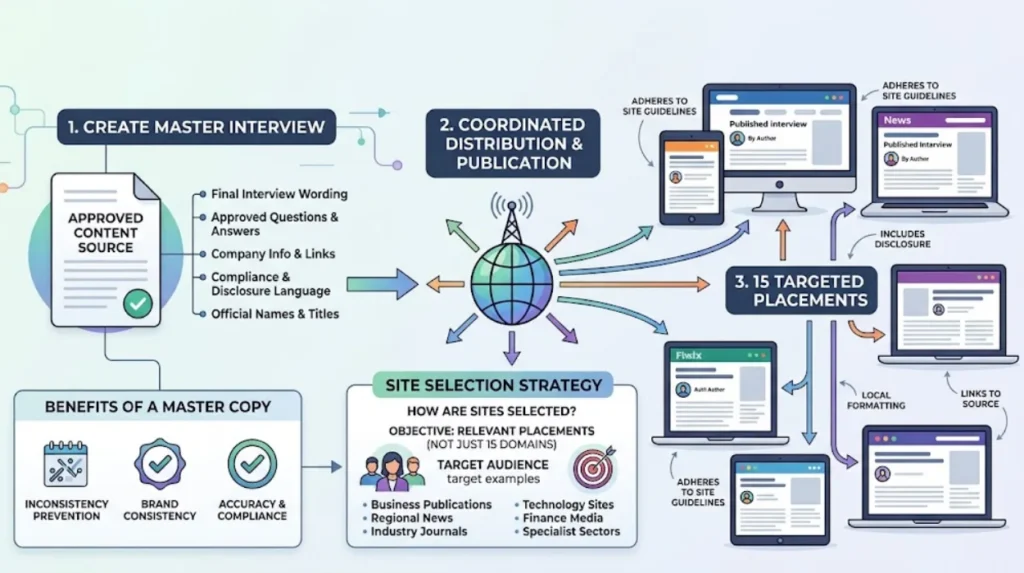
A 15-site sponsored interview campaign uses a central approved interview as the content source, followed by publication coordination across selected websites. Each placement follows the agreed content, disclosure, formatting, and publication requirements of the participating site.
The process starts with a master version. This version contains the approved interview questions, responses, company information, links, and disclosure language.
The distribution stage then coordinates publication across the selected sites.
What happens to the master interview?
The master interview acts as the controlled source document. It prevents inconsistent messaging between placements.
The approved version contains the final wording. Changes after approval require controlled review because alterations can affect accuracy, compliance, and brand messaging.
The master copy also establishes the correct spelling of names, job titles, company names, product names, and URLs.
How are the 15 sites selected?
Site selection depends on campaign objectives and audience relevance.
A distribution list can include:
- Business publications
- Regional news websites
- Industry publications
- Technology sites
- Finance publications
- Entrepreneurial media
- Specialist sector websites
For example, a UK property company benefits from relevant property and business audiences rather than unrelated general-interest websites.
The objective is therefore not simply to reach 15 domains. The objective is to establish 15 relevant publication placements.
What happens before sponsored interviews are published?
Before publication, the interview passes through content checks, factual review, approval, distribution preparation, and publication coordination. These steps confirm that the final material contains accurate information and meets the requirements established for each participating website.
Pre-publication review controls the final version.
What is checked?
The review process can examine:
- Names and job titles
- Company descriptions
- Dates
- Statistics
- Product information
- Quotes
- Links
- Spelling
- Grammar
- Disclosure language
- Formatting
The interviewee or authorised brand representative then approves the final content.
Approval is important because sponsored interviews contain statements attributed to specific people. Incorrect wording can create reputational and factual problems.
Why does editorial formatting matter?
Each website has its own publishing environment. Headline length, image requirements, paragraph formatting, author fields, hyperlinks, and disclosure placement can differ.
The core interview remains controlled while formatting is adapted to the destination.
This distinction separates content distribution from simple duplication. The central message remains consistent, while the publication presentation follows each site’s requirements.
How do sponsored interviews get published across different websites?
Publication coordination involves sending the approved interview to participating websites, confirming content requirements, supplying supporting assets, checking publication details, and monitoring completed placements until the agreed multi-site campaign is fully published.
Distribution requires coordination between the content owner and publication partners.
The publishing process normally includes several operational stages.
Stage 1: Final approval
The completed interview receives final approval before distribution. This establishes the version that publishers receive.
Stage 2: Publication preparation
The approved content is prepared for each destination. This includes headlines, images, links, author information, and sponsored-content labels where required.
Stage 3: Publisher submission
The interview is submitted through the relevant publication process. The submission contains the agreed materials and required publication information.
Stage 4: Publication confirmation
Once a site publishes the interview, the live page is checked. The check confirms that the article appears correctly and contains the expected information.
Stage 5: Campaign monitoring
The 15-site campaign is monitored against the distribution list. Published URLs are recorded for reporting and verification.
This process creates a traceable connection between the approved interview and every completed placement.
What makes 15-site sponsored interview distribution effective?
Effective 15-site distribution depends on relevance, editorial consistency, transparent sponsorship, accurate information, controlled messaging, appropriate formatting, and reliable publication tracking across every website included in the campaign.
Site quantity alone does not determine campaign quality.
Relevance connects the interview with audiences that have a genuine interest in the topic.
Consistency protects the central message across multiple placements.
Transparency tells audiences that the content has a commercial relationship.
Accuracy protects the credibility of the interview and the information attributed to the interviewee.
Tracking confirms which placements were successfully published.
These components work together as one distribution system.
For brands comparing different approaches, understanding:
Sponsored interviews provides useful context before assessing specific distribution options.
Do all 15 sites publish the interview in exactly the same way?
No. The approved interview provides the central content, but publication presentation differs between websites. Headlines, images, formatting, metadata, author information, links, and sponsorship disclosures follow the requirements of each individual publication.
A business publication and a regional news site can present the same interview differently.
One site can use a shorter headline. Another can place the company description in a different section. A third can use a different image format.
These differences do not automatically change the core interview.
The key requirement is controlled accuracy. Names, statements, facts, and approved commercial information need to remain correct.
What remains consistent?
The following elements generally remain controlled:
- Interviewee identity
- Company identity
- Core answers
- Key facts
- Approved claims
- Essential links
- Central topic
Publication-specific elements then adapt to the destination.
What benefits does publishing sponsored interviews across 15 sites provide?
Multi-site sponsored interview distribution creates repeated opportunities for audiences to encounter a brand’s expertise across relevant publications. It also produces a documented set of media placements that supports visibility, message consistency, and broader digital presence.
The first benefit is expanded publication reach.
A single interview appears across multiple media environments rather than remaining on one website.
The second benefit is message control. The brand establishes one approved interview instead of creating unrelated messages for every placement.
The third benefit is publication evidence. Each live placement produces a URL that can be recorded and reviewed.
The fourth benefit is audience diversification. Different sites attract different readers.
For example, a technology company can reach business readers through one publication and specialist technology readers through another.
These outcomes depend on the relevance and quality of the participating websites.
Which UK brands use sponsored interviews?
Sponsored interviews suit brands that need structured thought leadership, executive visibility, product explanation, or industry commentary through paid media placements. Common users include fintech companies, professional services firms, technology businesses, property organisations, and growing SMEs.
How can fintech brands use them?
A fintech company can use an interview to explain payment technology, financial infrastructure, customer experience, compliance developments, or market trends.
The interview format gives an executive a structured space to explain complex subjects.
How can professional services firms use them?
Consultancies and professional services businesses can focus on expertise.
A managing director can discuss regulatory developments, business transformation, risk management, procurement, or sector-specific challenges.
How can property companies use them?
Property organisations can discuss development trends, investment activity, construction priorities, sustainability, or regional market conditions.
The topic determines the audience and publication relevance.
How should businesses evaluate a 15-site sponsored interview campaign?
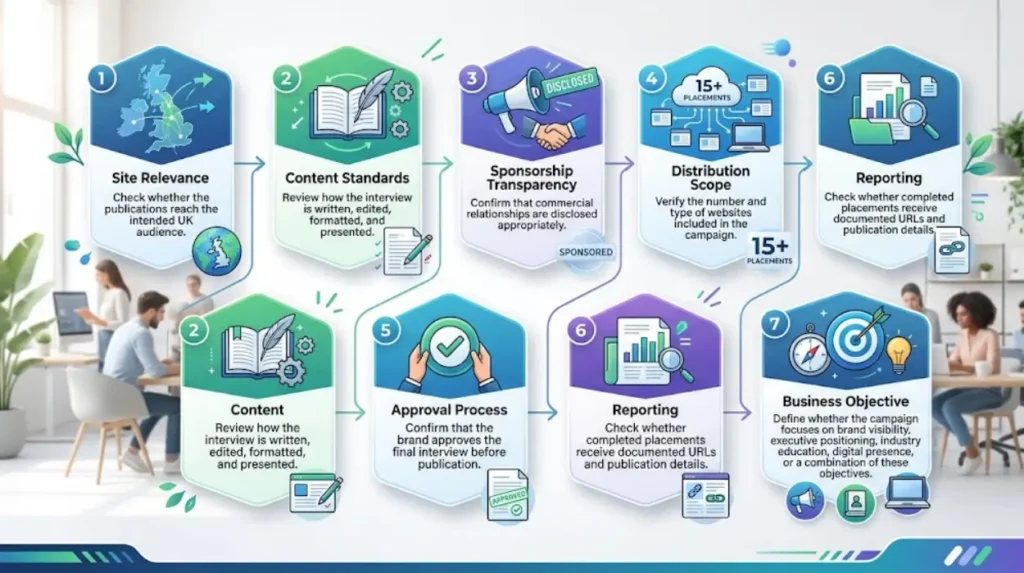
Businesses evaluating a 15-site campaign need to examine site relevance, publication transparency, content quality, distribution scope, approval controls, reporting, live URLs, and campaign objectives rather than judging the service solely by its number of placements.
A practical evaluation framework includes seven areas.
1. Site relevance
Check whether the publications reach the intended UK audience.
2. Content standards
Review how the interview is written, edited, formatted, and presented.
3. Sponsorship transparency
Confirm that commercial relationships are disclosed appropriately.
4. Distribution scope
Verify the number and type of websites included in the campaign.
5. Approval process
Confirm that the brand approves the final interview before publication.
6. Reporting
Check whether completed placements receive documented URLs and publication details.
7. Business objective
Define whether the campaign focuses on brand visibility, executive positioning, industry education, digital presence, or a combination of these objectives.
For businesses moving from research to provider evaluation,
Sponsored Interviews by Time Intelligence Media Group provides a service-specific reference point for comparing implementation options.
What should businesses expect after all 15 interviews are published?
After publication, businesses receive a completed set of media placements that can be reviewed against the original distribution plan. The final assessment focuses on published URLs, audience relevance, content accuracy, disclosure, and alignment with campaign objectives.
The completed campaign creates a measurable publication record.
Each live placement can be checked for:
- Correct interview content
- Correct company information
- Correct interviewee details
- Functional links
- Appropriate disclosure
- Publication status
- Website relevance
The resulting record supports internal reporting and future campaign planning.
Explore More Expert Insights:
How to Make Sponsored Content Credible for UK News Sites
How Manufacturing Sponsored Content Reaches Trade Readers
A 15-site sponsored interview campaign is therefore a coordinated media-distribution process rather than a single publishing action. It begins with content development, continues through approval and publication coordination, and ends with verification of the completed placements.



