

Sponsored content gives organisations access to established news environments while retaining control over the message. Credibility determines whether that content earns attention, communicates information clearly, and supports brand authority. On UK news sites, credibility depends on transparency, evidence, editorial quality, relevance, and clear separation between paid content and independent journalism.
For businesses evaluating sponsored content, the objective is not simply publication. The objective is producing material that meets professional publishing standards while clearly identifying its commercial origin. A credible sponsored article provides useful information, supports claims with evidence, uses appropriate language, and respects the expectations of UK audiences.
What makes sponsored content credible on UK news sites?
Credible sponsored content combines transparent commercial labelling, verified information, relevant evidence, professional writing, accurate sourcing, audience relevance, and responsible claims. It clearly identifies sponsorship while providing useful information that meets the quality expectations associated with reputable UK news publishing environments.
Credibility begins with transparency. A sponsored article must make its commercial status clear. Labels such as “Sponsored”, “Paid Content”, or “Advertiser Content” identify the relationship between the publisher and the organisation.
Transparency does not weaken the information. It establishes an accurate relationship with the audience.
Content quality also affects credibility. Poor grammar, exaggerated claims, unsupported statistics, excessive promotional language, and irrelevant links reduce trust. Professional structure creates a clearer distinction between useful information and direct advertising.
UK audiences also encounter strict expectations around accuracy. Claims involving finance, healthcare, property, employment, technology, or regulated industries require particular care. Factual statements need reliable supporting evidence.
The concept explored in:
Sponsored content credibility provides the foundation for understanding why these factors influence audience trust and publishing quality.
How should sponsored content be labelled on UK news sites?
Sponsored content requires visible commercial disclosure that tells users the material has been paid for or created through a commercial relationship. Clear labels protect transparency, distinguish advertising from independent journalism, and establish accurate expectations before readers consume the content.
Labelling needs to appear where users can recognise it before reading the article. A disclosure hidden at the bottom of a page provides weaker transparency than a visible label positioned near the headline or article introduction.
Common disclosure terms include:
- Sponsored Content
- Paid Content
- Advertiser Content
- Commercial Content
- Partner Content
The exact wording depends on the publisher’s editorial and advertising policies. The central requirement remains clear identification of the commercial relationship.
The article itself must also avoid presenting sponsored claims as independent editorial findings. Statements such as “the UK’s leading provider” require evidence and appropriate qualification. Unsupported superiority claims create credibility problems.
Why does disclosure improve credibility?
Disclosure provides factual context. It tells readers who funded the content and prevents confusion between paid communication and independent reporting.
Credibility therefore comes from openness rather than from attempting to make commercial material appear entirely editorial.
How can businesses verify claims before publishing sponsored content?

Businesses establish credibility by verifying statistics, research findings, market statements, customer claims, financial figures, and technical information before publication. Each material claim needs a reliable source, accurate wording, and sufficient context to prevent misleading interpretation.
Verification creates an evidence base for sponsored content. Businesses need an internal review process before submitting an article to a publisher.
A practical verification process includes four stages:
- Identify claims – Highlight every factual statement, statistic, percentage, date, ranking, and market figure.
- Locate sources – Match each claim with an authoritative source.
- Check context – Confirm that the source supports the exact interpretation used.
- Update information – Remove outdated statistics and replace them with current evidence.
For example, a fintech company discussing UK digital payments can reference data from recognised financial institutions, government departments, industry regulators, or established research organisations. The source must support the precise figure presented.
Technical claims require the same discipline. A cybersecurity company describing a threat level needs evidence from a credible security source rather than an unsupported internal assertion.
What information makes sponsored content useful rather than promotional?
Useful sponsored content answers a defined audience question through practical information, evidence, expert knowledge, examples, and relevant context. It prioritises reader understanding while maintaining appropriate commercial disclosure and limiting direct promotional statements to information relevant to the subject.
A useful article has a clear information purpose. It explains an issue, answers a question, interprets evidence, or provides practical guidance.
For example, a property company discussing UK commercial property trends can explain rental movements, vacancy rates, financing conditions, and regional differences. A direct sales pitch adds little informational value.
Promotional content typically focuses on products, services, prices, features, or repeated brand references. Sponsored content with stronger informational value focuses on the topic first.
What is the right balance between information and promotion?
A practical structure gives most of the article to the subject and a smaller section to the sponsoring organisation.
For example:
- Introduction: Define the issue and establish relevance.
- Evidence: Present verified data and industry information.
- Analysis: Explain what the evidence means.
- Examples: Demonstrate practical applications.
- Brand context: Explain the organisation’s relevant expertise.
- Conclusion: Summarise the key findings.
This structure keeps commercial information connected to the reader’s search intent.
How does sourcing affect the credibility of sponsored articles?
Strong sourcing connects important claims to identifiable and authoritative evidence. Government data, regulatory publications, academic research, recognised industry bodies, company reports, and named experts provide stronger foundations than anonymous statistics or unsupported statements.
Sources demonstrate where information originates. They also allow readers and publishers to assess factual accuracy.
UK sponsored content frequently benefits from authoritative sources such as government departments, regulators, universities, professional institutions, and recognised trade organisations. Examples include the Office for National Statistics, Financial Conduct Authority, Competition and Markets Authority, and relevant professional bodies.
Source quality depends on relevance as well as authority. A financial statistic needs a financially relevant source. A construction safety claim needs an appropriate safety or construction authority.
How should statistics be presented?
Statistics need context. A percentage without a date, population, geographic scope, or methodology gives incomplete information.
Instead of writing “70% of businesses use AI”, credible content identifies the source, measurement period, sample, and relevant business population.
This approach improves factual precision and gives publishers stronger grounds for approving the article.
How does writing quality influence sponsored content credibility?
Professional writing improves credibility through accurate grammar, concise sentences, logical structure, precise terminology, consistent facts, and controlled promotional language. Clear writing helps readers understand commercial information without confusing advertising claims with independent editorial reporting.
Writing quality directly affects how information is interpreted. A credible article uses one clear idea per paragraph and maintains consistent terminology throughout the text.
Headings also need to reflect the article’s actual content. A headline promising a detailed analysis needs corresponding evidence and explanation.
Common quality problems include:
- Repeated brand mentions
- Excessive superlatives
- Unsupported claims
- Generic introductions
- Long sentences
- Irrelevant statistics
- Poorly attributed quotations
- Unclear sources
- Excessive calls to action
Professional editing removes these weaknesses before publication.
For UK news environments, British spelling and appropriate terminology also improve contextual relevance. Terms such as “organisation”, “programme”, “labour”, and “licence” need consistent usage where applicable.
How should expert quotes be used in sponsored content?
Expert quotations strengthen sponsored content when the speaker has relevant expertise, the quotation accurately represents their position, and the article identifies their name, role, and organisation. Quotes must contribute information rather than function as unsupported promotional endorsements.
An expert quote adds perspective to factual information. It also provides a human source for analysis.
A useful quotation explains an issue, interprets evidence, identifies a practical challenge, or provides professional context.
For example, an employment article can include commentary from a human resources director about workforce planning. A construction article can include an engineer discussing project risk. A fintech article can include a qualified financial professional discussing regulatory developments.
The quote needs attribution. Readers need enough information to understand why the individual is qualified to discuss the subject.
Generic statements such as “our company is committed to excellence” provide little informational value. Specific observations provide stronger editorial substance.
How can sponsored content remain relevant to a UK news audience?
Audience relevance comes from matching the article’s subject, evidence, examples, language, and geographic context to the interests of UK readers. Relevant sponsored content addresses a defined problem rather than inserting a general corporate message into an unrelated publishing environment.
Relevance begins before writing. The organisation needs to identify the publication’s audience and the subject areas it regularly covers.
A UK business publication and a regional news site serve different information needs. A national financial audience expects different evidence from a local community audience.
Geographic relevance also matters. UK-specific legislation, market conditions, consumer behaviour, regulatory developments, and regional data create stronger contextual alignment.
For example, an article about business rates can distinguish between England, Scotland, Wales, and Northern Ireland where policy differences affect the subject.
This level of specificity improves informational usefulness and prevents generic content from appearing disconnected from the publication.
What role do links play in credible sponsored content?
Links support credibility when they direct readers to relevant evidence, authoritative sources, or genuinely useful resources. Link quantity does not establish credibility. Relevance, destination quality, descriptive anchor text, and editorial appropriateness determine whether links contribute useful context.
Sponsored content often includes links to the sponsoring organisation. These links need a clear relationship with the article.
A page selling an unrelated product provides little value to readers. A relevant service page that explains the topic in greater depth has stronger contextual relevance.
External links can also support factual claims. For example, a statistic about UK employment can link to the relevant official source.
Publishers also control link attributes, placement, and commercial disclosure according to their policies. Businesses need to understand these requirements before publication rather than assuming that every sponsored article provides the same SEO treatment.
How can businesses evaluate sponsored content options before publication?
Businesses can evaluate sponsored content through five criteria: publisher relevance, disclosure standards, evidence requirements, editorial quality, and distribution scope. Comparing these factors creates a structured basis for selecting an appropriate sponsored content solution.
A practical evaluation framework includes:
| Evaluation factor | Key question |
|---|---|
| Publisher relevance | Does the publication reach the intended UK audience? |
| Disclosure | Is commercial sponsorship clearly identified? |
| Editorial standards | Does the publisher review content quality? |
| Evidence | Are factual claims supported by reliable sources? |
| Links | Are link policies clearly defined? |
| Distribution | Where and how is the content published? |
| Reporting | What publication and performance information is provided? |
This comparison separates publication quality from simple placement volume.
A larger number of placements does not automatically indicate stronger credibility. Audience relevance, publisher reputation, editorial standards, and content quality remain central evaluation criteria.
For organisations assessing specific commercial solutions,
Credible sponsored content provides a natural next step for understanding how a professional sponsored content offering addresses these requirements.
What benefits does credible sponsored content provide?
Credible sponsored content supports brand visibility, audience education, topical authority, referral traffic, search visibility, and reputation by combining commercial disclosure with useful information published in relevant news environments. Its value depends on content quality, publisher relevance, and distribution.
The benefits extend beyond publication itself.
Brand visibility
Publication places the organisation’s expertise within an established media environment. Readers encounter the brand alongside information relevant to their interests.
Audience education
A well-structured sponsored article explains complex subjects. This approach works particularly well for fintech, technology, healthcare, property, professional services, and B2B organisations.
Search visibility
Relevant published content creates additional indexed assets associated with the organisation and its subject area. SEO value depends on publisher policies, link attributes, content quality, and search engine treatment.
Reputation
Transparent and evidence-led content demonstrates professional communication standards. Clear disclosure reinforces rather than conceals the commercial relationship.
Referral traffic
Relevant links provide a route from the article to supporting resources. Traffic quality depends on audience alignment and publication relevance.
When is sponsored content appropriate for UK businesses?
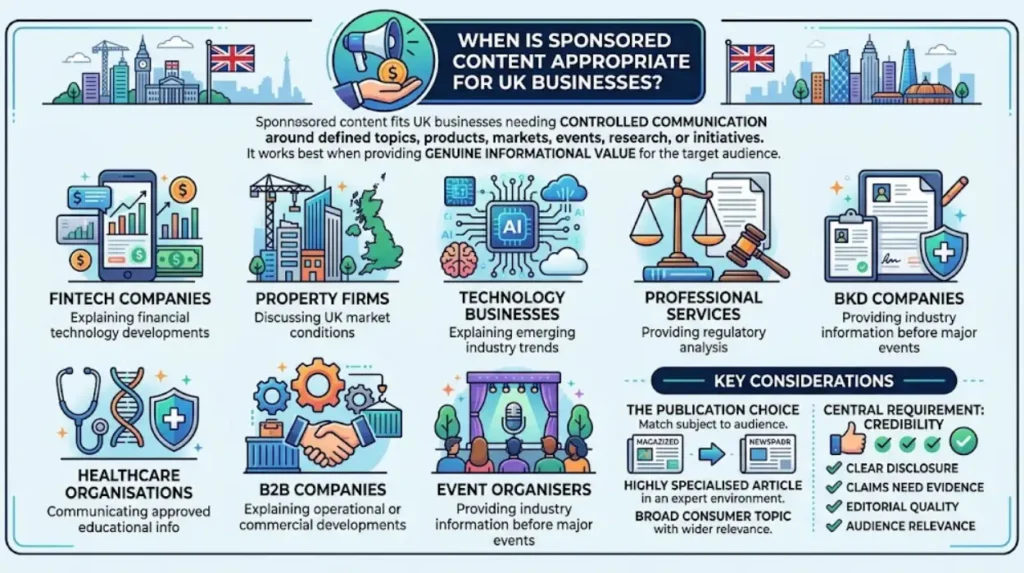
Sponsored content fits businesses that need controlled communication around a defined topic, product category, market development, event, research finding, or corporate initiative. It works best when the subject provides genuine informational value for the selected UK publication audience.
Common applications include:
- Fintech companies explaining financial technology developments
- Property firms discussing UK market conditions
- Technology businesses explaining emerging industry trends
- Professional services firms providing regulatory analysis
- Healthcare organisations communicating approved educational information
- B2B companies explaining operational or commercial developments
- Event organisers providing industry information before a major event
The publication choice needs to match the subject.
A highly specialised article belongs in an environment where the audience understands its terminology and context. A broad consumer topic requires accessible language and wider relevance.
Credibility remains the central requirement across these use cases. Sponsorship needs clear disclosure. Claims need evidence. Content needs editorial quality. The subject needs audience relevance.
How can businesses build a credible sponsored content process?
A credible sponsored content process moves from audience research to topic selection, evidence collection, content development, editorial review, disclosure confirmation, publication, and performance evaluation. Each stage protects accuracy, relevance, transparency, and consistency across the final published article.
A structured process can follow eight steps:
- Define the audience – Identify the UK readers and publication category.
- Select the topic – Choose a subject connected to audience information needs.
- Collect evidence – Gather current statistics, reports, expert sources, and supporting documentation.
- Develop the structure – Organise the article around clear questions and logical sections.
- Write the content – Use factual language and controlled brand references.
- Review accuracy – Check every important claim, statistic, name, date, and source.
- Confirm disclosure – Ensure the commercial relationship is clearly identified.
- Evaluate publication – Review placement, audience relevance, links, reporting, and resulting visibility.
Explore More Expert Insights:
How Manufacturing Sponsored Content Reaches Trade Readers
How Automotive Sponsored Content Reaches UK Buyers
This process turns sponsored content from a basic advertising placement into a structured communication asset.
The strongest approach remains factual, transparent, relevant, and publication-specific. UK businesses evaluating sponsored content need to assess both the quality of the article and the standards of the news site carrying it.



