What is a sponsored interview?
A sponsored interview is paid editorial-style content where a brand representative answers structured questions about a company, product, service, expertise, or industry topic. It combines controlled brand messaging with an interview format designed to provide information, context, and identifiable subject expertise to audiences.
Sponsored interviews differ from standard advertisements because the content centres on an individual spokesperson and their responses. The format presents information through questions and answers rather than through conventional promotional copy.
A typical sponsored interview includes a company founder, chief executive, specialist, consultant, or senior manager. The interviewer asks questions related to the person’s expertise, business activity, industry developments, or customer challenges.
The commercial relationship remains important. Sponsored content requires clear identification when applicable under advertising and media standards. Transparency helps audiences understand that the content has a commercial origin.
How does the interview format work?
The interview format creates a structured information sequence:
- Introduction: Identifies the spokesperson and organisation.
- Questions: Establish the subject, expertise, and business context.
- Answers: Provide detailed statements from the spokesperson.
- Evidence: Supports claims with facts, figures, examples, or relevant experience.
- Conclusion: Reinforces the central topic without replacing the informational purpose.
This structure gives audiences a clear route through complex information.
Why does sponsored interview content affect brand trust?
Sponsored interviews build trust when they provide transparent sponsorship, identifiable expertise, specific evidence, balanced explanations, and useful information. Trust develops through credible communication signals that help UK audiences assess the speaker, claims, context, and relevance before accepting business messages.
Trust in branded communication depends on several observable factors. Audiences assess who is speaking, what they are claiming, how claims are supported, and whether the commercial relationship is clear.
An interview gives the spokesperson space to explain decisions and expertise in greater detail than a short advertisement. This additional context helps audiences understand the organisation behind the message.
For example, a cybersecurity company discussing common phishing risks can explain attack methods, employee behaviours, prevention controls, and incident response processes. The interview provides educational information while establishing the spokesperson as a source of specialist knowledge.
Why does transparency matter?
Transparency establishes the relationship between the publisher, advertiser, and audience. A clearly labelled sponsored interview does not hide its commercial nature.
Labels such as “Sponsored”, “Paid Content”, or another appropriate disclosure tell audiences that the content has been commercially arranged. Clear disclosure supports informed interpretation of the material.
Trust therefore does not depend on making sponsored content appear independent. It depends on presenting the commercial relationship accurately while maintaining useful and factual content.
How does expert-led content strengthen credibility?

Expert-led interviews strengthen credibility by connecting a brand with a named spokesperson who explains knowledge, decisions, processes, and industry issues directly. Specific qualifications, professional experience, evidence, and clear answers give audiences stronger information for evaluating expertise and credibility.
A named spokesperson provides an identifiable source for statements. This differs from anonymous promotional claims because the audience can associate information with a specific professional role.
Expertise becomes stronger when the interview includes verifiable details. Relevant details include professional qualifications, years of industry experience, technical responsibilities, published research, business leadership, or recognised professional roles.
What makes an interview answer credible?
Credible answers contain specific information rather than broad promotional statements.
For example, instead of saying that a company provides “excellent customer service”, an interview can explain response times, support processes, service coverage, complaint procedures, or customer satisfaction measurements.
Specificity improves information quality because audiences receive measurable or identifiable details.
Evidence also matters. A financial technology spokesperson discussing payment security can explain authentication controls, fraud monitoring, transaction verification, and regulatory requirements. These details demonstrate subject knowledge without relying solely on promotional language.
How does storytelling through questions influence audience understanding?
Interview questions organise information around defined topics, allowing audiences to follow a logical sequence from background to expertise, challenges, actions, evidence, and outcomes. This structure improves comprehension because each answer addresses a specific information requirement rather than presenting disconnected claims.
Question structure determines how effectively an interview communicates information. Strong questions focus on subjects relevant to the intended audience.
A useful sequence starts with context before moving towards technical or commercial subjects.
What questions create useful sponsored interviews?
Relevant question categories include:
- Background questions: What does the organisation do?
- Expertise questions: What specific problem does the spokesperson understand?
- Industry questions: What changes affect the sector?
- Process questions: How does the organisation approach the issue?
- Evidence questions: What data or results support the explanation?
- Future-focused questions: What developments are shaping the subject?
For example, a construction business interview can move from the company’s specialism to construction safety, project management, material costs, sustainability requirements, and workforce skills.
The sequence creates context before introducing specific business information.
How does sponsored interview content provide more information than traditional advertising?
Sponsored interviews provide greater informational depth than short-form advertisements because they give spokespersons space to explain expertise, processes, evidence, industry conditions, and business decisions. The question-and-answer structure supports detailed context while retaining clear commercial disclosure for audiences.
Traditional advertising often prioritises concise messages, brand recognition, product benefits, and calls to action. Sponsored interviews use a longer information format.
The additional space allows brands to explain complex subjects.
For example, an insurance company can use an interview to explain policy considerations, claims procedures, risk assessment, exclusions, customer responsibilities, and changes affecting consumers. A short advertisement cannot provide equivalent detail within the same format.
Why does context matter for trust?
Context allows audiences to evaluate claims more accurately.
A statement such as “our platform reduces operational costs” lacks sufficient detail on its own. An interview can explain which processes create savings, how costs are measured, which period is assessed, and what operational changes produce the result.
The distinction is important for business audiences because B2B purchasing decisions often involve multiple stakeholders. Finance teams, procurement professionals, technical specialists, and senior managers require different information before assessing a commercial claim.
How does sponsored interview content support brand authority?
Sponsored interviews support brand authority by demonstrating subject knowledge through detailed explanations, relevant evidence, and consistent expertise. Authority develops when a spokesperson addresses important industry questions clearly and provides useful information that audiences can evaluate against established facts and professional standards.
Brand authority refers to the perceived expertise and knowledge associated with an organisation or professional.
An interview can demonstrate authority through subject-specific language and evidence. It also connects business activity with wider industry topics.
Which signals contribute to authority?
Important authority signals include:
- Named professional expertise
- Relevant qualifications
- Industry experience
- Specific data
- Clear explanations
- Defined processes
- Accurate terminology
- Relevant examples
- Consistent subject knowledge
- Transparent commercial disclosure
For example, a property specialist discussing UK commercial property can address rental demand, planning requirements, occupancy rates, development costs, and regional market conditions.
The interview demonstrates knowledge through the quality of the information rather than through unsupported statements about being a market leader.
How does consistency affect trust in sponsored interviews?
Consistent information strengthens trust because audiences encounter the same factual positioning across interviews, company materials, expert statements, and other communications. Consistency reduces conflicting claims and creates a clearer understanding of the organisation, spokesperson expertise, products, services, and industry position.
Consistency applies to factual claims, terminology, statistics, company descriptions, and spokesperson statements.
A business that describes its service differently across multiple publications creates uncertainty. Consistent information provides a stable reference point.
What information requires consistency?
Businesses need consistent treatment of:
- Company name
- Spokesperson name and role
- Product descriptions
- Service definitions
- Performance figures
- Industry claims
- Customer statistics
- Regulatory statements
- Technical terminology
Accuracy also requires dates and figures to remain current. An interview containing outdated statistics reduces informational reliability.
Which UK brands can use sponsored interviews?
Sponsored interviews apply across UK industries where organisations need to explain expertise, products, services, research, or industry issues. Common sectors include finance, technology, healthcare, property, construction, professional services, education, retail, manufacturing, energy, and business consultancy.
The format suits industries with complex products or specialist audiences because interviews provide additional explanatory space.
How do different sectors use the format?
Financial services: Executives can explain financial technology, payment systems, investment trends, risk management, or regulatory developments.
Technology: Technical leaders can discuss cybersecurity, artificial intelligence, cloud systems, software development, or digital transformation.
Healthcare: Specialists can explain healthcare technologies, service developments, patient information, or sector challenges, while maintaining applicable regulatory and advertising requirements.
Property and construction: Professionals can discuss planning, development, building standards, sustainability, project delivery, and market conditions.
Professional services: Consultants can explain tax, legal, accounting, recruitment, management, or operational issues.
Each example uses the interview to communicate expertise within a defined industry context.
What makes a sponsored interview trustworthy for UK audiences?
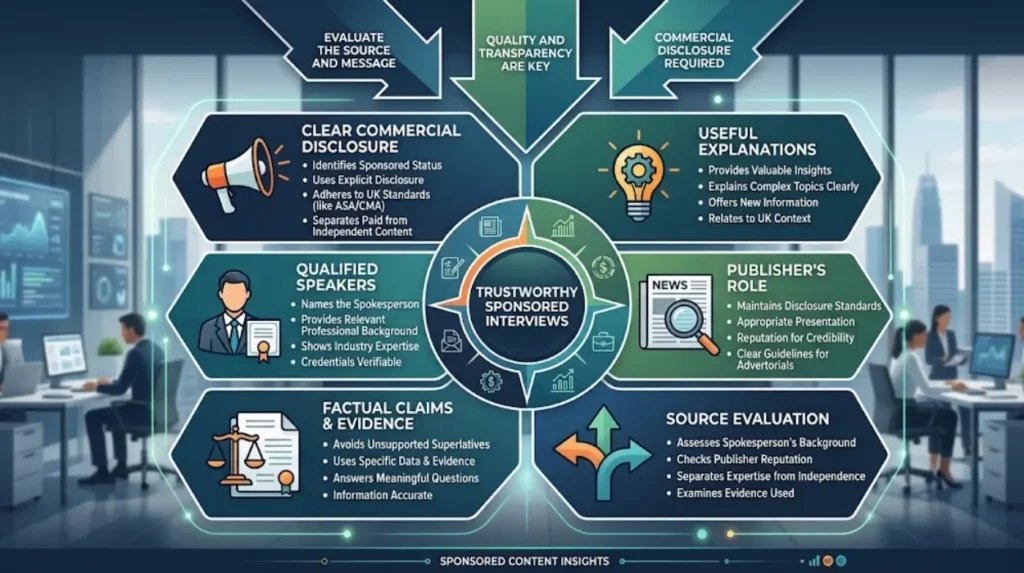
A trustworthy sponsored interview combines clear commercial disclosure, qualified speakers, factual claims, specific evidence, relevant questions, accurate information, and useful explanations. These elements help audiences distinguish paid communication from independent editorial content while still evaluating the information on its merits.
Trust does not come from sponsorship alone. It comes from the quality and transparency of the communication.
A credible interview identifies its commercial status. It names the spokesperson. It provides relevant expertise. It avoids unsupported superlatives. It uses specific evidence. It answers meaningful questions.
The publisher also has an important role in maintaining appropriate disclosure and presentation standards. UK audiences encounter sponsored content across digital publications, business websites, specialist publications, and other media environments.
Explore More Expert Insights:
What Makes Sponsored Content Credible on News Sites
How Manufacturing Firms Use Sponsored Editorial Content
Why should audiences evaluate the source as well as the message?
Source evaluation provides another layer of trust assessment. Audiences can examine the spokesperson’s professional background, the publisher’s reputation, the evidence used, and the clarity of sponsorship disclosure.
This process separates credibility of expertise from editorial independence. A sponsored interview can contain accurate expert information while still being paid content.
That distinction is essential. Trustworthy sponsored communication does not require audiences to mistake commercial content for independent journalism.
How should businesses approach sponsored interviews as a trust-building format?
Businesses build trust through sponsored interviews by prioritising factual accuracy, transparent disclosure, expert participation, useful questions, evidence-based answers, and consistent information. The strongest format treats the audience as an information seeker rather than presenting every response as direct promotion.
The starting point is topic selection. The subject needs relevance to the intended audience.
The second requirement is spokesperson selection. The interviewee needs direct knowledge of the subject.
The third requirement is question design. Questions need to generate substantive answers rather than repeated advertising statements.
The fourth requirement is evidence. Claims need appropriate supporting information.
The final requirement is transparency. The commercial nature of the content needs clear identification.
What is the central trust principle?
The central principle is straightforward: credibility comes from transparent communication and useful evidence, not from disguising commercial content as independent editorial material.
Sponsored interviews provide a structured environment for businesses to explain expertise, answer relevant questions, and communicate detailed information. When the format combines clear disclosure with factual and specialist content, audiences receive enough context to evaluate the message responsibly.
For UK brands, this makes sponsored interviews an informative communication format for demonstrating expertise while maintaining a clear distinction between paid content and independent editorial coverage.