
Manufacturing sponsored content is paid editorial-style material created for a defined industrial audience. It places company expertise, products, research, or industry perspectives within media environments where engineers, procurement teams, executives, and technical decision-makers already consume sector information.
Manufacturing sponsored content sits between traditional advertising and editorial communication. It uses an article, interview, analysis, case study, or expert commentary format to communicate a commercial message through an informative structure.
Trade publications are central to this model. A manufacturing audience often follows specialist media covering engineering, automation, aerospace, automotive, energy, construction, logistics, chemicals, and industrial technology.
The objective is audience relevance rather than broad consumer reach. A precision engineering company, for example, gains more value from reaching procurement managers and production engineers than from reaching a general entertainment audience.
Readers also enter the content with an existing interest in manufacturing topics. This creates a stronger contextual relationship between the publication, subject matter, and commercial message.
Companies evaluating:
Manufacturing sponsored content need to assess both where the content appears and who reads it.
How does sponsored content reach relevant manufacturing readers?
Sponsored content reaches trade readers through audience targeting, publication selection, contextual relevance, distribution, search visibility, and content format. Each stage connects the commercial message with a defined industrial readership and its information needs.
The process begins with audience definition. A manufacturer identifies the professional groups it needs to reach. These groups include plant managers, procurement directors, engineers, operations executives, technical buyers, and supply-chain professionals.
The next stage involves media selection. Publications are evaluated according to sector focus, readership profile, geographical relevance, authority, content format, and distribution channels.
Content then adapts to the selected audience. An article targeting procurement professionals focuses on supplier evaluation, cost control, compliance, and sourcing. An article targeting engineers focuses on technical performance, operational efficiency, materials, or production systems.
Distribution extends the initial publication placement. Content can appear through publication websites, newsletters, social channels, search results, and other permitted media distribution formats.
This creates several reader entry points rather than relying on one source of traffic.
What role does publication selection play?
Publication selection determines whether sponsored content reaches a relevant professional audience. A manufacturing company selling industrial robotics requires a different media environment from a company supplying packaging equipment.
A specialist engineering publication provides contextual relevance for robotics. A packaging industry publication provides stronger relevance for packaging machinery.
The publication also determines the terminology surrounding the content. Trade readers expect technical accuracy, recognised industry terminology, and evidence-based explanations.
Why does contextual relevance matter to trade readers?
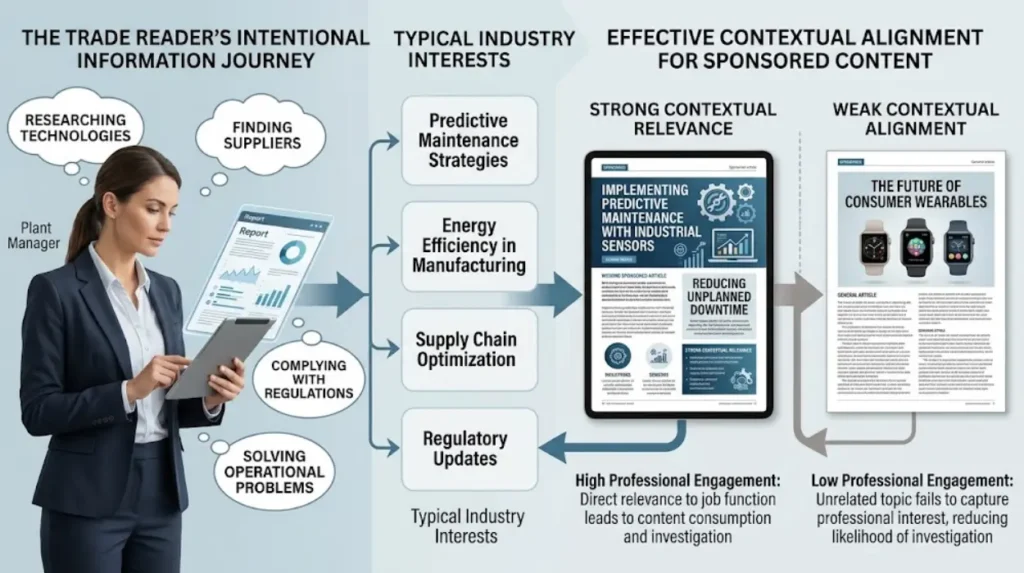
Contextual relevance connects sponsored content with the subject a trade reader already intends to understand. Industrial terminology, sector-specific problems, and professional use cases make the content relevant to the reader’s existing information journey.
Trade readers consume information for specific professional purposes. They research technologies, suppliers, regulations, operational problems, market developments, and business decisions.
Sponsored content becomes more relevant when its subject directly matches those interests.
For example, a manufacturer of industrial sensors can publish content about predictive maintenance. The topic connects the product category with a recognised manufacturing requirement.
The same company would receive weaker contextual alignment from an article focused on general consumer technology.
Relevance also influences content engagement. A production manager reading an article about reducing unplanned downtime has a direct professional reason to investigate the subject.
How does industry terminology improve relevance?
Industry terminology gives readers immediate context. Terms such as industrial automation, predictive maintenance, lean manufacturing, digital twins, supply-chain resilience, and Industry 4.0 identify the subject area.
Terminology also supports search discovery. Search engines use relationships between entities, topics, phrases, and supporting concepts to understand content.
A well-structured manufacturing article therefore connects the main subject with relevant entities rather than repeating one keyword throughout the page.
What types of sponsored content work for manufacturing audiences?
Manufacturing audiences respond to structured formats that explain technical subjects, operational challenges, market developments, and practical applications. Common formats include expert articles, case studies, interviews, industry analysis, technology explainers, and research-led content.
The format affects how information is presented.
Expert articles
Expert articles position technical knowledge around a defined manufacturing issue. A manufacturing director can discuss supply-chain resilience, while an engineering specialist can explain automation implementation.
Case studies
Case studies connect a product or service with a defined business problem. They normally explain the initial challenge, implementation process, operational change, and measurable result.
For example, an automation supplier can present a case study showing how robotic handling reduced manual processing time by a specific percentage.
Interviews
Interviews provide a structured way to present executive expertise. Questions focus on industry developments, operational priorities, technology adoption, or market changes.
Technical explainers
Technical explainers simplify complex subjects without removing essential technical detail. They work well for subjects such as industrial IoT, machine vision, digital twins, additive manufacturing, and energy management.
Industry analysis
Industry analysis examines a defined market issue. Examples include reshoring, manufacturing investment, industrial cybersecurity, energy efficiency, and supply-chain disruption.
Each format serves a different reader intent. Selecting the format requires alignment between the subject, audience, publication, and business objective.
How do trade publications distribute sponsored content?
Trade publications distribute sponsored content through their websites, newsletters, search channels, social platforms, email databases, and other established audience touchpoints. Distribution expands visibility beyond readers who visit the publication directly.
Publication websites provide the primary content environment. Readers discover articles through category pages, internal navigation, search engines, and direct visits.
Newsletters provide another distribution channel. A manufacturing publication with an established subscriber base can place sponsored material within a relevant email environment.
Social distribution extends visibility to professional audiences following the publication or industry topic.
Search visibility provides an additional discovery route. A well-optimised article can attract readers searching for the specific problem or technology discussed in the content.
The strength of distribution depends on the publication’s audience structure and the content’s relevance.
A single article therefore operates across multiple discovery points.
What makes sponsored content useful for B2B manufacturing marketing?
Sponsored content supports B2B manufacturing marketing by combining specialist audience access with detailed information. It gives companies space to explain complex products, establish expertise, address buyer questions, and introduce solutions within a relevant industry context.
Manufacturing purchasing decisions often involve multiple stakeholders.
A capital equipment purchase can involve engineering, procurement, operations, finance, and senior management. Each stakeholder evaluates different information.
Sponsored content supports this research process by presenting detailed information in an accessible format.
A manufacturer selling automated inspection equipment can explain inspection accuracy, integration requirements, production benefits, implementation considerations, and operational results.
This structure provides more information than a short display advertisement.
Sponsored content also supports earlier stages of B2B research. A reader does not need to be ready to purchase immediately. The content introduces the company and its expertise while addressing a recognised industry subject.
This creates awareness before direct commercial evaluation begins.
How can manufacturing companies measure sponsored content performance?
Manufacturing sponsored content performance is measured through publication reach, qualified traffic, engagement, referral activity, search visibility, lead interactions, and business outcomes. Measurement requires defined objectives and consistent tracking across distribution channels.
The first measurement layer concerns visibility.
Relevant metrics include:
- Article views
- Unique visitors
- Newsletter exposure
- Social impressions
- Referral traffic
- Search impressions
The second layer concerns engagement.
Relevant indicators include time spent on page, scroll behaviour, content interactions, and visits to related pages.
The third layer concerns commercial activity.
Companies can track form submissions, enquiry activity, downloads, consultation requests, and visits from target accounts.
Why does audience quality matter more than raw reach?
A manufacturing campaign with 20,000 relevant trade readers can have greater commercial value than one with 200,000 unrelated impressions.
Audience quality depends on professional relevance.
A specialist aerospace publication reaching aerospace procurement professionals provides a different commercial environment from a general business website with a mixed audience.
Measurement therefore needs to distinguish total exposure from qualified exposure.
This distinction is important for manufacturers selling high-value products with long B2B sales cycles.
How does sponsored content support the manufacturing buyer journey?
Sponsored content supports the manufacturing buyer journey by providing information during awareness, research, comparison, and solution-evaluation stages. Its value increases when content addresses specific questions that professional buyers ask before contacting suppliers.
The buyer journey contains different information requirements.
During awareness, a reader identifies an operational problem. Content can explain why the problem matters.
During research, the reader investigates possible approaches. Content can explain technologies, processes, and implementation requirements.
During comparison, the reader evaluates suppliers and solutions. Case studies, technical evidence, and expert commentary provide supporting information.
During evaluation, the reader requires detailed commercial and technical information. Sponsored content can direct readers towards relevant product pages, reports, demonstrations, or further resources.
The content therefore needs to match the reader’s stage.
A general article about industrial automation serves a different purpose from a technical comparison of robotic systems.
Which manufacturing sectors use sponsored content?
Sponsored content applies across manufacturing sectors where specialist audiences influence purchasing, technology adoption, investment, and operational decisions. Common sectors include automotive, aerospace, engineering, chemicals, pharmaceuticals, food production, electronics, energy, and industrial equipment.
Different sectors require different editorial contexts.
Automotive manufacturing
Content can focus on automation, electric vehicle production, supply chains, robotics, materials, and manufacturing efficiency.
Aerospace manufacturing
Content can address precision engineering, advanced materials, quality control, certification, and production technology.
Food manufacturing
Content can focus on packaging, automation, hygiene, traceability, energy efficiency, and production optimisation.
Pharmaceutical manufacturing
Content can address manufacturing compliance, process control, quality systems, automation, and production technology.
Industrial engineering
Content can focus on machinery, maintenance, digitalisation, engineering software, sensors, and production systems.
Sector-specific content improves relevance because the reader recognises the operational context immediately.
How should companies evaluate manufacturing sponsored content options?

Companies evaluating manufacturing sponsored content need to compare audience relevance, publication authority, sector alignment, content format, distribution channels, reporting, and commercial objectives. The strongest option connects a defined manufacturing audience with a clearly structured information requirement.
A practical evaluation framework includes six factors.
- Audience: Identify the professional roles reached by the publication.
- Sector alignment: Confirm that the publication covers the relevant manufacturing category.
- Content format: Select articles, interviews, case studies, or explainers based on the communication objective.
- Distribution: Review website, newsletter, social, and search exposure.
- Measurement: Establish reporting requirements before publication.
- Business objective: Connect content activity with awareness, traffic, engagement, or lead generation.
The decision is therefore not based solely on publication size.
A smaller specialist publication with a concentrated engineering readership can provide stronger relevance than a larger general business platform.
Companies also need to distinguish sponsored editorial content from conventional advertising. Sponsored content provides greater space for explanation, while display advertising focuses on immediate visual exposure.
For organisations assessing:
Manufacturing sponsored content, the next step is evaluating the specific distribution model, campaign structure, deliverables, and reporting framework.
What is the key principle behind reaching trade readers?
The central principle is audience alignment. Manufacturing sponsored content reaches trade readers when the publication, topic, format, terminology, distribution channel, and business message all correspond with the professional information needs of the intended audience.
Effective manufacturing content starts with the reader rather than the product.
The audience defines the publication. The publication influences the topic. The topic determines the content format. The format shapes distribution. Measurement then establishes whether the content reached the intended professional audience.
Explore More Expert Insights:
How Automotive Sponsored Content Reaches UK Buyers
Sponsored Content vs PR: Which Reaches UK Readers Better
This creates a clear operating sequence:
Define the trade audience → select relevant media → identify the information need → create sector-specific content → distribute through established channels → measure qualified engagement → refine future campaigns.
For UK manufacturing companies, this approach keeps sponsored content connected to specialist readers and measurable B2B objectives. It also provides a structured route from media exposure to informed consideration.