Sponsored interviews by Time Intelligence Media Group provide UK businesses with a structured way to present founders, executives, specialists, and brand representatives through professionally produced interview content. The service combines interview-led storytelling with sponsored media distribution across relevant publication environments.
For brands evaluating sponsored interviews, the key decision factors are publication reach, editorial presentation, interview quality, disclosure, distribution, content accuracy, and reporting. A clear process connects the initial interview with the final published coverage.
Businesses entering the decision stage also benefit from understanding how:
Sponsored interviews get published across 15 sites. This explains the distribution model, publication workflow, and role of each stage. For the broader strategic value of interview-led media,
Sponsored interviews provides useful context.
What are sponsored interviews by Time Intelligence Media Group?
Sponsored interviews are paid media placements built around an interview format, where a brand representative answers structured questions and the completed content is prepared for publication across selected media outlets.
A sponsored interview differs from a standard display advertisement because the primary content format is an interview. The published article centres on an identifiable person, business, expertise area, product category, or business development story.
Time Intelligence Media Group positions sponsored interviews as a media publishing service. The process covers interview preparation, content development, publication coordination, and distribution.
The interview format supports several business objectives:
- Executive positioning
- Founder visibility
- Brand awareness
- Expertise communication
- Product or service explanation
- Corporate storytelling
- Industry commentary
- Market positioning
For example, a UK fintech founder can discuss payment innovation, regulatory developments, business growth, and customer challenges through a structured interview rather than a conventional promotional article.
How does the sponsored interview publishing process work?
The publishing process starts with campaign requirements, continues through interview preparation and content production, then moves into publication and distribution across selected media sites with completed coverage available for review.
Campaign requirements
The first stage defines the campaign subject, interviewee, target audience, industry, key messages, and preferred publication environment.
A campaign for a property company requires different subject framing from a campaign for a fintech business. The interview questions and publication targets need to reflect that distinction.
Interview preparation
Questions are structured around the interviewee’s expertise and the campaign objective. Strong questions produce specific answers rather than generic promotional statements.
For example, a construction executive can address project delivery, sustainability standards, procurement challenges, and market conditions.
Content production
The responses are transformed into a publication-ready interview. The content retains the interviewee’s factual information while applying a clear editorial structure.
Typical elements include:
- Headline
- Introduction
- Interviewee identification
- Question-and-answer sections
- Supporting business information
- Sponsored-content disclosure where required
Publication and distribution
The completed interview enters the publishing stage. Distribution across multiple sites increases the number of publication environments where the interview appears.
The 15-site model provides a defined distribution framework rather than relying on one publication alone.
What does Time Intelligence Media Group include in a sponsored interview service?
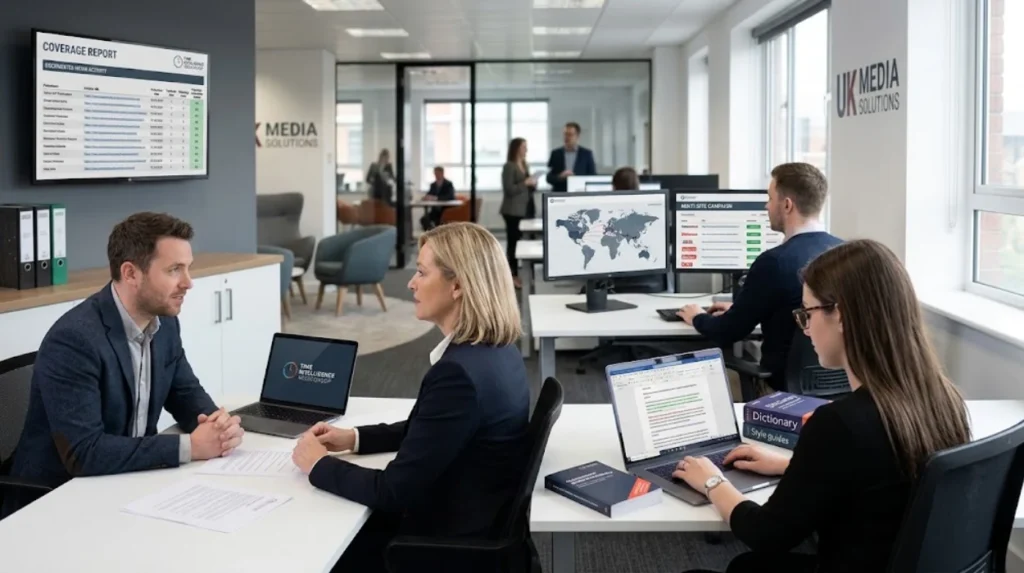
A sponsored interview service combines interview content development, publication preparation, media distribution, and coverage reporting into one managed workflow for businesses seeking structured UK media visibility.
The service components determine the practical value of the campaign.
Interview development
Interview development establishes the questions, subject focus, and information required from the spokesperson.
The objective is factual and structured communication. Questions focus on areas relevant to the interviewee’s expertise and business context.
Content preparation
The supplied responses require editing for readability, structure, grammar, and publication requirements. The finished interview presents the spokesperson clearly and maintains consistency throughout the article.
Media distribution
Distribution places the completed sponsored interview across the agreed publication network.
A multi-site campaign creates several individual publication URLs. Each URL represents a separate published media placement.
Publication reporting
Reporting provides evidence of where the interview appeared. A useful report identifies publication names, article URLs, publication dates, and other available campaign information.
These records allow marketing teams to document completed media activity.
Why does publishing a sponsored interview across 15 sites matter?
Publishing across 15 sites creates multiple media placements from one structured interview campaign, increasing the number of publication environments where a brand, executive, or specialist appears.
The distribution model creates a broader media footprint.
One interview can communicate the same core expertise across multiple publication destinations. This gives businesses a consolidated content asset with multiple published instances.
For example, a UK technology company launching an AI platform can use an executive interview to explain its market focus, technology application, customer problem, and business direction across the campaign’s publication network.
The 15-site structure also creates a measurable distribution target. Teams can compare planned placements with completed placements through campaign reporting.
For readers exploring the operational side of multi-publication distribution, sponsored interviews explains how this publishing model works across multiple sites.
How can sponsored interviews support UK brand credibility?
Sponsored interviews support brand credibility by presenting identifiable experts, detailed answers, and business information in a structured media format while maintaining clear sponsored-content identification and factual communication.
Credibility depends on content quality and transparency.
A named spokesperson gives the article a clear source. Specific answers provide substance. Accurate company information reduces ambiguity.
The interview format also allows businesses to explain complex subjects through direct responses.
For example, a healthcare technology company can explain how its platform works, which operational problem it addresses, and how organisations use the technology. This gives readers more information than a short promotional statement.
Sponsored disclosure remains important. Paid media needs to be presented accurately so audiences understand the commercial relationship behind the placement.
What types of UK businesses use sponsored interviews?
Sponsored interviews apply to businesses that need structured executive visibility, specialist commentary, product explanation, or brand storytelling across media publications, including technology, finance, property, healthcare, construction, and professional services.
Fintech companies
Fintech businesses can use interviews to explain financial technology, payment systems, digital banking, compliance, or investment platforms.
Technology companies
Technology firms can focus interviews on software development, artificial intelligence, cybersecurity, cloud services, or digital transformation.
Property businesses
Property companies can discuss development projects, investment activity, construction, sustainability, and market expertise.
Professional services firms
Consultancies, legal businesses, recruitment firms, and business advisers can use interviews to communicate specialist knowledge.
Healthcare and life sciences companies
Healthcare businesses can explain services, technologies, research developments, and operational solutions while maintaining appropriate factual standards.
Construction companies
Construction businesses can use executive interviews to discuss infrastructure, project management, procurement, engineering, sustainability, and industry development.
What makes a sponsored interview suitable for publication?
A publication-ready sponsored interview contains accurate information, clear questions and answers, a defined subject, identifiable expertise, readable structure, and appropriate commercial disclosure for the sponsored media environment.
Several content standards affect publication quality.
Clear interviewee identity
The article needs to establish who is speaking and why that person’s expertise is relevant.
Specific answers
Specific answers create stronger informational value. Statements containing measurable facts, processes, examples, or defined business activities are more useful than generic claims.
Consistent terminology
Industry terminology needs to remain accurate throughout the interview. A fintech interview, for example, requires consistent use of terms such as payments, digital banking, compliance, and financial technology.
Factual accuracy
Company names, job titles, product descriptions, dates, statistics, and technical information require accuracy before publication.
Transparent sponsorship
Sponsored content needs appropriate labelling according to the publication’s requirements and applicable advertising standards.
What results can businesses measure from sponsored interviews?
Businesses can measure sponsored interview performance through completed publication count, publication URLs, audience relevance, content engagement, referral activity, branded visibility, and documented media coverage.
Measurement needs to match the campaign objective.
If the objective is media visibility, publication completion and outlet relevance are core metrics. If the objective is website discovery, referral traffic and engagement provide additional information.
If the objective is executive positioning, the number and relevance of published interviews provide evidence of media presence.
A campaign report can organise results into categories such as:
| Measurement area | Example |
|---|---|
| Publication volume | 15 published placements |
| Coverage evidence | Individual article URLs |
| Content asset | Completed executive interview |
| Visibility | Publication audience and reach data where available |
| Referral activity | Website visits from published articles |
| Brand positioning | Executive name and company references |
The exact available metrics depend on the publication and reporting system.
How does sponsored interview distribution compare with a single publication?
Multi-site sponsored interview distribution creates a broader publication footprint than a single sponsored placement because one campaign produces coverage across multiple media destinations instead of concentrating visibility within one publication.
A single publication can provide focused exposure within one audience environment.
A 15-site distribution model creates multiple publication points. This supports businesses that require broader media presence from one campaign asset.
The choice depends on the campaign requirement. A targeted niche campaign can prioritise audience relevance. A multi-site campaign prioritises distribution breadth and repeated publication presence.
The distinction is important when evaluating service proposals. Businesses need to confirm the number of planned sites, publication criteria, content format, reporting process, and expected deliverables.
How can businesses evaluate Time Intelligence Media Group before purchasing?
Businesses can evaluate the service by checking the distribution scope, publication process, interview format, disclosure standards, reporting deliverables, turnaround requirements, and relevance of the media network to their target audience.
A practical evaluation checklist includes:
- Confirm the number of publication sites.
- Review the interview production process.
- Establish who prepares the questions.
- Confirm content review procedures.
- Check how sponsored content is disclosed.
- Request examples of completed publications.
- Confirm reporting details.
- Review expected turnaround.
- Establish what information the client must provide.
- Check whether publication targets align with the intended UK audience.
These factors create a clearer basis for comparing sponsored interview services.
Why choose sponsored interviews by Time Intelligence Media Group?
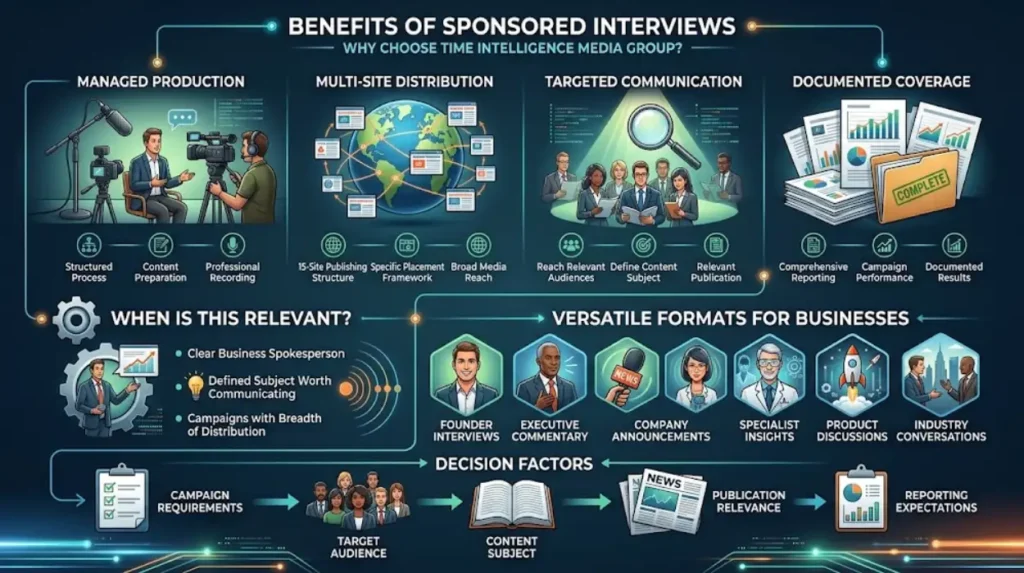
Time Intelligence Media Group provides a structured sponsored interview service for businesses seeking managed interview production and multi-site media distribution, with the campaign organised around content preparation, publication, and coverage documentation.
The service is relevant when a business has a clear spokesperson and a defined subject worth communicating through an interview format.
It also suits campaigns where distribution breadth matters. The 15-site publishing structure gives the campaign a specific placement framework.
Businesses can use the format for founder interviews, executive commentary, company announcements, specialist insights, product discussions, and industry-focused conversations.
The decision depends on campaign requirements, target audience, content subject, publication relevance, and reporting expectations.
What should businesses do before ordering a sponsored interview?
Businesses need to define the interviewee, subject, target audience, key messages, desired publication scope, and measurement criteria before ordering a sponsored interview to ensure the campaign has clear operational and commercial requirements.
Prepare the core information before production begins.
The interviewee needs a defined role and relevant expertise. The subject needs a clear relationship with the business and audience. Key messages need factual support.
The marketing team also needs to establish what success means. A campaign focused on executive visibility has different measurement requirements from one focused on website referral traffic.
A defined brief makes the production process more efficient and gives the media service a clear basis for interview development and distribution.
Explore More Expert Insights:
Credible Sponsored Content by Time Intelligence Media Group
Manufacturing Sponsored Content by Time Intelligence Media Group
Sponsored interviews by Time Intelligence Media Group provide a decision-stage media solution for UK businesses seeking structured interview content and distribution across 15 publication sites. The strongest campaigns combine a relevant spokesperson, specific subject matter, accurate content, transparent sponsorship, defined distribution, and measurable reporting.