
Pharma event news coverage across 15 UK sites is a structured media distribution approach that places one verified pharmaceutical event story across 15 relevant UK news platforms while maintaining factual accuracy, regulatory awareness, editorial consistency, and transparent event information.
Pharma event news coverage connects pharmaceutical conferences, product education events, medical congresses, healthcare exhibitions, executive forums, and industry launches with UK media audiences. The objective is broader editorial visibility without weakening compliance controls.
A compliant campaign separates event reporting from promotional pharmaceutical claims. Coverage focuses on verifiable facts such as event purpose, location, speakers, attendance, scientific themes, organisational participation, and documented announcements.
For organisations evaluating a distribution service, the 15-site model provides a defined coverage target. It creates a measurable media output rather than relying on an undefined promise of exposure.
For context, Explore:
How does a 15-site pharma event coverage campaign work?
A 15-site campaign starts with event verification, develops an editorial release, applies UK compliance checks, selects suitable publications, distributes the approved content, and records published coverage across all confirmed media destinations.
1. Event verification
The first stage establishes the factual basis of the story. Relevant information includes:
- Event name
- Event date
- Venue or online format
- Organising organisation
- Speakers and professional roles
- Event subject
- Registration information
- Publicly verifiable announcements
- Relevant scientific or business context
The content team removes unsupported claims before distribution.
2. Editorial development
The release converts event information into a news format. The headline identifies the event and its news value. The opening paragraph establishes the core fact. Subsequent sections provide supporting details.
A pharmaceutical conference announcing a new research programme, for example, requires precise wording about the programme rather than unsupported statements about future clinical outcomes.
3. Compliance review
Compliance review checks claims, terminology, references, statistics, quotations, and promotional language. The review also checks whether a statement presents established information as fact or introduces an unsupported interpretation.
4. UK media distribution
The approved release is distributed to selected UK publications. A 15-site target creates a defined deliverable structure.
The publications can include business news, healthcare media, pharmaceutical trade publications, regional news platforms, and other relevant editorial outlets, depending on the campaign requirements and available distribution network.
5. Coverage verification
Published URLs, publication names, dates, headlines, and coverage status are recorded. This creates an auditable campaign record.
Which UK regulatory considerations affect pharmaceutical event coverage?
UK pharmaceutical event coverage requires accurate claims, responsible presentation, clear separation between editorial information and promotion, and careful treatment of medicines, healthcare products, clinical evidence, and professional statements.
The regulatory environment includes several relevant frameworks. The Medicines and Healthcare products Regulatory Agency (MHRA) regulates medicines and medical devices in the UK. The Human Medicines Regulations 2012 establish important requirements for medicinal products.
The Association of the British Pharmaceutical Industry (ABPI) Code also provides a recognised framework for pharmaceutical industry promotion. Its requirements are particularly relevant when event content includes information connected to prescription medicines or promotional activity.
The Advertising Standards Authority (ASA) and the CAP Code are also relevant where content constitutes advertising rather than independent editorial reporting.
This distinction matters. A factual announcement about a pharmaceutical conference is different from an advertisement claiming that a medicine delivers a particular patient outcome.
Why does claim accuracy matter?
Pharmaceutical communication frequently contains technical information. Incorrect wording can change the meaning of clinical evidence.
For example, reporting that a study demonstrated efficacy requires evidence supporting that statement. Reporting that researchers presented findings from a study describes the event without adding an unsupported conclusion.
This approach improves factual integrity and reduces unnecessary regulatory exposure.
What content belongs in a compliant pharma event news release?
A compliant pharma event release prioritises factual event information, verified organisational details, documented scientific developments, attributable quotations, and transparent context while avoiding unsupported efficacy claims, misleading comparisons, and disguised promotional language.
Core content components
A strong release normally includes:
- Event identification — the name, date, location, and purpose.
- Organisational identity — the organisation hosting or participating in the event.
- News angle — the specific development that makes the event newsworthy.
- Speaker information — names, roles, and affiliations.
- Scientific context — relevant research or healthcare themes supported by evidence.
- Quotes — attributable statements from identified individuals.
- Event information — registration or attendance details where appropriate.
- Contact information — a relevant media or organisational contact.
The structure keeps the news value visible while limiting unnecessary promotional language.
How do 15 UK news sites improve pharmaceutical event visibility?
Coverage across 15 UK sites creates multiple publication points for one verified event story, increasing the number of searchable media references and giving stakeholders a broader view of the event across national, regional, business, healthcare, and specialist audiences.
The value of multi-site coverage depends on publication relevance and editorial quality. Fifteen identical pages do not automatically represent fifteen meaningful media relationships.
A stronger campaign maps the story to appropriate publication categories.
For example, a pharmaceutical research conference can have relevance for:
- Healthcare news audiences
- Pharmaceutical professionals
- Life sciences businesses
- Regional business communities
- Corporate decision-makers
This segmentation gives the event greater contextual relevance.
How does multi-site coverage support search visibility?
Published news pages create additional indexed references to the event. Each page can reinforce important entities such as the organisation, event name, speakers, location, research area, and industry topic.
The content also establishes consistent terminology. Consistency helps search systems identify relationships between the event, organisation, people, and pharmaceutical subject matter.
Coverage remains strongest when publications provide genuine editorial context rather than mechanically reproducing unrelated material.
What should organisations check before choosing a pharma event coverage service?
Organisations evaluating pharma event distribution need to verify publication quality, compliance procedures, site count, editorial controls, reporting standards, delivery terms, and the exact definition of successful coverage before approving a campaign.
Questions to ask a provider
A decision checklist includes:
- Does the service define 15 specific publication placements?
- Are the sites relevant to UK healthcare or business audiences?
- Does the provider conduct compliance and factual checks?
- Are published URLs included in the final report?
- Does the service distinguish guaranteed distribution from editorial pickup?
- Are publication dates recorded?
- Does the provider identify removed or unpublished placements?
- Are sponsored, syndicated, and editorial placements clearly distinguished?
- Does the reporting show the exact coverage achieved?
- Are claims reviewed before publication?
These questions turn a general media promise into measurable service specifications.
What does “15 UK sites” need to mean?
The phrase needs a defined delivery standard. It can refer to 15 publication placements, 15 domains, 15 URLs, or a combination of media and syndication pages.
A professional campaign specifies the measurement method in advance.
This distinction matters for procurement. A buyer comparing two distribution services needs equivalent definitions before comparing price, reach, or outcomes.
What results can a compliant pharma event coverage campaign deliver?
A compliant campaign delivers measurable media distribution, searchable event references, structured publication reporting, broader UK audience exposure, and a documented record of where the pharmaceutical event story appeared across the selected media network.
The primary measurable output is published coverage. Additional outcomes depend on the event, publication audience, content quality, and search behaviour.
Measurable campaign outputs
A final report can include:
| Metric | Purpose |
|---|---|
| Number of target sites | Confirms distribution scope |
| Published URLs | Verifies coverage |
| Publication names | Identifies media destinations |
| Publication dates | Establishes delivery timing |
| Headline | Confirms story consistency |
| Audience category | Shows media relevance |
| Coverage status | Separates published and pending items |
These metrics support internal reporting and supplier evaluation.
The campaign also creates reusable evidence for communications teams. Marketing, public relations, investor relations, and event teams can reference verified coverage when documenting the event’s media activity.
When is 15-site UK pharma event coverage most useful?
Fifteen-site coverage is most useful when a pharmaceutical organisation needs defined UK media distribution for a conference, healthcare event, scientific meeting, industry exhibition, executive forum, research announcement, or corporate pharmaceutical milestone.
Pharmaceutical conferences
A conference release can introduce speakers, research themes, institutional participation, and key announcements.
Healthcare exhibitions
Exhibition coverage can focus on participation, demonstrations, professional attendance, partnerships, and the event’s industry purpose.
Scientific and medical meetings
Scientific meetings require especially careful terminology. Coverage focuses on documented presentations, study findings, research programmes, and speaker statements.
Corporate pharmaceutical events
Corporate events can include leadership announcements, strategic partnerships, facility developments, investment updates, or organisational milestones.
The content format changes according to the event. The compliance principle remains constant: publish accurate, attributable, and appropriately framed information.
How can organisations evaluate pharma event news coverage before purchase?
Organisations can evaluate coverage services by comparing publication relevance, compliance controls, guaranteed deliverables, reporting detail, distribution scope, turnaround requirements, and total cost against the specific objectives of their pharmaceutical event campaign.
A practical evaluation begins with the campaign objective.
If the objective is 15 confirmed UK placements, the provider needs to define those placements clearly. If the objective is healthcare-sector visibility, publication relevance becomes a primary selection criterion. If the objective is search visibility, indexed URLs and entity consistency become important evaluation points.
The buyer also needs to distinguish distribution from guaranteed editorial interest. A distribution provider controls the delivery of approved content to its network. Independent editorial decisions remain separate from distribution.
This distinction creates a more accurate expectation of campaign performance.
Why does compliance matter when selecting a pharma media distribution provider?
Compliance matters because pharmaceutical event communications contain regulated subject matter, technical claims, clinical terminology, and healthcare information that require accurate presentation, controlled wording, transparent attribution, and appropriate separation between editorial reporting and promotion.
A provider’s process needs to reflect the nature of pharmaceutical communication.
The strongest workflow combines editorial preparation, factual verification, regulatory awareness, controlled distribution, and transparent reporting.
For organisations ready to compare a defined distribution solution,
What is the final decision framework for 15-site pharma event coverage?
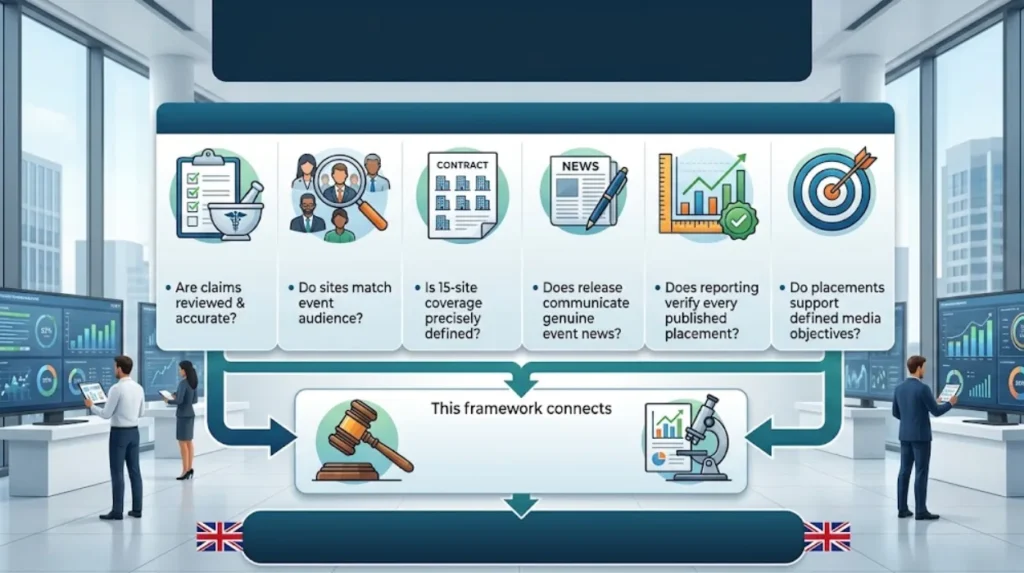
The strongest 15-site pharma event campaign is defined by verified event facts, UK regulatory awareness, relevant publication selection, controlled editorial content, measurable placement targets, transparent reporting, and a clear distinction between distribution and independent editorial coverage.
Before approving a campaign, organisations can assess six factors:
- Compliance: Are pharmaceutical claims reviewed and accurately presented?
- Relevance: Do the selected sites match the event’s audience?
- Scope: Does 15-site coverage have a precise contractual definition?
- Editorial quality: Does the release communicate genuine event news?
- Measurement: Does reporting verify every published placement?
- Outcome alignment: Do the placements support the organisation’s defined media objective?
Explore More Expert Insights:
Why Times Intelligence Beats UK Event Coverage Competitors in 2026
Expo News Coverage Services Across 15 UK Sites
This framework provides a practical basis for selecting pharmaceutical event news coverage across 15 compliant UK sites. It connects regulatory discipline with measurable media distribution and gives decision-makers a clear method for assessing service quality.



