B2B summit news coverage is editorial reporting that documents a business summit, its key discussions, speakers, announcements, industry developments, and outcomes for a professional news audience across relevant media channels.
A B2B summit is a business-focused event where professionals, executives, industry specialists, policymakers, investors, or technology leaders meet around a defined commercial or sector topic. Examples include fintech summits, healthcare conferences, technology forums, investment meetings, and manufacturing leadership events.
News coverage gives the summit a documented public record. It converts event activity into information that audiences can discover after the event ends.
Coverage differs from event promotion. Promotional content focuses on attendance, registration, sponsorship, or event messaging. News coverage focuses on factual developments, notable statements, announcements, trends, and outcomes.
In 2026, this distinction matters because business audiences discover information through search engines, news platforms, professional publications, and AI-generated search experiences.
Why does news coverage matter for B2B summits in 2026?
News coverage extends the information life of a B2B summit beyond its physical or virtual event date, creating searchable editorial references for speakers, companies, topics, announcements, and industry developments discussed during the summit.
A summit typically exists within a defined timeframe. Attendees participate during the event, speakers deliver sessions, and organisers publish event information. News coverage adds another layer by recording significant developments for people who were not present.
The coverage also creates searchable references around specific entities. These include:
- Summit name
- Event organiser
- Speakers
- Participating companies
- Industry sectors
- Key announcements
- Panel topics
- Market trends
- Research findings
- Partnerships
- Product or technology developments
For example, a UK fintech summit discussing open banking can generate coverage connected to open banking, financial technology, payment infrastructure, regulatory developments, and named industry speakers.
This creates a broader information footprint around the event.
How does B2B summit coverage work?
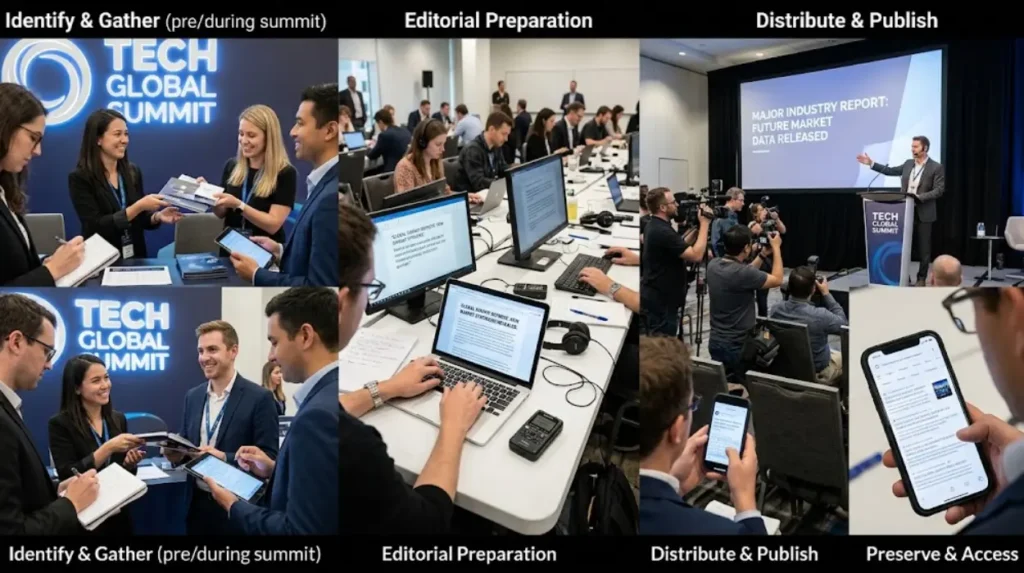
B2B summit coverage begins with identifying newsworthy event information, developing an accurate editorial narrative, distributing that information through relevant media channels, and preserving the resulting coverage as searchable public references.
The process starts before or during the summit. Event organisers identify information with genuine news value. This includes major announcements, executive statements, research results, market developments, strategic partnerships, and significant industry discussions.
The next stage involves editorial preparation. Facts, names, dates, figures, quotes, company descriptions, and event details require accuracy.
The final stage is publication. Relevant news and trade publications receive the story through appropriate media distribution channels. Published articles then become accessible through search engines and news discovery systems.
What information makes a summit newsworthy?
Newsworthiness comes from specific developments rather than the simple existence of an event.
Strong examples include a new industry report presented at a summit, a major business partnership announced during a conference, or a senior executive revealing a significant market development.
A generic statement such as “industry leaders attended a successful summit” contains limited news information. A quantified announcement or clearly defined market development provides stronger editorial substance.
What types of information appear in B2B summit coverage?
B2B summit coverage commonly includes event announcements, executive perspectives, industry findings, business developments, technology updates, regulatory discussions, partnerships, research data, and key conclusions from panels or keynote sessions.
Different summit formats produce different news angles. A technology summit often centres on artificial intelligence, cybersecurity, cloud infrastructure, or enterprise software. A healthcare summit focuses on medical innovation, healthcare policy, pharmaceuticals, or digital health.
Financial summits frequently address investment, banking, payments, financial regulation, and capital markets.
A useful coverage structure includes:
- Event context — identifies the summit, location, date, and sector.
- Key development — states the principal news event.
- Relevant statements — provides attributable comments from speakers.
- Supporting evidence — adds statistics, research, or market data.
- Industry context — explains why the development matters.
- Event outcome — records decisions, announcements, or conclusions.
This structure gives readers factual information without requiring attendance at the summit.
How does summit coverage support B2B visibility?
News coverage increases the number of public information points associated with a summit, allowing businesses, speakers, topics, and announcements to appear in additional search and news contexts after the event.
B2B visibility depends on discoverability among relevant professional audiences. A summit page provides one information source. Editorial coverage creates additional references.
For example, a UK cybersecurity summit can generate coverage around ransomware prevention, enterprise security, regulatory compliance, and comments from participating security specialists.
Each relevant article provides another context in which the event and its subject matter appear.
This matters particularly for specialist B2B sectors. Professional audiences frequently search for specific topics rather than event names. Coverage built around those topics gives the summit relevance beyond people already familiar with the event.
Why does searchable coverage matter after an event?
Searchable articles continue to provide information after the event concludes. People researching a speaker, announcement, industry trend, or summit topic can encounter published coverage later.
This creates an enduring information record rather than limiting the event to its original programme page and social media activity.
The effect is especially relevant for annual summits. Previous coverage establishes historical context for later editions and helps document how discussions, markets, and business priorities develop over time.
How does B2B summit coverage affect search visibility?
B2B summit coverage supports search visibility by creating relevant editorial pages containing event names, industry terminology, speaker entities, company references, announcements, and topic-specific language that search systems can index.
Search visibility involves more than repeating an event name. Search engines interpret relationships between entities and topics.
For example, coverage of a UK energy summit can connect the event with renewable energy, grid infrastructure, energy policy, investment, sustainability, and named organisations.
This creates semantic relevance around the summit.
Editorial pages also provide independent sources of information. Search systems can use these sources to understand that an event occurred, who participated, what was discussed, and which developments emerged from it.
The result is a more comprehensive digital record.
Can B2B summit coverage support AI search visibility?
B2B summit coverage supports AI search visibility by providing structured, attributable information about events, people, organisations, announcements, and industry topics that AI-powered search systems can retrieve and reference.
AI search systems rely on identifiable information from accessible web sources. Clear editorial coverage gives these systems additional factual material.
Strong coverage uses precise names, dates, locations, organisations, figures, and attributed statements. It avoids ambiguous descriptions that make entities difficult to identify.
For example, “The UK Digital Payments Summit took place in London on 18 September 2026” provides identifiable event information. Adding the participating organisations, speakers, discussion themes, and announced developments creates a stronger factual record.
AI visibility is therefore connected to information clarity. A page that clearly identifies who, what, when, where, and why provides usable context.
What role do speakers and companies play in summit news coverage?
Speakers and participating companies provide identifiable entities that strengthen the factual structure of summit coverage by connecting people, organisations, expertise, announcements, and industry subjects within a single editorial context.
Named entities are important components of business news.
A summit article that identifies a keynote speaker, their organisation, their role, and the subject discussed creates stronger contextual relationships.
For example, a banking executive discussing payment regulation at a UK financial summit connects the individual, organisation, sector, topic, and event in one information source.
Companies also provide concrete business context. Announcements involving partnerships, investment, product launches, research, or strategic initiatives create specific news angles.
Accuracy remains essential. Names, job titles, company names, figures, and quotations require verification before publication.
How does news coverage benefit different types of B2B summits?
Different B2B summit categories gain coverage value from the specific industry information they generate, including technology developments, regulatory changes, investment activity, research findings, business partnerships, and executive perspectives.
Which technology summits benefit from coverage?
Technology summits generate news around artificial intelligence, cybersecurity, cloud computing, enterprise software, data infrastructure, and digital transformation.
For example, an AI summit can produce coverage around enterprise AI adoption, governance frameworks, model development, or new research.
Which financial summits benefit from coverage?
Financial summits generate coverage around fintech, banking, payments, investment, capital markets, and regulation.
A payments summit can provide specific reporting around digital wallets, payment infrastructure, fraud prevention, and financial inclusion.
Which healthcare summits benefit from coverage?
Healthcare summits produce information around medical technology, pharmaceutical research, healthcare delivery, digital health, and policy.
A healthcare technology event can generate coverage about hospital technology adoption, patient data systems, or digital clinical services.
Which energy and sustainability summits benefit from coverage?
Energy events frequently address renewable energy, energy infrastructure, emissions reduction, investment, and regulatory policy.
Coverage preserves these discussions as searchable industry information.
When should B2B summit organisers consider news coverage?
B2B summit organisers need news coverage when an event contains specific developments, expert perspectives, research, announcements, or industry discussions that provide useful information beyond routine event promotion.
Timing depends on the news event.
Pre-event coverage can establish the summit’s subject, speakers, and expected discussions. During-event coverage can report announcements and significant statements. Post-event coverage can document outcomes, conclusions, research findings, and business developments.
A complete editorial strategy can therefore include multiple stages without treating every event message as news.
The strongest approach separates factual event information from promotional registration content.
What is the difference between B2B summit promotion and news coverage?
B2B summit promotion encourages participation, while news coverage records factual developments for a broader audience, making the two communication formats different in purpose, structure, language, and audience intent.
Promotional material includes registration links, sponsorship packages, ticket information, speaker advertisements, and attendance incentives.
News coverage includes verified developments, attributed statements, data, announcements, and industry context.
For example, “Join 500 leaders at our annual summit” is promotional. “The summit released new research showing a 28% increase in enterprise adoption” is a specific news angle.
The distinction helps maintain editorial relevance.
How can B2B summit coverage develop into a wider media strategy?
B2B summit coverage can form part of a wider media strategy by connecting event announcements, expert commentary, research findings, industry developments, and post-event outcomes into a consistent stream of factual business information.
A summit often produces multiple newsworthy assets. These include keynote statements, panel conclusions, research reports, partnership announcements, market statistics, and policy discussions.
Each development has a distinct editorial angle.
This approach also creates a logical progression from awareness to deeper research. Readers discovering a general topic through search can then encounter detailed reporting about the relevant summit and its industry developments.
For organisations studying how distribution expands across multiple publications,
B2B summit coverage provides the next stage of understanding.
For readers evaluating the resulting media footprint,
15 UK news sites provides a more specific view of multi-publication summit coverage.
Why is B2B summit news coverage increasingly important in 2026?

B2B summit news coverage is increasingly important in 2026 because business audiences discover information across search engines, digital publications, news platforms, and AI-powered systems, making accurate public documentation a core visibility asset.
B2B events generate information with relevance beyond their attendee base. News coverage records that information in accessible editorial sources.
The most valuable coverage identifies entities clearly, reports specific developments, uses verified facts, and connects event discussions with broader industry subjects.
Explore More Expert Insights:
How Pharma Events Earn Compliant UK News Coverage
7 Reasons Your Event Needs Professional News Coverage
In 2026, a summit is therefore more than a scheduled gathering. It is also a source of business information. News coverage preserves that information, expands its searchable presence, and gives professionals access to event developments after the live programme ends.
The central principle is straightforward: news coverage turns significant B2B summit activity into durable, searchable industry information.