Charity gala news coverage across 15 UK news sites means securing editorial exposure for one gala announcement across multiple relevant publications. The coverage extends event visibility, strengthens digital authority, supports donor communications, and creates measurable media assets for the organising charity.
A charity gala is a formal fundraising event organised to generate donations, recognise supporters, attract sponsors, and increase public awareness of a charitable cause. News coverage turns the event into a documented media story rather than limiting visibility to attendees and existing supporters.
Coverage across 15 UK news sites creates a broader distribution footprint. It can include national, regional, business, lifestyle, charity, entertainment, and community publications when the story fits their editorial requirements.
For organisations evaluating a media distribution service, the objective is not simply to count 15 URLs. The relevant assessment includes publication quality, geographic relevance, editorial presentation, story consistency, indexing, reporting, and the commercial or fundraising objective behind the campaign.
Organisations researching the earlier stages of the process can review:
Charity gala coverage to understand how distribution reaches multiple UK publications.
How is a charity gala announcement prepared for distribution across 15 UK news sites?
A charity gala announcement is prepared by defining the news angle, confirming event facts, identifying supporting evidence, writing an editorial release, selecting relevant media categories, checking compliance, and formatting assets before distribution to targeted UK news publications.
What information belongs in the announcement?
A strong charity gala release establishes the essential event facts first:
- Charity or organisation name
- Gala date and location
- Fundraising purpose
- Confirmed fundraising target
- Amount raised, where applicable
- Named speakers or guests
- Sponsors and partners
- Beneficiary information
- Notable programme details
- Official quotes
- Event photographs
- Donation or registration information
- Contact details
The release also needs a clear news angle. “Charity hosts annual gala” provides limited differentiation. A stronger angle identifies a specific development, such as a £250,000 fundraising target, a new national initiative, a major corporate partnership, or recognition of a measurable community outcome.
Why does the news angle affect publication potential?
UK news sites receive large volumes of announcements. Editors need a reason to publish a story.
A charity gala becomes more newsworthy when the announcement contains verifiable facts, named entities, public interest, financial context, community impact, or a significant event development.
For example, a gala raising £500,000 for children’s education provides a clearer editorial proposition than an announcement containing only venue and attendance information.
Which components determine the quality of 15-site charity gala coverage?
The quality of 15-site charity gala coverage depends on publication relevance, editorial accuracy, geographic diversity, story consistency, media authority, image availability, live URLs, indexing status, and reporting depth rather than the publication count alone.
Publication relevance
A 15-site campaign needs publications relevant to the charity’s audience and story.
For example, a London-based healthcare charity can prioritise UK business publications, London news outlets, healthcare media, charity publications, and community-focused sites.
Geographic coverage
Geographic distribution helps organisations reach audiences beyond the event venue.
A gala in Manchester can support coverage across Greater Manchester publications while also targeting UK-wide business, charity, lifestyle, or national news audiences.
Editorial consistency
Every published version needs to preserve the factual core of the original announcement. Names, dates, fundraising figures, quotes, organisations, and event details require accuracy.
Inconsistent figures across publications create credibility problems and complicate reporting.
Visual assets
Professional event photography increases the usability of the story. Images can show the gala venue, speakers, guests, award recipients, fundraising activity, or representatives of the beneficiary organisation.
Image captions and alternative text also provide useful contextual information for digital publication.
How does a 15-site charity gala media distribution process work?
A 15-site distribution process starts with campaign planning, continues through editorial preparation and publication outreach, and ends with coverage monitoring and reporting. Each stage connects the charity’s event objective with measurable media distribution outcomes.
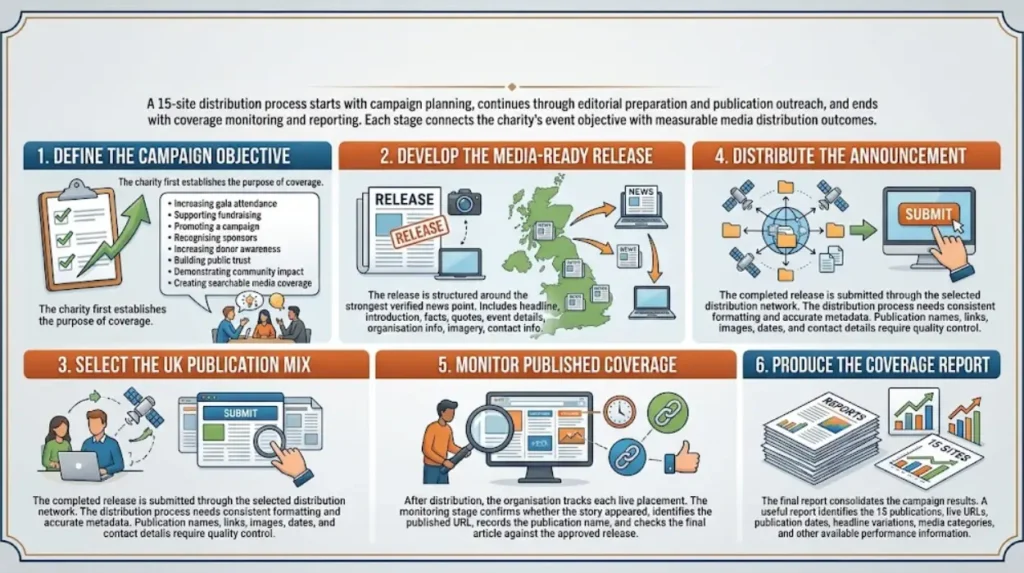
1. Define the campaign objective
The charity first establishes the purpose of coverage.
The objective can focus on:
- Increasing gala attendance
- Supporting fundraising
- Promoting a campaign
- Recognising sponsors
- Increasing donor awareness
- Building public trust
- Demonstrating community impact
- Creating searchable media coverage
The objective determines the story angle and publication selection.
2. Develop the media-ready release
The release is structured around the strongest verified news point.
It includes a headline, introduction, supporting facts, quotes, event details, organisation information, imagery, and contact information.
3. Select the UK publication mix
The campaign then identifies suitable news sites.
A 15-publication strategy can combine national and regional outlets with sector-specific publications. The selection depends on the charity, gala location, beneficiary, audience, and story.
4. Distribute the announcement
The completed release is submitted through the selected distribution network.
The distribution process needs consistent formatting and accurate metadata. Publication names, links, images, dates, and contact details require quality control.
5. Monitor published coverage
After distribution, the organisation tracks each live placement.
The monitoring stage confirms whether the story appeared, identifies the published URL, records the publication name, and checks the final article against the approved release.
6. Produce the coverage report
The final report consolidates the campaign results.
A useful report identifies the 15 publications, live URLs, publication dates, headline variations, media categories, and other available performance information.
What makes 15 UK news sites valuable for a charity gala?
Fifteen UK news placements create multiple documented media touchpoints for one event. They expand discoverability, provide evidence for sponsors and trustees, support digital communications, and create reusable media assets after the gala has ended.
The value comes from distribution breadth combined with relevance.
A charity can use published coverage in sponsor reports, annual communications, fundraising presentations, social media campaigns, stakeholder updates, and future event promotion.
The coverage also creates a permanent digital record of the gala when publications retain their articles online.
How does coverage support sponsor visibility?
Sponsors often need evidence that their partnership generated public exposure.
Published articles can document sponsor participation where the sponsor is relevant to the story and included within the approved release.
For example, a corporate sponsor supporting a £300,000 gala campaign can reference legitimate media coverage within its corporate social responsibility reporting.
How does coverage support fundraising communication?
Charities can use published articles as third-party media references when communicating the success of a campaign.
The organisation can share selected coverage through donor newsletters, campaign pages, social media posts, stakeholder emails, and annual reports.
The media coverage does not replace direct fundraising communication. It provides supporting evidence of public activity and organisational engagement.
How should charities measure the results of 15-site gala coverage?
Charities should measure 15-site coverage through publication count, live placements, audience relevance, geographic distribution, indexed URLs, referral activity, engagement, brand visibility, and campaign outcomes linked to fundraising, attendance, sponsorship, or stakeholder communications.
Publication metrics
The first measurement layer confirms distribution.
Track:
- Number of targeted publications
- Number of live articles
- Publication categories
- Geographic coverage
- Publication dates
- Article URLs
- Image inclusion
- Headline variations
If 15 placements were contracted, the final report needs to distinguish between the intended distribution and confirmed live coverage.
Digital visibility metrics
Digital performance provides a second measurement layer.
Relevant metrics include search visibility, indexed pages, referral traffic, branded search activity, social engagement, and interactions with linked campaign destinations.
These metrics require separate analytics systems when the publisher does not provide detailed traffic information.
Business and fundraising outcomes
The strongest evaluation connects coverage with the original campaign objective.
For example, a gala campaign can track:
- Event registrations
- Donation-page visits
- Donations
- Sponsor enquiries
- Volunteer enquiries
- Newsletter subscriptions
- Social engagement
- Corporate partnership enquiries
The reporting period needs to match the campaign objective. A fundraising campaign requires different measurement from a sponsor-recognition campaign.
When is a 15-site charity gala coverage service the right choice?
A 15-site coverage service fits charities that need structured UK media distribution, documented publication results, wider event visibility, and a consolidated reporting process without coordinating individual publication submissions and follow-ups separately.
The model is particularly relevant when a charity has a defined news event and requires measurable media output.
It also fits organisations working with sponsors that expect documented publicity, charities launching fundraising initiatives around a gala, and organisations using media coverage as part of a wider communications campaign.
A direct distribution service provides a defined media-placement objective. Traditional PR retainers provide broader strategic services, such as campaign planning, media relations, journalist outreach, crisis communications, and ongoing reputation management.
The correct choice depends on the required outcome.
For a single gala announcement with a defined 15-site distribution requirement, a structured media distribution campaign provides a more specific scope.
What should charities check before choosing a UK gala news coverage provider?
Charities should verify the provider’s publication network, placement definition, reporting method, editorial process, turnaround time, image support, campaign requirements, pricing structure, and policies governing live coverage before committing to a 15-site distribution campaign.
Publication verification
Ask for the type of publications included in the campaign.
A provider needs to distinguish between recognised news websites, automated syndication pages, directories, blogs, and unrelated websites.
The charity also needs to confirm whether the 15-site figure represents 15 unique publications or multiple versions across a smaller network.
Coverage definition
Clarify what counts as a completed placement.
The agreement needs to specify whether a live article, indexed article, publication URL, or distribution record represents fulfilment.
Reporting
A professional campaign report needs clear evidence.
The charity should receive publication names, URLs, dates, and relevant performance information available from the distribution provider.
Editorial requirements
Charity announcements need accurate facts and compliant claims.
The provider needs a defined process for reviewing content, formatting releases, handling images, and addressing publication requirements.
How can a charity prepare a gala release for 15 UK publications?
A charity can prepare a gala release by identifying one strong news angle, confirming every factual claim, adding measurable fundraising information, supplying professional images, securing approved quotes, and preparing publication-ready contact and organisation details.
The preparation process starts before distribution.
First, identify the single fact that makes the gala newsworthy. Next, confirm dates, figures, names, venues, sponsors, beneficiaries, and quotations. Then prepare the supporting media assets.
The headline needs to communicate the primary news point.
The opening paragraph needs to answer who, what, where, when, and why. Supporting paragraphs provide evidence and context.
The final section provides organisation information and an appropriate contact route.
This structure gives publications a clear, factual article that requires limited interpretation.
What outcomes can a charity expect from a 15-site coverage campaign?
A 15-site charity gala campaign produces a documented UK media footprint that supports event visibility, sponsor reporting, fundraising communications, search discovery, stakeholder engagement, and long-term digital evidence of the charity’s public activities.
The immediate outcome is published media exposure.
The longer-term outcome is a collection of media assets that the charity can reuse across communications channels.
The campaign also gives marketing and communications teams a measurable distribution record. Instead of reporting that a gala received “wide coverage,” the organisation can identify specific publications and live URLs.
For charities evaluating media distribution providers, this distinction is important. A defined 15-site target creates a concrete deliverable that can be compared against campaign objectives, publication relevance, editorial quality, and reporting standards.
Organisations ready to evaluate a structured solution can use:
Charity gala news coverage as the decision-stage reference point for planning distribution, assessing deliverables, and measuring campaign results.
What is the best way to evaluate a 15-site charity gala coverage campaign?
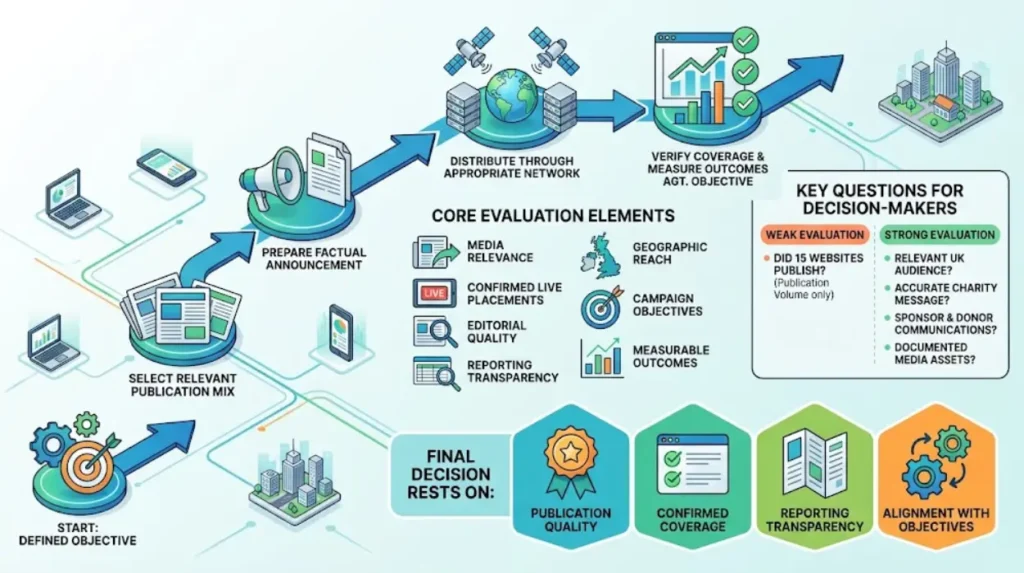
The best evaluation combines media relevance, confirmed live placements, editorial quality, geographic reach, reporting transparency, campaign objectives, and measurable outcomes. Publication volume alone does not establish the effectiveness of charity gala news coverage.
A successful campaign starts with a defined objective.
The charity then selects a relevant publication mix, prepares a factual announcement, distributes the release through an appropriate network, verifies the resulting coverage, and measures outcomes against the original objective.
For decision-makers, the key question is not simply whether 15 websites published the announcement. The stronger evaluation asks whether those 15 placements reached relevant UK audiences, communicated the charity’s message accurately, supported sponsor and donor communications, and generated documented media assets.
Explore More Expert Insights:
Times Intelligence vs Newswire: 15-Site Event Coverage Compared
Event Coverage vs PR Agency: Why 15 News Sites Win
This approach makes charity gala news coverage across 15 UK news sites a measurable communications activity rather than an undefined publicity claim.
For charities planning an upcoming gala, the final decision rests on four measurable factors: publication quality, confirmed coverage, reporting transparency, and alignment with the event’s fundraising or communications objective.