News coverage is third-party publication of information about a person, organisation, event, research finding, or announcement. In SEO, coverage creates discoverable references from external websites, including news publishers, industry publications, regional outlets, and specialist media with established audiences and searchable content.
News coverage connects a subject with independent online publications. A published article contains contextual references, branded mentions, quotes, statistics, or links to relevant websites.
For search engines, these references provide signals about entities, topics, relationships, and online prominence. The value depends on the publication, relevance, editorial context, link attributes, and surrounding content.
News coverage differs from publishing content on a company website. The company controls its own website content. A publisher controls the external article and its editorial context.
How Do News Articles Create Backlinks?
A backlink is a hyperlink from one website to another website. News articles create backlinks when publishers reference a source, organisation, research document, event page, product page, or other relevant destination within editorial content published online.
A backlink connects two web documents. The referring page contains the hyperlink. The destination page receives the link.
For example, a technology publication covering a software announcement can link to the company’s announcement page. A business publication covering new research can link to the original report. A regional newspaper covering an event can link to the event information page.
Common backlink destinations include:
- Official websites
- Research reports
- Data studies
- Event pages
- Corporate announcements
- Expert profiles
- Product information
- Regulatory documents
Not every news article includes a backlink. Some publications use plain-text brand mentions. Others use links selectively based on editorial relevance.
What Is the Difference Between a Backlink and a Brand Mention?
A backlink contains a clickable hyperlink. A brand mention identifies an organisation, person, product, or project without necessarily linking to a website.
Both forms contribute to online entity recognition. A backlink provides a direct connection between web documents. A mention provides contextual information that search systems can associate with an entity.
Why Do Backlinks Matter for SEO Authority?
Backlinks matter because search engines use links to discover pages, understand relationships between websites, and evaluate external references. Relevant links from established publications provide stronger contextual signals than unrelated links from low-quality or irrelevant websites.
SEO authority describes the strength and credibility associated with a website or topic within search systems. It is not a single universal score assigned by search engines.
External links form part of a wider search ecosystem. A publication linking to a website establishes a documented relationship between the two pages.
Relevance remains important. A backlink from a respected financial publication about financial research has stronger topical alignment than a link from an unrelated entertainment website.
Other factors also influence search performance:
- Content quality
- Search intent alignment
- Internal linking
- Website architecture
- Crawlability
- Entity clarity
- Page experience
- Topical coverage
- External references
Backlinks therefore work as one component of a broader SEO system.
Does Every Backlink Have the Same SEO Value?
No. Links differ according to source relevance, editorial placement, destination relevance, surrounding text, accessibility, and link attributes.
A contextual link inside an article about the same subject provides clearer topical information than a generic link placed in an unrelated section.
Search engines also distinguish link attributes such as nofollow, sponsored, and ugc. These attributes communicate information about the relationship between the referring page and destination.
How Does News Coverage Build Topical Authority?

Topical authority develops when a website consistently demonstrates useful knowledge about a defined subject. News coverage supports this process by connecting the website, its people, research, announcements, and expertise with relevant external publications and topic-specific editorial contexts.
Topical authority involves breadth, depth, relevance, and relationships between related concepts.
For example, a company operating in renewable energy can receive coverage about solar technology, energy storage, grid infrastructure, sustainability research, and industry regulation. Each relevant article adds another external context around the entity.
The relationship becomes stronger when publications cover connected subjects rather than isolated keywords.
Search engines evaluate content within broader topical systems. Clear terminology helps establish those relationships.
Which Signals Strengthen Topical Relevance?
Several signals work together:
- Subject-specific terminology
- Consistent entity references
- Relevant external links
- Expert commentary
- Original research
- Industry statistics
- Related content
- Consistent publication themes
For example, an article about fintech regulation that references payment services, compliance requirements, financial institutions, and regulatory frameworks creates a richer semantic environment than an article containing a single generic keyword.
How Does News Coverage Support Link Discovery?
News coverage supports link discovery because search engines continuously crawl published web pages and follow accessible hyperlinks between documents. New articles therefore create additional pathways connecting websites, pages, entities, research, events, and other indexed resources across the wider web.
Search engines discover URLs through multiple sources. Links remain an important mechanism because they connect documents within the web graph.
When a news article links to an existing page, crawlers encounter that destination through another published document. The destination then exists within an additional discoverable relationship.
Fresh coverage also creates new URLs. These pages can enter search indexes and appear for relevant queries.
For example, an article covering a UK business conference can contain links to speaker profiles, research documents, event information, and the organisation hosting the event.
This creates multiple connected entities around one news topic.
Does New Coverage Always Improve Rankings?
No. Publishing more articles does not automatically produce higher rankings.
Search performance depends on relevance, content quality, technical accessibility, competition, search intent, and the overall authority of the website.
Ten highly relevant editorial links from recognised publications provide a different SEO environment from hundreds of unrelated or low-quality links.
Quality and contextual relevance remain central.
What Makes a News Backlink Valuable?
A valuable news backlink comes from a relevant, accessible, established publication and appears within useful editorial content. The destination page must also match the subject of the article, creating a clear relationship between source, context, entity, and linked information.
Backlink value involves several measurable characteristics.
How Does Publication Relevance Affect Backlink Value?
A relevant publication provides stronger topical context. A healthcare article linking to clinical research has direct subject alignment. A construction publication linking to infrastructure research provides another relevant industry relationship.
Geographic relevance also matters. UK-focused businesses benefit from coverage within relevant UK publications because the content establishes geographic and topical associations.
Examples include:
- UK business publications
- Regional newspapers
- Trade magazines
- Professional journals
- Industry news websites
- Specialist technology publications
Why Does Editorial Context Matter?
Editorial context explains why the link exists.
A link embedded within a sentence discussing a research report has clearer meaning than a link positioned in a generic website directory.
The surrounding words help establish the relationship between the referring page and destination page.
How Does News Coverage Create Long-Term SEO Benefits?
News coverage creates long-term SEO value when published articles remain accessible, indexed, relevant, and connected to useful destination pages. Persistent coverage expands the number of external references associated with an entity and provides continuing opportunities for discovery through search.
A published article can remain searchable after the original announcement date.
An article about a business milestone, research finding, event, or industry development can continue attracting searches when its subject remains relevant.
Long-term value comes from persistence and relevance rather than publication volume alone.
A strong article can also attract secondary attention. Other websites can discover the article and reference its information in their own content.
This creates an additional layer of external visibility.
Can One News Article Generate More Than One SEO Benefit?
Yes. One article can provide several forms of value:
- A backlink to an official page.
- A brand or entity mention.
- Search visibility for the article itself.
- Referral traffic from readers.
- A citation source for later content.
- Additional discovery opportunities for related pages.
The combined effect depends on the publication, article quality, relevance, and continued accessibility.
How Does Event Coverage Connect With Backlink Strategy?
Event coverage connects events with SEO by turning sessions, announcements, speakers, research, and outcomes into published editorial assets. These articles can contain relevant backlinks while establishing topical, geographic, and entity relationships around the event and participating organisations.
Events generate multiple information types.
A conference can produce speaker insights, research findings, panel discussions, announcements, statistics, interviews, and audience questions. Each element creates potential editorial context.
For example, coverage of a UK technology event can reference the event website, speaker profiles, research findings, participating organisations, and published announcements.
This creates a structured network of related entities.
For readers exploring the next stage of this topic,
For decision-focused exploration,
Why Are Events Useful Sources of Linkable Information?
Events often contain original information that does not exist elsewhere. Speakers introduce new findings. Organisations announce developments. Panels discuss industry changes. Research presentations provide statistics.
Original information gives publishers a factual reason to reference an event or its associated resources.
The strongest link opportunities therefore come from useful information rather than link placement alone.
How Can Organisations Build SEO Authority Through News Coverage?
Organisations build SEO authority through relevant news coverage by providing accurate information, original evidence, expert commentary, useful resources, and clear destination pages. Consistent external references then reinforce relationships between the organisation, its expertise, its topics, and its digital assets.
The process begins with useful information.
A factual announcement provides stronger editorial material than promotional language without evidence. Research, statistics, expert commentary, documented developments, and significant events provide clearer reasons for coverage.
The destination website also needs logical structure. A publisher linking to a research report needs an accessible research page. A publisher referencing an event needs an informative event page.
What Content Attracts Editorial References?
Useful linkable content includes:
- Original research
- Industry statistics
- Survey findings
- Expert analysis
- Regulatory information
- Event information
- Technical documentation
- Market reports
- Public datasets
- Detailed guides
Each resource gives publishers a specific destination for supporting information.
The objective is not simply to obtain links. The broader SEO objective is to establish a credible relationship between the organisation and the subjects it represents.
What Is the Overall SEO Impact of News Coverage?
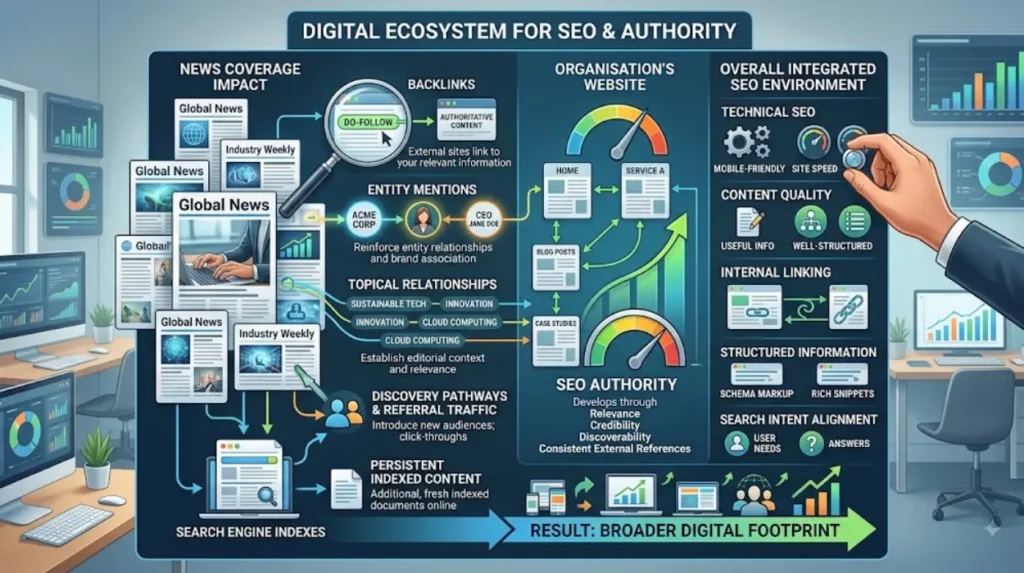
News coverage supports SEO through backlinks, entity mentions, topical relationships, discovery pathways, referral traffic, and persistent indexed content. Its strongest impact occurs when relevant publications connect useful external information with clearly structured, authoritative destination pages.
News coverage forms one part of an integrated SEO environment.
Backlinks connect external publications with destination pages. Mentions reinforce entity relationships. Editorial context establishes topical relevance. Published articles create additional indexed documents. Referral traffic introduces new audiences.
These elements work alongside technical SEO, content quality, internal linking, structured information, and search intent alignment.
The result is a broader digital footprint around an organisation and its subject areas.
Explore More Expert Insights:
How Webinars Earn Coverage Across 15 UK News Sites
What News Coverage Looks Like for Hybrid UK Events
SEO authority therefore develops through a combination of relevance, credibility, discoverability, and consistent external references. News coverage contributes to each area when the underlying information is useful and the editorial relationship is genuine.
For organisations seeking stronger organic visibility, understanding how news coverage generates backlinks provides a foundation for evaluating media mentions, editorial links, topical authority, and long-term search performance.