Hybrid event coverage is news reporting that documents an event delivered through both physical and digital channels. It can include event previews, live developments, speaker commentary, attendance details, announcements, outcomes, photographs, and post-event reporting across relevant UK news publications.
A hybrid UK event combines an in-person venue with a digital participation format. Attendees can join physically, online, or through both channels. Examples include business conferences, industry exhibitions, university events, product launches, charity events, cultural programmes, and professional forums.
News coverage turns selected event information into editorial content. The resulting article focuses on information with public, industry, regional, or business relevance.
Coverage differs from event marketing. Event marketing promotes attendance, registration, sponsorship, or commercial activity. News coverage reports an event as a documented development with identifiable facts.
How does news coverage work for a hybrid event?
News coverage follows an editorial process that starts with event information and continues through story selection, reporting, publication, distribution, and audience discovery. Hybrid events add digital participation details alongside conventional venue, speaker, and programme information.
The process normally contains several stages:
- Event information is collected.
- A news angle is identified.
- Relevant facts are organised.
- Editorial content is prepared.
- Publication decisions are made.
- Articles appear on selected news sites.
- Readers discover coverage through search, websites, social platforms, or news aggregation.
The event format affects the information available to journalists. A physical venue provides location, attendance, photography, speakers, demonstrations, and audience interaction. The digital element adds virtual speakers, remote attendance figures, online sessions, streaming details, and digital participation.
These elements create a broader factual record than a traditional physical-only event.
What information appears in an event news story?
A typical article contains the event name, date, location, organisers, purpose, speakers, participants, programme details, key announcements, and relevant outcomes.
For example, a UK technology conference can generate coverage describing its London venue, online attendance, keynote speakers, technology demonstrations, and announcements made during the programme.
The article does not need to reproduce the entire event schedule. Editorial selection determines which details form the central story.
What types of news coverage do hybrid UK events receive?
Hybrid UK events receive different forms of coverage depending on their news value, timing, audience, and available information. Common formats include event announcements, previews, speaker stories, live developments, industry reports, announcement-led articles, and post-event coverage.
Event announcement coverage
Announcement coverage introduces an upcoming event. It identifies the event, date, location, digital participation option, subject area, and principal speakers.
This format appears before the event takes place. It gives readers factual information about what is scheduled.
Event preview coverage
A preview explains why an upcoming event is relevant to a specific audience. It can focus on a major speaker, industry issue, programme theme, new research, or expected announcement.
For example, a UK energy conference can receive preview coverage focused on renewable infrastructure, policy discussions, or investment announcements.
Speaker-led coverage
A prominent speaker can become the central news angle. Coverage focuses on the person’s role, expertise, speech, announcement, or contribution to the event.
A business event featuring a chief executive, government representative, academic, or industry specialist provides clear entities for editorial identification.
Live event coverage
Live or near-live reporting records developments while the event is taking place. It can include announcements, speeches, panel discussions, product demonstrations, audience participation, and other confirmed developments.
Digital access provides additional reporting information because remote participation is part of the event structure.
Post-event coverage
Post-event reporting summarises what happened after the programme concludes. It can include attendance, announcements, speaker statements, key findings, awards, partnerships, launches, and measurable outcomes.
This format provides a completed event record rather than a future event announcement.
What makes hybrid event coverage different from traditional event coverage?
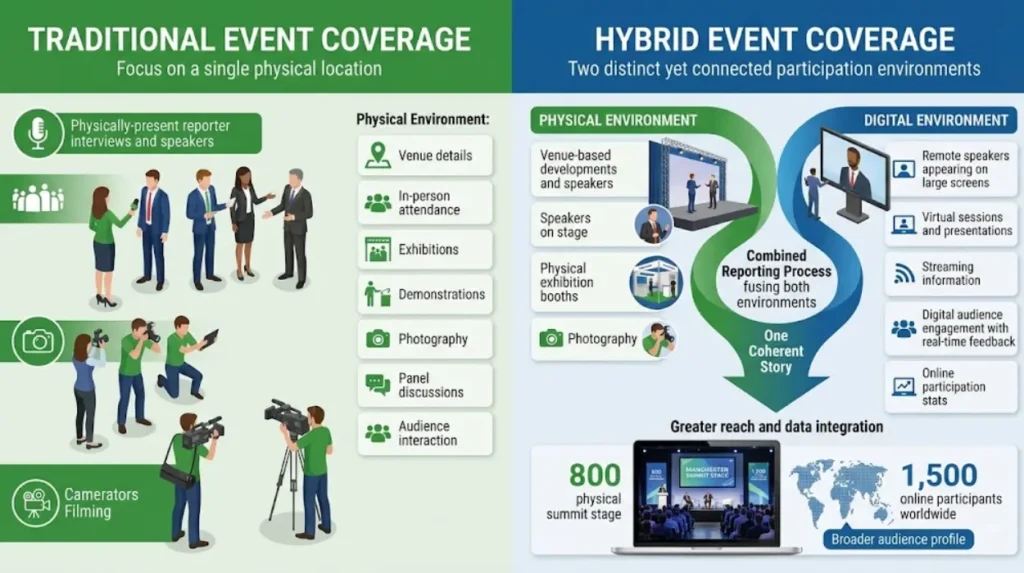
Hybrid event coverage contains information from both physical and digital participation. It therefore includes venue-based developments alongside online sessions, remote speakers, virtual attendance, streaming information, and digital audience engagement within one editorial event record.
Traditional event coverage primarily records activity at a physical location. Hybrid coverage has two connected participation environments.
The physical environment can provide:
- Venue details
- In-person attendance
- Exhibitions
- Demonstrations
- Photography
- Panel discussions
- Audience interaction
The digital environment can provide:
- Remote speakers
- Virtual sessions
- Online attendance
- Digital presentations
- Remote questions
- Streaming activity
- Online participation
The reporting process combines these elements into one coherent story.
For example, a Manchester business summit with 800 physical attendees and 1,500 online participants presents a broader attendance profile than a venue-only event. Coverage can report the two participation formats separately while treating them as one event.
What news angles are used for hybrid UK events?
News angles identify the specific fact that makes an event relevant to readers. Hybrid event angles include major announcements, new research, industry developments, prominent speakers, attendance milestones, regional significance, technology adoption, partnerships, and measurable event outcomes.
The event itself is not always the complete news angle. Editorial coverage needs a specific development or information point.
Announcements
A new product, partnership, investment, policy initiative, research finding, or organisational development provides a defined news angle.
Research and data
New statistics can create coverage around measurable developments. For example, an event presenting research about UK consumer behaviour provides specific factual information for an article.
Industry developments
Events focused on finance, technology, healthcare, education, property, manufacturing, or energy can generate sector-specific coverage when the event addresses an identifiable industry development.
Regional relevance
The UK location can provide an important angle. An event in Birmingham, Leeds, Glasgow, Cardiff, Bristol, Edinburgh, or Manchester can have regional significance when its subject directly relates to the local economy, community, institution, or industry.
Participation scale
Attendance figures provide measurable information. A hybrid event can report physical and digital participation separately.
This distinction matters because online participation does not represent the same activity as physical attendance.
How do journalists evaluate information from hybrid events?
Journalists evaluate event information according to relevance, accuracy, timeliness, identifiable sources, audience interest, and editorial usefulness. Hybrid events provide additional information, but each fact still requires clear context, attribution, and verification before becoming part of news coverage.
Event information needs identifiable sources. Speakers, organisers, researchers, companies, institutions, and official reports can provide attribution.
Specific information is more useful than general claims. A statement such as “the event attracted strong interest” provides limited factual detail. A verified attendance figure gives a measurable reference point.
Timing also affects coverage. Information released during an event has a different editorial position from information published several weeks later.
The strongest factual details usually answer basic journalistic questions:
- What happened?
- Who was involved?
- Where did it happen?
- When did it happen?
- Why is it relevant?
- What changed as a result?
- What evidence supports the claim?
These questions help establish a clear event narrative.
What does coverage look like across multiple UK news sites?
Coverage across multiple UK news sites consists of separate published articles that identify the same event while presenting information for different audiences. Publication formats, headlines, story angles, article length, regional emphasis, and editorial context vary between news websites.
One hybrid event can therefore produce different forms of coverage.
A national business publication can focus on an investment announcement. A regional publication can focus on the event’s local economic relevance. A specialist publication can focus on a technical development.
The underlying event remains the same. The editorial context changes.
This creates an important distinction between distribution and duplication. Distribution places event information within relevant publication environments. Editorial coverage presents that information according to each publication’s audience and format.
Readers exploring the next stage can learn more about:
Hybrid event coverage across multiple news sites to understand how publication environments differ.
How does search affect discovery of hybrid event coverage?
Search engines help readers discover hybrid event coverage through event names, speaker names, organisations, announcements, locations, industry terms, and distinctive factual details. Clear entities and specific information make published articles easier to understand and retrieve.
Search discovery depends on the information contained in an article.
Important entities include:
- Event name
- Organisation name
- Speaker names
- Venue
- UK city or region
- Industry
- Product or service
- Research report
- Announcement
- Event date
A clear article connects these entities through factual relationships.
For example, an article can establish that a named organisation hosted a technology conference in London, that a named executive delivered the keynote, and that the event announced a specific initiative.
This structure gives search systems identifiable entities and relationships.
What benefits does news coverage provide for hybrid events?
News coverage creates a public record of an event and extends information beyond attendees. It documents announcements, speakers, developments, and outcomes while allowing people who did not participate physically or digitally to discover the event through published editorial content.
Coverage creates several informational outcomes.
Public visibility
Published articles allow non-attendees to learn what happened at the event.
Search visibility
Articles can become searchable references for event names, speakers, organisations, announcements, and related topics.
Industry documentation
Coverage records developments that matter to professional audiences. This creates a dated reference point for announcements and discussions.
Regional awareness
UK regional publications can connect events with specific cities, communities, and local industries.
Post-event reference
Published coverage remains useful after the event. Readers can use it to identify speakers, announcements, findings, and outcomes.
Which hybrid UK events commonly receive news coverage?
Hybrid events across business, technology, education, finance, healthcare, property, energy, culture, and professional sectors generate different forms of news coverage when they contain identifiable developments, relevant participants, measurable information, or announcements that matter to defined UK audiences.
Common examples include:
- Business conferences
- Technology summits
- Financial services events
- University conferences
- Industry exhibitions
- Healthcare forums
- Property conferences
- Energy and sustainability events
- Professional association meetings
- Charity conferences
- Cultural programmes
- Product launches
The coverage depends on the event’s factual content rather than its hybrid format alone.
A virtual component does not automatically make an event newsworthy. The reporting value comes from the people involved, information presented, developments announced, audience relevance, and measurable outcomes.
Explore More Expert Insights:
How Virtual Events Get Real UK News Coverage
Why Festivals Need Multi-Site News Coverage in 2026
How should readers understand the role of hybrid event coverage?
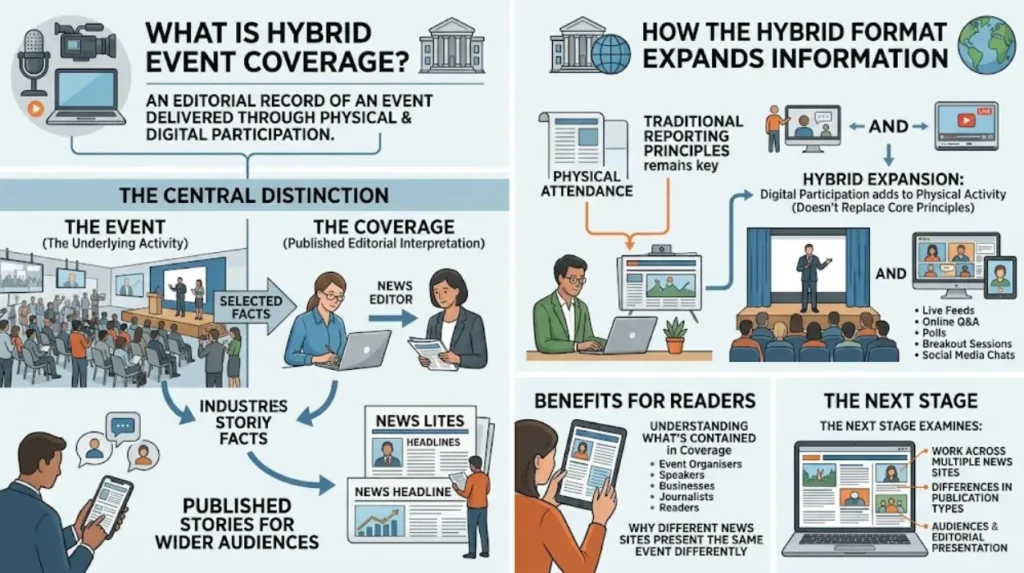
Hybrid event coverage is an editorial record of an event delivered through physical and digital participation. It combines event facts, people, announcements, developments, and outcomes into published stories that reach audiences beyond the original event participants.
The central distinction is between the event and its coverage.
The event is the underlying activity. Coverage is the published editorial interpretation of selected facts from that activity.
A hybrid format expands the available event information by adding digital participation to physical activity. It does not replace traditional reporting principles.
Understanding this process helps event organisers, speakers, businesses, journalists, and readers identify what published coverage contains and why different news sites present the same event in different ways.
The next stage examines how:
Hybrid event coverage works across multiple news sites, including the differences between publication types, audiences, and editorial presentation.