

Hybrid event coverage distributes one event story across 15 relevant UK news sites, combining physical and virtual event information into structured media content that expands visibility, supports search discovery, and creates measurable publication coverage.
Hybrid event coverage connects an event with audiences attending in person and online. Media distribution extends that event beyond the venue and event platform.
For organisations seeking measurable press exposure, publication across 15 news sites creates a defined distribution target. The coverage can include event announcements, speaker information, business developments, product launches, partnerships, awards, or sector-specific announcements.
The key requirement is consistency. The event facts, organisation details, spokesperson information, dates, locations, and supporting evidence must remain accurate across every publication.
The 15-news-site model also creates a practical benchmark for campaign planning. It gives marketers a specific publication target rather than relying on general claims about media reach.
Businesses can use this approach for conferences, webinars, exhibitions, product demonstrations, corporate events, panel discussions, and industry forums.
For organisations comparing distribution options, understanding:
Hybrid event coverage provides the foundation for evaluating a media distribution service.
How does hybrid event coverage work across 15 news sites?
A 15-site campaign starts with event information, develops a publication-ready story, identifies suitable news outlets, distributes the content, monitors publication results, and records each live article for reporting and performance evaluation.
1. Event information is collected
The campaign begins with verified information. This includes:
- Event name
- Event date
- Physical location
- Online participation details
- Speakers and organisations
- Event purpose
- Key announcements
- Registration information
- Supporting statistics
- Contact information
The information defines the factual foundation of the article.
2. The story is prepared
A hybrid event press release needs a clear news angle. The content focuses on what happened, what is being announced, who is involved, and why the information is relevant to the target audience.
A conference announcing a new technology partnership has a different media angle from a charity hosting an online fundraising event. The story structure reflects the specific announcement.
3. Relevant news sites are selected
The 15 publications need to match the event, industry, geography, and audience.
A fintech conference can target financial and business publications. A property event can target construction and property media. A healthcare technology event can target healthcare and technology publications.
Relevance improves the commercial value of coverage because the publication audience aligns with the subject matter.
4. Distribution takes place
The completed content is distributed through the selected media network. Each publication receives the information in a format suitable for its editorial and publishing process.
The campaign then moves from content preparation to publication tracking.
5. Coverage is verified
Each published article is checked for its live URL, headline, publication name, date, and content accuracy.
The final report records the 15 publication outcomes individually.
What components are included in a 15-site hybrid event campaign?
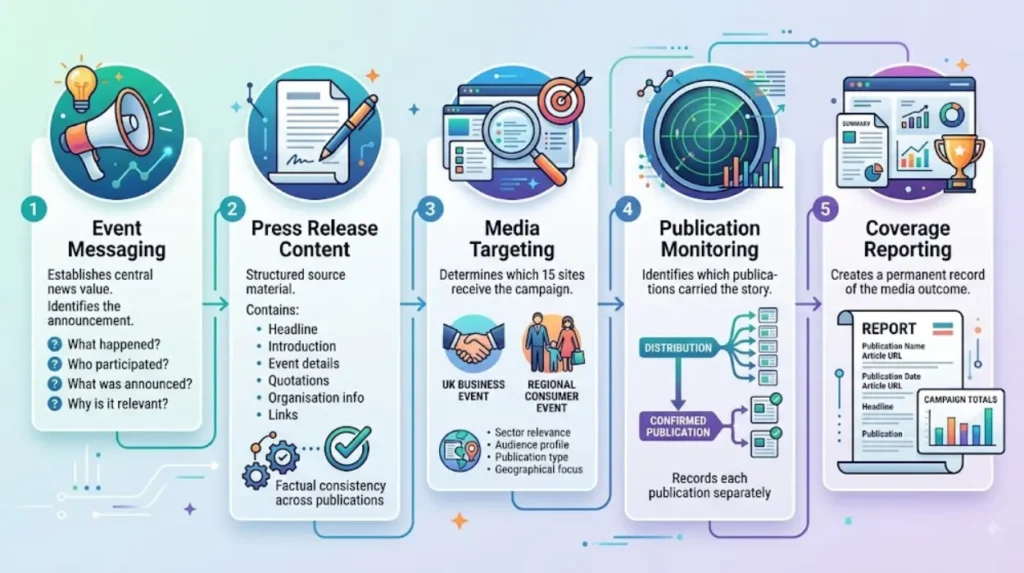
A complete campaign includes event messaging, press release development, media targeting, publication distribution, live-link monitoring, coverage verification, and reporting, giving organisations a defined process from initial event information through confirmed media publication.
Event messaging
The messaging establishes the central news value. It identifies the announcement rather than simply describing the event.
Strong event messaging answers four questions:
- What happened?
- Who participated?
- What was announced?
- Why is the announcement relevant?
Press release content
The press release provides the structured source material for distribution. It normally contains a headline, introduction, event details, supporting information, quotations, organisation information, and relevant links.
The content needs factual consistency because the same core announcement can appear across multiple publications.
Media targeting
Targeting determines which 15 sites receive the campaign.
A UK business event requires different media targeting from a regional consumer event. Sector relevance, audience profile, publication type, and geographical focus all influence selection.
Publication monitoring
Monitoring identifies which publications have carried the story.
A useful campaign report records each publication separately. This provides a clear distinction between distribution and confirmed publication.
Coverage reporting
The final report can include publication names, article URLs, publication dates, headlines, and campaign totals.
This creates a permanent record of the media outcome.
How can a hybrid event get published across 15 UK news sites?
A hybrid event gains publication coverage by presenting a clear newsworthy announcement, using accurate UK-focused information, targeting relevant publications, distributing the story through an established network, and verifying every resulting article after publication.
UK media targeting requires regional and sector awareness.
A London-based technology conference has a different media profile from a manufacturing event in Birmingham. A national announcement also requires different targeting from a regional business development.
The story needs a specific news angle. Generic statements such as “successful event held” provide limited editorial information. A concrete announcement provides stronger content.
For example, a UK sustainability conference announcing a £2 million industry partnership contains identifiable news information. The partnership, financial value, participating organisations, and event context give journalists and readers specific facts.
Hybrid participation also needs clear explanation. The article can distinguish physical attendance from virtual attendance, explain the online format, and identify how remote participants engaged with the event.
This information helps search engines and readers understand the event entity, its purpose, location, participants, and outcomes.
What types of hybrid events can use 15-site news distribution?
Conferences, exhibitions, webinars, product launches, business forums, awards, training events, industry panels, corporate announcements, and fundraising events can all use 15-site distribution when the event contains a clear and relevant news story.
Business conferences
Business conferences generate news around speakers, partnerships, research announcements, investment, market developments, and industry discussions.
Product launches
A hybrid product launch can combine an in-person demonstration with an online presentation. Media coverage records the launch and provides searchable publication references.
Industry exhibitions
Exhibitions can generate coverage through exhibitor announcements, new product introductions, partnerships, technology demonstrations, and market developments.
Corporate events
Corporate events can support announcements involving acquisitions, appointments, strategic partnerships, financial developments, expansion, and new initiatives.
Awards and recognition events
Awards events provide clear news points through winners, categories, achievements, and organisational recognition.
Webinars and virtual forums
Virtual events also qualify when they contain substantive announcements, original research, expert findings, or business developments. The hybrid format does not require every attendee to be physically present.
What are the benefits of publishing hybrid event coverage on 15 news sites?
Publishing across 15 relevant news sites creates broader media visibility, multiple indexed publication references, stronger brand exposure, reusable coverage assets, and measurable campaign outcomes that marketing teams can incorporate into wider communications activity.
Broader media visibility
One event story reaches audiences across multiple publication environments. This extends visibility beyond registered attendees and existing followers.
Search visibility
Published articles create additional web pages containing the organisation, event, speakers, topics, and announcements.
Consistent entity information helps establish clear relationships between the event and participating organisations.
Third-party publication evidence
A published article provides an external media reference. Marketing teams can use live coverage in campaign reports, presentations, investor communications, sales materials, and corporate communications.
Content reuse
Published coverage can support social posts, newsletters, event recaps, sales communications, and internal reporting.
For example, a company hosting a hybrid technology summit can reference coverage when promoting its next event. The existing articles demonstrate previous media activity.
Measurable distribution
A target of 15 sites creates a simple campaign measurement framework. Teams can compare planned distribution with confirmed publication results.
The measurement process also separates distribution volume from published coverage. Sending a story to 15 outlets is not identical to achieving 15 live articles.
How should businesses evaluate a 15-news-site coverage service?
Businesses should evaluate publication relevance, confirmed site numbers, UK media targeting, content support, reporting detail, live-link verification, turnaround times, and the distinction between distribution and guaranteed publication before selecting a hybrid event coverage service.
Publication relevance
Check whether the service targets publications relevant to the organisation’s industry and audience.
Fifteen unrelated websites provide less strategic value than 15 relevant publications.
Confirmed publication criteria
Ask how the provider defines publication. A confirmed publication requires a live article accessible on the stated news site.
Reporting
A professional report identifies individual publication outcomes. It includes live links and publication names rather than relying only on aggregate reach figures.
Content support
Determine whether the service includes press release writing, editing, formatting, media targeting, distribution, monitoring, or reporting.
These components affect the amount of internal work required from the organisation.
UK relevance
For UK campaigns, confirm whether the distribution network includes UK publications rather than relying mainly on international outlets.
Regional and sector-specific targeting also matters when the event has a defined geographic audience.
What results can organisations expect from a 15-site campaign?
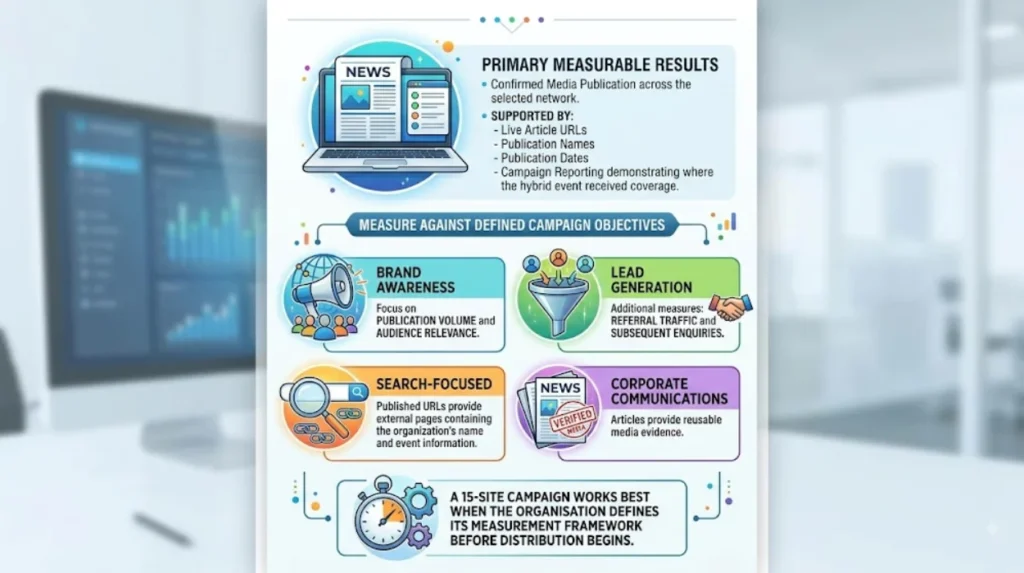
The primary measurable result is confirmed media publication across the selected network, supported by live article URLs, publication names, publication dates, and campaign reporting that demonstrates where the hybrid event received coverage.
Results need to be measured against defined campaign objectives.
For a brand-awareness campaign, publication volume and audience relevance are important. For a lead-generation campaign, referral traffic and subsequent enquiries provide additional measures.
Explore More Expert Insights:
Virtual Event News Coverage Across 15 UK News Sites
Festival News Coverage Services Across 15 UK Websites
For search-focused campaigns, published URLs provide external pages containing the organisation’s name and event information.
For corporate communications, the articles provide reusable media evidence.
A 15-site campaign therefore works best when the organisation defines its measurement framework before distribution begins.
Is 15-site hybrid event coverage suitable for UK businesses?
Fifteen-site hybrid event coverage suits UK businesses that need structured media distribution for an event announcement and require measurable publication outcomes across relevant news, business, regional, or trade publications.
The model is particularly relevant when an event has a defined news angle and a target audience beyond existing attendees.
A UK fintech company launching a new payment platform at a hybrid industry event can use coverage to communicate the launch beyond the event audience. A construction company hosting a hybrid development forum can use relevant business and property publications to extend the announcement.
The decision depends on publication relevance, campaign objectives, content quality, and reporting requirements.
For businesses already researching:
UK event media coverage, the next step is to define the event story, identify the target publications, confirm the required distribution scope, and establish the reporting criteria before launch.
A 15-site campaign provides a clear operational framework: one event, one structured news story, 15 targeted publication opportunities, and a documented record of confirmed coverage.



