

Festival news coverage services across 15 UK websites provide a structured way to distribute festival announcements, event updates, artist news, programme launches, attendance milestones, and post-event stories across relevant digital publications. For organisers, promoters, brands, venues, and agencies, multi-site distribution creates measurable UK media visibility.
Festival coverage is no longer limited to one publication or one event announcement. A coordinated campaign connects a festival story with multiple editorial audiences while maintaining consistent messaging, publication timing, and reporting.
The decision at BOFU stage focuses on execution. Buyers need to evaluate website selection, editorial relevance, distribution processes, turnaround times, coverage reporting, and campaign outcomes.
Organisations assessing the fundamentals can first review:
Festival coverage to understand how multi-site publishing works before selecting a service.
What does a festival news coverage service across 15 UK websites include?
A festival news coverage service distributes approved event news across 15 selected UK websites using coordinated submission, publication, monitoring, and reporting processes. The service connects festival announcements with relevant audiences while maintaining consistent information, timing, messaging, and measurable coverage records.
A professional service normally begins with a press release or news announcement. The content contains the festival name, location, dates, organisers, programme information, key participants, and relevant event developments.
The provider then prepares the announcement for distribution across an agreed publication network. The 15 websites represent the campaign’s media footprint. Selection criteria include audience relevance, UK reach, topical alignment, publication authority, and editorial suitability.
Typical festival announcements include:
- Festival launch announcements
- Line-up confirmations
- Headliner announcements
- Ticket release updates
- Venue announcements
- Sponsorship announcements
- Charity and community initiatives
- Attendance milestones
- Programme changes
- Post-event results
The service also includes coverage monitoring. Published URLs, publication dates, website names, headlines, and campaign details form the core reporting record.
How does festival coverage run across 15 UK websites?
Festival coverage runs through a defined workflow covering content preparation, website selection, distribution, publication monitoring, URL verification, and reporting. Each stage establishes control over campaign consistency, publication accuracy, timing, and measurable media coverage across UK websites.
The process starts with campaign requirements. The organiser defines the festival story, target audience, publication requirements, preferred timing, and required number of websites.
1. Content preparation
The press release is reviewed for factual accuracy, structure, spelling, dates, names, quotes, and supporting information. Festival content requires particular attention to event dates, venue names, artist names, ticket information, and programme details.
2. Website selection
The campaign is mapped against 15 UK websites. A suitable network includes publications relevant to entertainment, culture, events, regional audiences, business, lifestyle, or specific festival themes.
3. Distribution
The approved release enters the distribution workflow. Publication requests are coordinated across the selected websites according to the agreed campaign schedule.
4. Publication monitoring
Each website is checked for publication status. Monitoring confirms that the article appears correctly and contains the intended information.
5. Coverage verification
Published URLs are collected and checked. The final report identifies where the festival story appeared and records the relevant publication information.
6. Reporting
The completed campaign produces a coverage record. This provides an operational reference for internal marketing teams, PR agencies, festival organisers, and stakeholders.
For readers comparing operational approaches,
Multi-site festival coverage provides useful context before selecting a distribution model.
Which 15 UK websites should a festival coverage service target?
The 15 websites should match the festival’s audience, location, subject, and communication objectives. A strong selection combines national, regional, entertainment, lifestyle, business, and specialist publications rather than relying on websites with identical editorial audiences.
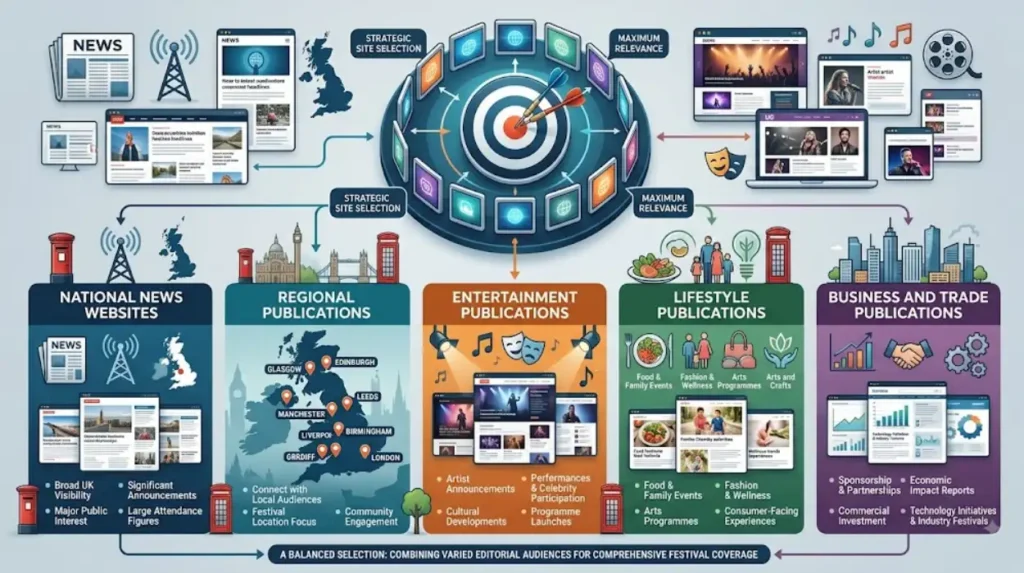
Website selection directly affects the relevance of festival coverage. A music festival requires different media targeting from a food festival, cultural festival, technology event, or regional community festival.
A UK campaign can divide its media footprint into distinct publication categories.
National news websites
National publications provide broad UK visibility. They suit festival announcements with significant public interest, major performers, large attendance figures, or national cultural relevance.
Regional publications
Regional websites connect the announcement with audiences near the festival location. Examples include publications covering Manchester, Birmingham, Liverpool, Edinburgh, Glasgow, Cardiff, Bristol, Leeds, and London.
Entertainment publications
Entertainment-focused websites are relevant for artist announcements, performances, celebrity participation, programme launches, and cultural developments.
Lifestyle publications
Lifestyle media suits food festivals, family events, fashion festivals, wellness events, arts programmes, and consumer-facing experiences.
Business and trade publications
Business publications fit sponsorship announcements, economic impact reports, commercial partnerships, investment announcements, technology initiatives, and industry-focused festivals.
The 15-site structure therefore represents a targeted media portfolio rather than an arbitrary publication count.
Why is 15-site festival news distribution useful for UK event organisers?
Fifteen-site distribution gives festival organisers a defined media footprint for one campaign. It expands the number of publication environments carrying the story, creates multiple coverage records, and provides structured evidence for evaluating visibility, reach, relevance, and campaign performance.
A single publication provides one coverage location. A 15-site campaign creates a broader distribution footprint.
This structure supports several practical objectives.
Increased coverage opportunities
More relevant websites create more opportunities for the announcement to reach distinct audiences. A regional festival can combine local coverage with national and specialist publications.
Stronger event visibility
Repeated appearance across relevant websites increases the number of locations where audiences encounter the festival story. Each published article creates a separate media asset.
Geographic relevance
UK festivals often depend on location-based audiences. Regional publications connect the announcement with people and businesses close to the event.
Audience segmentation
Different websites serve different audience groups. A festival announcement can therefore reach entertainment audiences, local communities, businesses, families, cultural audiences, and specialist readers through one coordinated campaign.
Campaign documentation
A multi-site campaign creates a defined record of published coverage. This supports reporting to sponsors, management teams, partners, performers, and event stakeholders.
What should buyers evaluate before choosing a festival news coverage service?
Buyers should evaluate website relevance, confirmed publication scope, editorial requirements, turnaround process, reporting detail, content requirements, campaign coordination, and service limitations. The evaluation must focus on verifiable deliverables rather than headline claims about visibility or exposure.
A service comparison requires specific questions.
Are all 15 websites clearly identified?
The provider must define what the 15-site package contains. Buyers need to understand whether websites are fixed, selected from a network, or chosen according to campaign requirements.
Are the websites relevant to the festival?
A website’s audience matters more than the number of publications alone. A music festival benefits from entertainment and culture coverage. A regional food festival benefits from local and lifestyle publications.
What does publication mean?
Buyers need a clear definition. Publication can refer to a live article, a hosted release, syndicated content, or another form of online placement. The service specification must identify the actual deliverable.
What reporting is provided?
A useful report includes publication names, live URLs, publication dates, headlines, and campaign identifiers where available.
What are the content requirements?
The provider needs defined requirements for word count, images, links, quotes, formatting, contact information, and supporting materials.
What is the turnaround process?
Timing matters for festival announcements. Buyers need to know the submission process, expected publication window, review stages, and reporting schedule.
How can festival coverage services support different types of UK festivals?
Festival coverage services support music, arts, food, cultural, technology, business, family, and community festivals by adapting publication targeting to each event’s audience, location, subject matter, announcement type, and stakeholder requirements within a structured distribution campaign.
Different festivals generate different news angles. The distribution strategy therefore needs to reflect the event category.
Music festivals
Music festivals require coverage for headliners, artist confirmations, ticket launches, venue information, performance schedules, partnerships, and attendance figures.
Food festivals
Food festivals generate stories around chefs, vendors, regional producers, restaurant participation, programme launches, and visitor numbers.
Arts and cultural festivals
These events require coverage for exhibitions, performances, cultural programmes, community projects, and artist participation.
Technology festivals
Technology events focus on speakers, product demonstrations, innovation programmes, business partnerships, investment, and industry participation.
Family and community festivals
Local publications become particularly relevant for community festivals. Coverage can focus on activities, local businesses, charitable partnerships, safety information, and attendance.
Business festivals
Business-focused events require publications covering entrepreneurship, investment, economic development, professional services, and industry sectors.
The service specification remains consistent while the media targeting changes according to the festival’s characteristics.
What results can organisers measure from 15-site festival coverage?
Organisers can measure coverage volume, publication URLs, publication dates, website categories, geographic distribution, content consistency, and campaign completion. These metrics establish a factual record of where the festival announcement appeared and support structured post-campaign reporting.
Measurement starts with publication verification.
A campaign report can record:
- Number of live articles
- Number of websites publishing the announcement
- Publication dates
- Live article URLs
- Website categories
- Geographic publication coverage
- Headline variations
- Campaign-specific content
- Sponsor or partner mentions
- Event information included
These metrics provide operational evidence of campaign completion.
Organisers can also compare coverage against campaign objectives. For example, a festival targeting audiences in northern England can assess the proportion of coverage appearing on relevant regional websites.
Sponsors can use the coverage record as part of wider partnership reporting. Marketing teams can use published URLs in campaign documentation. PR teams can maintain the URLs as evidence for internal reporting.
The important distinction is between coverage delivered and business outcomes. A published article confirms media placement. Ticket sales, registrations, sponsorship enquiries, website traffic, and attendance require separate measurement systems.
When is a 15-site festival news coverage service the right choice?
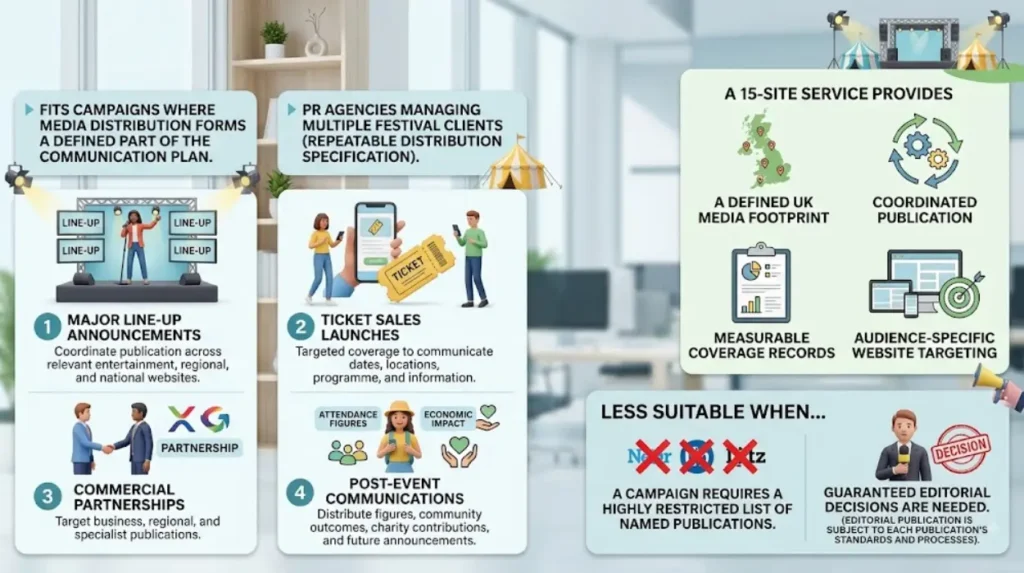
A 15-site service fits festivals requiring a defined UK media footprint, coordinated publication, measurable coverage records, and audience-specific website targeting. It suits launch campaigns, major announcements, programme updates, partnerships, ticket campaigns, and post-event communications.
The model fits campaigns where media distribution forms a defined part of the communication plan.
A festival organiser preparing a major line-up announcement can use the service to coordinate publication across relevant entertainment, regional, and national websites.
A festival launching ticket sales can use targeted coverage to communicate dates, locations, programme details, and ticket information.
A festival announcing a commercial partnership can target business, regional, and specialist publications.
A post-event campaign can distribute attendance figures, community outcomes, charity contributions, economic impact findings, or future-event announcements.
The model also fits PR agencies managing multiple festival clients because the 15-site structure provides a repeatable distribution specification.
It is less suitable when a campaign requires a highly restricted list of named publications with guaranteed editorial decisions. Editorial publication remains subject to each publication’s standards and processes.
How should a buyer select a festival news coverage service?
A buyer should select a service by matching the festival’s communication objective with publication relevance, confirmed website scope, distribution workflow, reporting requirements, timing, and measurable deliverables. The final decision must reflect campaign requirements rather than website quantity alone.
Start by defining the announcement. A line-up launch has different media requirements from a sponsorship announcement or post-event report.
Next, define the target audience. Identify geographic, demographic, industry, entertainment, cultural, and business audiences.
Then evaluate the 15-site network. Check publication categories, UK relevance, audience alignment, and campaign suitability.
After that, verify the operational specification. Confirm submission requirements, publication process, timing, reporting format, URL delivery, and campaign completion criteria.
Finally, assess the service against the campaign’s reporting needs. A strong specification makes the delivered coverage easy to verify.
Explore More Expert Insights:
Book Sports Event Coverage on 15 UK News Sites
Real Estate Event Coverage Across 15 UK News Sites
For organisations ready to implement a structured campaign, Festival News Coverage Services Across 15 UK Websites provide a defined framework for distributing festival announcements across a targeted UK media network.
The decision rests on five measurable factors: website relevance, 15-site scope, distribution process, publication verification, and reporting quality. These factors create a clear basis for comparing providers and selecting a service aligned with the festival’s communication objectives.



