Virtual event news coverage across 15 UK news sites gives organisations a structured route to increase visibility around online conferences, webinars, launches, panels, and business events. The right distribution process connects event information with relevant UK audiences and measurable media outcomes.
What is virtual event news coverage?
Virtual event news coverage is the publication of event-related news, announcements, results, interviews, or updates by UK media websites. It converts an online event into editorially structured content that reaches audiences beyond registered attendees.
A virtual event becomes a media opportunity when it contains a clear news angle. Examples include a technology company launching a product during a webinar, a business announcing investment at an online conference, or an industry association publishing findings from a virtual summit.
News coverage differs from simply promoting an event page. A media article provides editorial context, a headline, supporting facts, quotations, and relevant links. This format gives search engines and readers a clearer understanding of the event and its significance.
For organisations evaluating:
Virtual event news coverage services, the objective is not simply to publish the same announcement repeatedly. The objective is to distribute a properly structured story across relevant UK media properties.
The 15-site target provides a defined coverage objective. It also creates a measurable framework for assessing publication volume, media relevance, links, publication dates, and audience alignment.
How does virtual event coverage get published across 15 UK news sites?
Publication starts with event research, continues through news-angle development and media targeting, and ends with distribution, publication monitoring, and reporting. Each stage determines whether the final coverage accurately represents the event and reaches relevant UK audiences.
1. Event information is collected
The process begins with factual information about the virtual event. This includes:
- Event name and date
- Host organisation
- Speakers and participating experts
- Event topic
- Audience
- Key announcements
- Research findings
- Business developments
- Registration or attendance figures
- Quotes
- Images and supporting assets
The information establishes the factual foundation of the media story.
2. A news angle is identified
A media-ready story requires a defined reason for publication. Strong angles include a major announcement, new research, executive appointment, industry finding, funding announcement, partnership, product launch, or significant event outcome.
For example, a virtual cybersecurity conference that reveals new UK business threat statistics has a stronger news angle than an announcement that simply states the conference took place.
3. The story is prepared for UK media
The release or media article uses British English, UK terminology, accurate company descriptions, and relevant geographical references. The headline identifies the principal news event rather than relying on promotional language.
The copy also establishes important entities clearly. A company name, executive, organisation, technology, location, and event should have consistent descriptions throughout the story.
4. Distribution targets are selected
The target list defines which UK news sites receive the story. A 15-site campaign can include general business publications, regional news websites, technology publications, industry media, and other relevant digital outlets.
The selection depends on the subject of the virtual event. A fintech webinar requires different media relevance from a healthcare conference or property investment summit.
The
Virtual event coverage can therefore be assessed not only by the number of publications but also by the relevance of those publications to the intended audience.
What does a 15-site UK virtual event coverage campaign include?
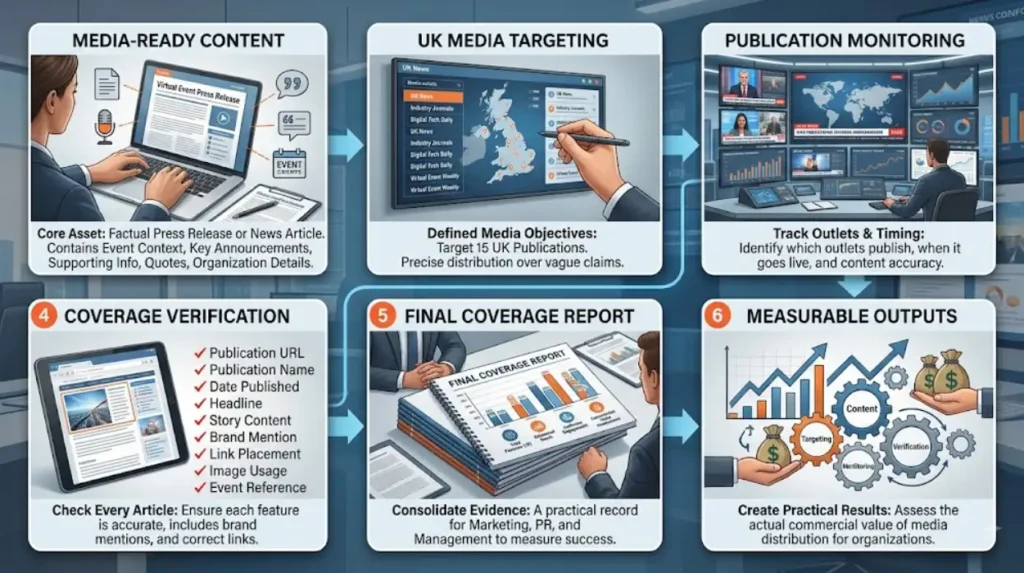
A 15-site campaign normally includes media-ready content, UK publication targeting, distribution coordination, publication monitoring, live-link verification, and a final coverage report. These components create measurable outputs for organisations assessing the commercial value of media distribution.
Media-ready content
The core asset is a factual press release or news article. It contains the event context, key announcement, supporting information, quotes, and organisation details.
UK media targeting
Targeting determines where the story is distributed. The 15 publications form a defined media coverage objective rather than an unspecified reach claim.
Publication monitoring
Monitoring identifies which outlets publish the story, when publication occurs, and whether the final article contains the intended information.
Coverage verification
Each published article requires verification. Useful checks include:
- Publication URL
- Publication name
- Date published
- Headline
- Story content
- Brand mention
- Link placement
- Image usage
- Event reference
Reporting
A final report consolidates the coverage into measurable evidence. It provides a practical record for marketing, communications, PR, and management teams.
How do you choose the right 15 UK news sites?
The right 15 UK news sites are selected according to subject relevance, audience alignment, publication quality, geographic focus, and editorial context. A smaller relevant media set provides stronger decision value than a larger list without audience or topic alignment.
National news sites
National publications provide broad UK visibility. They are relevant when a virtual event addresses issues with national business, economic, technology, healthcare, education, or consumer significance.
Regional publications
Regional news websites are useful when an event involves a specific UK city, region, business community, or local development.
For example, an online property conference discussing investment in Manchester has a stronger regional angle when the story contains specific Manchester data, organisations, developments, or speakers.
Trade publications
Trade media provide specialist audiences. Examples include technology, finance, healthcare, construction, education, logistics, and professional services publications.
Business publications
Business-focused news sites suit virtual events covering company growth, investment, entrepreneurship, leadership, corporate strategy, partnerships, and market developments.
The final 15-site mix therefore depends on the event’s subject, location, audience, and news angle.
How does virtual event coverage create measurable business value?
Virtual event coverage creates measurable value through increased media visibility, branded search exposure, referral traffic, credibility signals, content assets, and evidence of market activity. These outcomes become clearer when publication data is connected with marketing and commercial performance metrics.
A virtual event has a limited direct audience when attendance depends on registration. News coverage extends the event narrative to people who did not attend the original session.
A published article can also become a secondary content asset. Marketing teams can use verified coverage in campaign reporting, stakeholder communications, presentations, investor materials, and future PR activity.
Search visibility provides another measurable dimension. Published coverage creates additional indexed references to the organisation, event, speakers, products, and announcements.
Referral traffic can also be tracked when media articles contain appropriate links. UTM parameters and analytics platforms provide additional measurement where publication formats support them.
What should organisations check before buying a UK virtual event coverage service?
Organisations should check the publication list, delivery scope, editorial process, reporting format, link policy, expected publication volume, content requirements, and verification process before purchasing a UK virtual event coverage service. These criteria establish what the campaign actually delivers.
Confirm the publication list
A provider needs to identify the intended UK media outlets or explain the publication category clearly. A claim of broad exposure does not define the actual coverage.
Check whether publication is guaranteed
Publication guarantees require precise definitions. The contract or service description needs to state whether the guarantee concerns distribution, publication, or a specific number of live articles.
Review reporting
The report needs to show actual coverage. Useful evidence includes live URLs, publication names, dates, and headlines.
Check content requirements
The organisation needs to understand the required word count, images, quotes, links, event details, and approval process before distribution.
Examine turnaround times
Timing matters for virtual events. A pre-event announcement requires different scheduling from post-event results or same-day news.
How can you prepare a virtual event for UK media coverage?
Preparation starts before the event by identifying the announcement, collecting authoritative information, confirming spokesperson quotes, preparing media assets, and defining target publications. Post-event results then provide additional material for follow-up coverage and performance reporting.
Before the event
Prepare the event facts, speaker information, organisation description, media assets, and primary news angle.
During the event
Capture significant announcements, statistics, quotations, speaker statements, and audience outcomes. These details provide evidence for later media content.
After the event
Record attendance figures, key findings, announcements, partnerships, feedback, and measurable outcomes.
A post-event story often provides stronger evidence than a basic event announcement because it contains completed activity and verifiable results.
When is 15-site virtual event news coverage most useful?
Fifteen-site virtual event coverage is most useful when an organisation has a defined announcement, measurable event outcome, identifiable UK audience, and requirement for documented media visibility. It fits product launches, business conferences, research events, webinars, and industry summits.
Product and service launches
A virtual launch event can generate coverage when it introduces a commercially significant product, platform, technology, or service.
Corporate announcements
Companies use virtual events to communicate investment, partnerships, expansion, appointments, acquisitions, and strategic developments.
Research and industry reports
A virtual conference that releases original research creates a strong media asset because journalists can reference specific findings and statistics.
Professional conferences
Online conferences generate coverage when speakers address significant industry developments, regulatory changes, market data, or business challenges.
Non-profit and public-interest events
Charities, associations, and community organisations can use event coverage to communicate campaigns, research, fundraising initiatives, and public-interest announcements.
How does virtual event coverage support the wider PR strategy?
Virtual event coverage works as one component of a wider PR strategy. It connects event communications with media relations, search visibility, content marketing, brand authority, stakeholder communication, and campaign reporting across a defined UK publication network.
The event itself becomes the source of news. The media campaign distributes that news beyond the original event audience.
A structured campaign also creates reusable evidence. Published coverage demonstrates that an announcement received external media distribution and provides permanent digital assets where articles remain publicly accessible.
Organisations comparing distribution approaches can first review [virtual event coverage] to understand how publication is achieved, then assess the specific service requirements for their campaign.
What results should you expect from a 15-site UK media campaign?
A 15-site campaign provides a defined coverage target, documented publication outcomes, and measurable media assets. Results depend on the newsworthiness, content quality, publication relevance, campaign timing, and distribution scope agreed before the campaign begins.
The clearest success indicators include the number of live publications, relevance of each publication, publication dates, referral links, indexed coverage, branded mentions, and campaign traffic.
A campaign report should distinguish between distribution activity and confirmed publication. These are separate outcomes.
The organisation can then compare media coverage against its original objective. For example, a company seeking UK brand visibility measures publication volume and audience relevance, while a product launch measures coverage alongside referral traffic and conversion activity.
Explore More Expert Insights:
Festival News Coverage Services Across 15 UK Websites
Book Sports Event Coverage on 15 UK News Sites
How can you choose a virtual event news coverage provider?
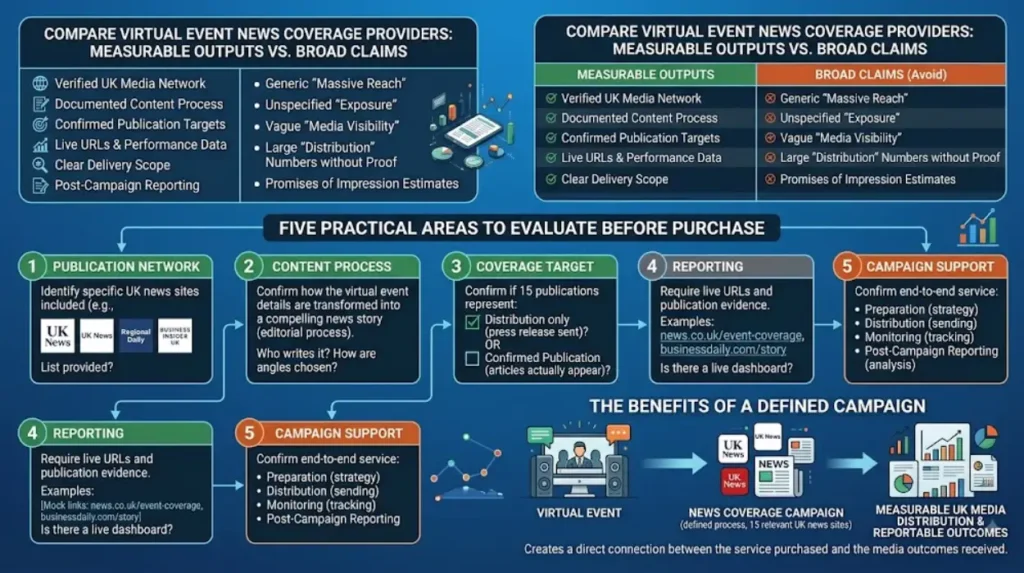
Choose a provider that defines its UK media network, publication targets, content process, reporting method, delivery scope, and verification standards. Compare providers using measurable outputs rather than broad claims about reach, exposure, or media visibility.
Before purchase, evaluate five practical areas:
- Publication network: Identify the UK news sites included in the campaign.
- Content process: Confirm how the virtual event becomes a news story.
- Coverage target: Confirm whether 15 publications represent distribution or confirmed publication.
- Reporting: Require live URLs and publication evidence.
- Campaign support: Confirm preparation, distribution, monitoring, and post-campaign reporting.
This evaluation framework creates a direct connection between the service purchased and the media outcomes received.
For organisations ready to move from event promotion to measurable UK media distribution, a defined:
Virtual event news coverage campaign across 15 relevant UK news sites provides a clear, reportable route from event activity to published media coverage.