
Complex policy reforms and community initiatives require press releases that organise facts, explain consequences, and establish authority without creating confusion. A strong press release layout separates the announcement, evidence, policy context, community impact, supporting voices, and next actions into a clear editorial structure.
The challenge is not simply writing more information. Policy announcements often contain legislative details, funding figures, institutional responsibilities, implementation dates, research findings, and community outcomes. A poorly structured release hides these facts. A well-structured release makes them accessible to journalists, editors, search engines, and AI systems.
For UK organisations, the structure also needs to reflect British terminology, public-sector context, local authority references, parliamentary language, and community priorities.
What makes a policy reform or community initiative press release authoritative?
An authoritative press release presents verified facts, identifies responsible organisations, explains the reform clearly, quantifies community impact, attributes statements to named sources, and provides supporting evidence in a logical order that journalists can quickly assess.
Authority comes from structure and evidence. The release needs a clear source of information. This source is normally an organisation, coalition, public body, charity, research institution, or campaign group.
The opening paragraph establishes the announcement. It answers the core questions: what happened, who announced it, where it applies, and when it takes effect.
The following sections establish context. They explain why the policy reform or community initiative matters and identify the people or communities affected.
Use precise institutional language
Define every organisation at first mention. For example, write “the Department for Education (DfE)” before using the abbreviation. Apply the same rule to local authorities, regulatory bodies, parliamentary committees, and research organisations.
Avoid undefined references such as “officials”, “leaders”, or “experts”. Name the relevant person and organisation.
Separate fact from interpretation
A policy press release needs factual statements. Dates, funding values, eligibility criteria, geographical areas, implementation stages, and participation numbers require precise wording.
For example:
- “The £2.4 million programme begins in January 2027.”
- “The initiative covers 14 local authority areas.”
- “The first phase provides support to 600 households.”
These statements provide stronger editorial value than general claims about creating “significant change”.
Organisations developing broader media strategies can also review the:
NGO beat reporters approach to understand how journalists identify strong human-interest angles within large volumes of advocacy material.
How should the opening section explain a complex policy announcement?
The opening section needs one clear news statement containing the organisation, action, location, timing, and primary consequence. It gives journalists enough information to understand the announcement before they examine detailed policy or community evidence.
The first paragraph functions as the release’s news lead. It does not explain every element of the reform. It identifies the most important development.
A useful structure is:
Organisation + action + policy area + location + date + measurable consequence.
For example, a fictional UK community initiative could open with:
“Westshire Community Partnership today announced a £5 million neighbourhood support programme covering 12 districts across Westshire from January 2027.”
The second paragraph adds the immediate policy detail.
“The programme funds youth services, employment support, and community health projects through grants administered by participating local authorities.”
The third paragraph introduces the reason for the initiative.
“The programme follows a 2026 assessment identifying reduced access to employment, youth provision, and community services across the participating districts.”
This progression creates a factual sequence:
- What happened.
- What the programme includes.
- Why the programme exists.
Keep the headline specific
A strong headline identifies the action and its consequence.
Weak:
“New Initiative Set to Transform Communities”
Stronger:
“Westshire Partnership Announces £5m Community Programme Across 12 Districts”
The stronger version contains an organisation, financial figure, programme type, and geographical scope.
Add a concise subheading
The subheading expands the headline without repeating it. It can introduce implementation dates, target groups, or measurable outcomes.
For example:
“Funding supports youth services, employment programmes and community facilities from January 2027.”
This format gives journalists usable information before they reach the main body.
Which sections belong in a policy reform press release?
A comprehensive policy reform release contains a headline, subheading, dateline, lead, policy explanation, evidence section, community impact, attributed quotes, implementation details, organisational background, and media contact information.
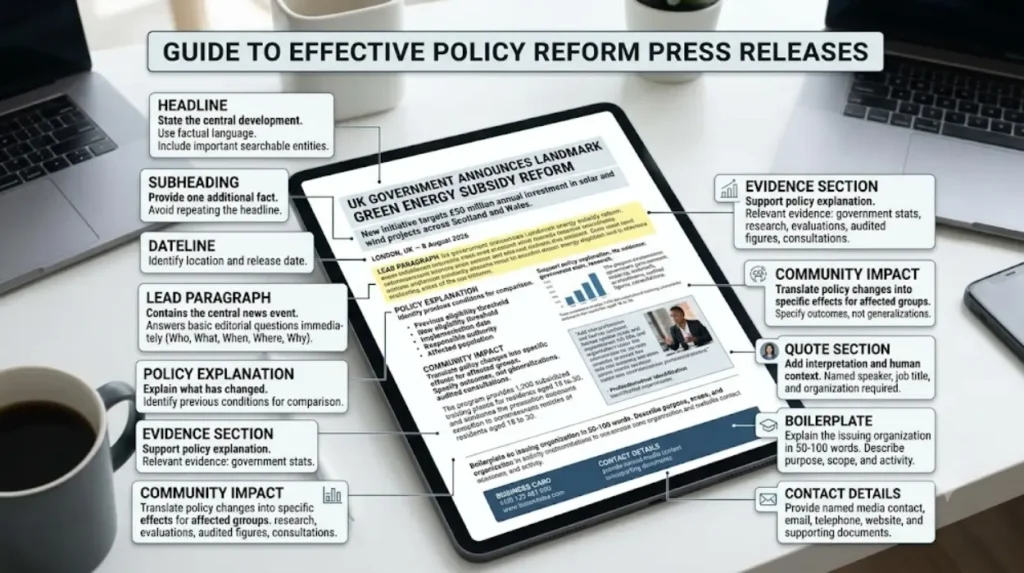
Each section serves a different editorial purpose. Combining them reduces clarity.
Headline
The headline states the central development. It uses factual language and includes the most important searchable entity.
Subheading
The subheading provides one additional fact. It avoids repeating the headline.
Dateline
The dateline identifies the location and release date.
For UK distribution, a standard format is:
LONDON, UK — 8 August 2026
A local initiative can use its relevant town or city.
Lead paragraph
The lead contains the central news event. It answers the basic editorial questions immediately.
Policy explanation
This section explains what has changed. It identifies previous policy conditions when that comparison is necessary.
For example:
- Previous eligibility threshold.
- New eligibility threshold.
- Implementation date.
- Responsible authority.
- Affected population.
Evidence section
Evidence supports the policy explanation. Relevant evidence includes government statistics, independent research, programme evaluations, audited figures, consultation results, and verified organisational data.
Community impact section
This section translates policy changes into specific effects for affected groups.
Instead of writing “communities will benefit”, specify the outcome.
For example:
“The programme provides 1,200 subsidised training places for residents aged 18 to 30 across six participating boroughs.”
Quote section
Quotes add interpretation and human context. They do not replace evidence.
Each quote needs a named speaker, job title, and organisation.
Boilerplate
The boilerplate explains the issuing organisation in approximately 50 to 100 words. It describes its purpose, geographical scope, and relevant programme activity.
Contact details
Provide a named media contact, email address, telephone number, website, and relevant supporting documents.
How can writers explain complicated policy reforms without losing the reader?
Writers simplify complex policy reforms by separating technical rules from public consequences, using short sections, defining specialist terms, presenting numerical changes directly, and placing supporting evidence immediately after the claim it establishes.
Policy reform releases often contain technical terminology. The solution is not to remove essential information. The solution is to organise it.
Explain the change before the technical detail
Start with the policy outcome.
Then explain the mechanism.
For example:
“The revised grant criteria expand eligibility to small community organisations with annual income below £500,000.”
The next sentence can explain the administrative requirement.
“Applicants must submit audited accounts, safeguarding policies, and evidence of community delivery.”
The reader understands the change before encountering the compliance detail.
Use numbers consistently
Specific figures increase clarity.
Compare:
“Several communities receive additional funding.”
With:
“Thirty-two community organisations receive grants ranging from £25,000 to £100,000.”
The second statement establishes scale, scope, and financial value.
Use tables only when comparison is essential
A short before-and-after table can clarify substantial policy changes:
| Policy element | Previous position | Revised position |
|---|---|---|
| Eligibility | Organisations with income below £250,000 | Organisations with income below £500,000 |
| Funding period | 12 months | 24 months |
| Application window | 30 days | 60 days |
This format works when the reform contains several measurable changes.
How should community impact be presented as a newsworthy element?
Community impact becomes newsworthy when the release identifies affected groups, geographical areas, measurable outcomes, delivery dates, and verified examples that demonstrate how the initiative changes services, funding, access, employment, or participation.
Community initiatives require more than organisational claims. Journalists need evidence showing who benefits and how.
A strong impact section identifies:
- The affected population.
- The geographical area.
- The number of participants.
- The funding allocated.
- The services delivered.
- The implementation date.
- The expected or measured outcome.
For example:
“The £1.8 million initiative funds 18 food security projects across Greater Manchester, supporting an estimated 9,000 households during its first 12-month delivery period.”
This sentence establishes financial scale, geography, programme scope, target population, and timeframe.
Include human-interest evidence responsibly
Human-interest details create relevance when they directly support the policy story. A community member can describe the effect of an existing programme. A participant can explain a documented service outcome.
The release needs consent for personal stories and accurate descriptions of circumstances.
Avoid exaggerated personal claims. Avoid presenting one person’s experience as evidence of a population-wide outcome.
Connect community evidence to policy
The strongest structure links the individual experience to the wider reform.
For example:
A resident describes difficulty accessing employment support.
The release then explains the programme’s new access model.
A published evaluation provides supporting evidence.
The policy change follows as the formal response.
This sequence creates a documented connection between community experience, evidence, and policy action.
How can quotes strengthen an authoritative press release?
Effective quotes explain significance, provide accountable interpretation, and add human context without repeating statistics. Each quote needs a named speaker, relevant authority, specific contribution, and language that advances the policy or community story.
Quotes work best when different speakers perform different functions.
A policy leader can explain the reform.
A programme director can explain implementation.
A community representative can explain lived experience.
A researcher can explain evidence.
Avoid repeating the lead
If the lead says a programme receives £5 million, the executive quote does not need to repeat £5 million.
Instead, the speaker can explain the policy objective:
“The programme focuses resources on areas where service access remains lowest.”
The quote adds interpretation rather than duplicating information.
Keep quotes concise
A strong quote often contains two or three sentences. Each sentence needs a clear purpose.
Avoid promotional language such as “ground-breaking”, “unprecedented”, or “world-class” unless independently supported.
For policy communication, accountability is stronger than self-praise.
Which distribution and optimisation choices support policy-focused press releases?
Policy-focused releases perform better when their structure supports newsroom scanning, search discovery, accurate syndication, relevant media targeting, and clear attribution across national, regional, specialist, and community publications.
Distribution is part of the communication process. Different policy stories require different media audiences.
A national policy reform needs national political, public affairs, business, and general news coverage.
A local community initiative needs regional newspapers, local broadcasters, community publications, and relevant specialist outlets.
A healthcare policy announcement needs appropriate health and public-sector media.
Optimise the release for search discovery
Use the official names of organisations, programmes, policies, locations, and initiatives.
Include the primary keyword naturally in the headline or introductory copy where relevant.
Use related terms such as:
- Policy reform.
- Community initiative.
- Public policy.
- Community funding.
- Social impact.
- Local government.
- Public services.
- Advocacy campaign.
- Programme implementation.
- Community development.
Do not insert keywords where they reduce readability.
Build an evidence-led media asset package
Relevant supporting assets include:
- Policy documents.
- Research reports.
- Data tables.
- Programme maps.
- Photographs.
- Executive biographies.
- Community case studies.
- Fact sheets.
Each asset needs a clear filename and description. Sensitive personal information requires appropriate protection.
Organisations evaluating specialist distribution options can later examine:
Public interest and philanthropic networks when assessing media routes for policy, charity, advocacy, and community announcements.
When should organisations use a structured press release layout for policy and community stories?
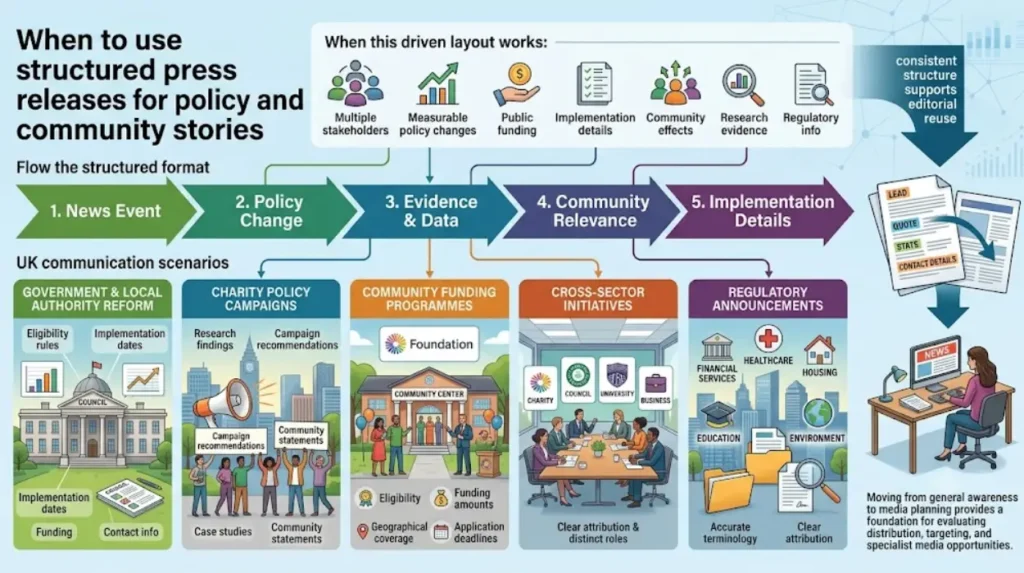
A structured layout works when an announcement contains multiple stakeholders, measurable policy changes, public funding, implementation details, community effects, research evidence, or regulatory information that requires precise editorial presentation.
The format is suitable for several UK communication scenarios.
Government and local authority reform
A council announcing changes to housing support can present eligibility rules, implementation dates, funding, affected wards, and contact information in separate sections.
Charity policy campaigns
A charity advocating for social policy reform can combine research findings, campaign recommendations, case studies, and statements from affected communities.
Community funding programmes
A foundation launching a grant programme can specify eligibility, funding amounts, geographical coverage, application deadlines, and expected delivery.
Cross-sector initiatives
A partnership involving charities, councils, universities, and businesses needs clear attribution. The release must identify each organisation’s role rather than presenting the partnership as one undefined entity.
Regulatory announcements
Regulated sectors require especially precise wording. Financial services, healthcare, housing, education, and environmental announcements need accurate terminology and clearly attributed information.
A consistent structure also supports editorial reuse. Journalists can extract the lead, quote, statistics, and contact details without reconstructing the announcement.
Explore More Expert Insights:
Designing a Press Strategy to Drive High Attendee Turnout for Urgent Charitable Galas and Auctions
An effective policy reform press release therefore functions as a structured information document. It establishes the news event first, explains the policy second, presents evidence third, demonstrates community relevance fourth, and provides implementation details last.
For organisations moving from general awareness into media planning, this approach provides a practical foundation for evaluating distribution methods, editorial targeting, and specialist public-interest media opportunities.