

Press release syndication distributes a campaign announcement across multiple media outlets, search environments, and relevant publications. Consistent follow-up converts temporary visibility into repeated volunteer touchpoints, clearer actions, stronger trust, and measurable recruitment activity.
Press release syndication is the distribution of a news release through a network of media publishers, news websites, industry publications, regional outlets, and digital platforms. For humanitarian organisations, the process creates visibility around campaigns, emergency responses, fundraising initiatives, community programmes, and volunteer opportunities.
The first publication creates awareness. The post-campaign period determines whether that awareness produces sustained engagement.
A volunteer recruitment campaign needs more than one exposure. Potential volunteers often require information about the organisation, the cause, available roles, time commitments, location, safeguarding requirements, and registration process before completing a sign-up.
This makes post-campaign communication an important part of volunteer acquisition.
Organisations can also connect continuous press activity with broader audience journeys. The initial announcement introduces the campaign. Follow-up coverage explains progress. Volunteer-focused stories demonstrate participation. Subsequent announcements provide new reasons to engage.
The result is a structured communication cycle rather than a single publicity event.
What happens after the initial press release?
After syndication, organisations can track coverage, identify audience response, repurpose campaign information, and develop follow-up stories. These activities extend the useful life of the original announcement.
For example, a humanitarian organisation launching a winter support programme can issue an initial release about the programme, followed by updates on volunteer recruitment, regional activity, community partnerships, and programme milestones.
Each development provides a distinct news angle without repeating the original announcement.
What is the connection between press visibility and volunteer sign-ups?
Press visibility creates repeated opportunities for potential volunteers to encounter an organisation, understand its work, verify its activity, and access a clear registration route. Long-term recruitment depends on connecting each visibility opportunity with relevant volunteer information and action.
Volunteer recruitment involves both awareness and conversion. Press coverage addresses the awareness stage by placing organisational activity in front of new audiences.
The conversion stage requires additional information.
A person discovering an organisation through a news article needs a direct path to understand the opportunity. Relevant information includes the volunteer role, eligibility requirements, expected commitment, location, application process, and contact method.
This creates an important distinction between media visibility and volunteer conversion.
Media visibility measures exposure across publications and platforms. Volunteer conversion measures the number of people who progress from exposure to a completed registration or enquiry.
Why does repeated exposure matter?
Repeated exposure reinforces organisational recognition. A potential volunteer who sees an organisation once receives limited information. Later coverage adds context and evidence.
For example, an individual might first encounter a humanitarian organisation through a press release about flood response. A later article about volunteer coordinators provides operational context. A third update about local community activities presents a specific opportunity to participate.
Each interaction answers a different question.
This approach also supports the educational journey discussed in:
Continuous press presence. The focus shifts from simply securing coverage to maintaining relevant visibility after the initial campaign.
How can organisations turn a press release into a volunteer recruitment journey?
Organisations can extend a press release into a recruitment journey by connecting the announcement to follow-up stories, role-specific information, registration pages, email communication, social content, and measurable conversion points across defined campaign stages.
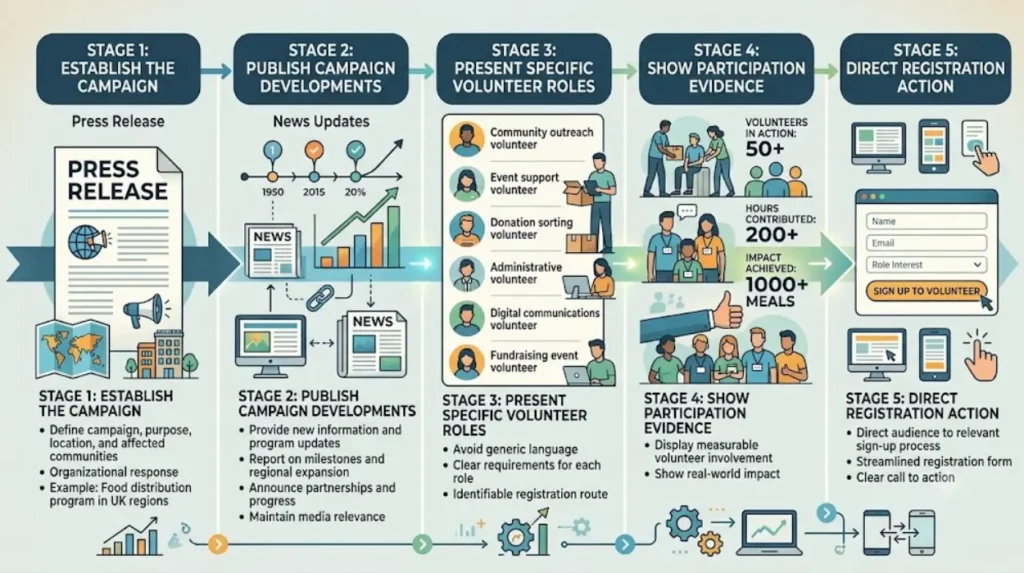
A post-campaign recruitment journey requires connected communication.
The initial press release establishes the event or campaign. Subsequent communication introduces participation opportunities. The organisation then directs interested audiences towards a specific volunteer action.
A practical sequence contains five stages:
- Campaign announcement – Introduce the humanitarian initiative.
- Campaign development – Report verified progress and operational activity.
- Volunteer opportunity – Explain specific roles and requirements.
- Participation evidence – Show measurable volunteer involvement.
- Registration action – Direct audiences towards the relevant sign-up process.
Each stage has a different communication purpose.
Stage 1: Establish the campaign
The first release defines the campaign, its purpose, location, affected communities, and organisational response.
The information must remain factual and specific.
For example, a release can identify a food distribution programme serving communities in three UK regions and explain the volunteer functions required to support delivery.
Stage 2: Publish campaign developments
Follow-up coverage provides new information.
Updates can include programme milestones, regional expansion, partnership announcements, volunteer participation figures, or changes to operational requirements.
Each update creates another media opportunity while maintaining relevance to the original campaign.
Stage 3: Present specific volunteer roles
Generic recruitment language produces less useful information than defined opportunities.
A release can identify roles such as:
- Community outreach volunteer
- Event support volunteer
- Donation sorting volunteer
- Administrative volunteer
- Digital communications volunteer
- Fundraising event volunteer
Each role needs clear requirements and an identifiable registration route.
Which content elements help convert media attention into volunteer registrations?
Volunteer conversion improves when campaign content contains specific roles, measurable activity, clear eligibility requirements, geographic information, time commitments, registration instructions, and evidence of organisational activity that helps potential volunteers make informed decisions.
The content surrounding a press campaign influences the next action.
A press release does not need to contain every recruitment detail. It needs enough information to establish relevance and direct interested people towards complete volunteer information.
Role definition
A volunteer opportunity needs a defined purpose.
“Volunteers needed” provides limited context. “Weekend food distribution volunteers needed in Birmingham” provides a clearer participation opportunity.
Time commitment
Volunteer recruitment content needs a defined schedule.
Examples include:
- Four hours per week
- One Saturday per month
- Three-day campaign support
- Six-week community programme
Specific time requirements reduce uncertainty.
Location
Location information is important for local volunteer recruitment. Organisations can identify cities, boroughs, community centres, distribution sites, or remote participation options.
For UK campaigns, regional specificity also supports relevant media targeting.
Registration pathway
The registration process needs a clear next step.
The journey can direct potential volunteers to a dedicated registration form, volunteer information page, application portal, or contact process.
The link between media coverage and registration must remain measurable.
How can organisations measure post-campaign volunteer recruitment?
Organisations can measure post-campaign recruitment by tracking media coverage, referral traffic, landing-page visits, registration starts, completed applications, conversion rates, and volunteer source data across each press and campaign activity.
Measurement turns press distribution into an operational recruitment channel.
A campaign dashboard can separate visibility metrics from recruitment metrics.
Useful indicators include:
| Metric | Purpose |
|---|---|
| Media placements | Measures distribution reach |
| Referral visits | Measures traffic generated by coverage |
| Volunteer page visits | Measures recruitment interest |
| Registration starts | Measures intent |
| Completed registrations | Measures conversion |
| Conversion rate | Measures registration efficiency |
| Source attribution | Identifies effective channels |
| Regional registrations | Measures geographic performance |
Why is source attribution important?
Source attribution identifies where volunteers discovered the opportunity.
A registration form can include a source field such as:
- News article
- Search engine
- Social media
- Existing volunteer
- Organisation website
- Partner organisation
Campaign-specific URLs provide another measurement method.
For example, an organisation can use a dedicated landing page for a winter volunteer campaign. Traffic and registrations from that page provide campaign-level performance data.
How can press release syndication be combined with owned media?
Press syndication provides external visibility, while owned media provides detailed information and conversion infrastructure. Combining both channels creates a controlled journey from third-party discovery to organisational information, volunteer education, registration, and follow-up communication.
Owned media includes the organisation’s website, volunteer pages, email newsletters, blogs, and social channels.
These channels perform different functions from press distribution.
A news article provides independent exposure. The organisation’s website provides detailed information. Email communication supports follow-up. Social content reinforces campaign developments.
What should the volunteer landing page contain?
A dedicated landing page can include:
- Campaign purpose
- Volunteer roles
- Eligibility criteria
- Location
- Time commitment
- Safeguarding requirements
- Application process
- Frequently asked questions
- Registration form
- Contact details
The page must remain aligned with information published through media channels.
Inconsistent dates, locations, or requirements create friction and reduce confidence.
How can organisations repurpose campaign coverage without repeating the same story?
Organisations can repurpose campaign coverage by developing new factual angles from verified developments, including volunteer stories, regional progress, partnership activity, programme milestones, operational needs, and measurable outcomes rather than repeating the original announcement.
Repurposing extends campaign value without producing duplicate content.
A single humanitarian campaign can generate multiple legitimate news angles.
For example, an emergency relief campaign can produce stories about volunteer mobilisation, regional response, community partnerships, distribution milestones, and recruitment requirements.
Which follow-up angles work for volunteer recruitment?
Useful angles include:
Volunteer impact: Explain the number of volunteers involved and the functions they perform.
Regional activity: Highlight work in a specific UK city or region.
Operational milestone: Report the completion of a defined campaign target.
Recruitment need: Explain a new or continuing volunteer requirement.
Community partnership: Highlight collaboration with local organisations.
Volunteer experience: Present verified experiences from participants while respecting consent and safeguarding requirements.
These angles create distinct reasons for journalists and audiences to engage with later announcements.
When does post-campaign press activity become most useful for humanitarian organisations?
Post-campaign press activity becomes most useful when an organisation has verified developments, continuing volunteer requirements, measurable milestones, regional activity, or new participation opportunities that create legitimate reasons for additional media communication.
Continuous publishing requires meaningful developments.
The objective is not to distribute identical announcements repeatedly. The objective is to maintain relevance through new information.
This distinction matters for humanitarian organisations operating in environments where public attention changes rapidly.
A campaign can lose visibility when communication stops immediately after launch. Continued updates maintain awareness while providing new information for potential volunteers.
For example, an emergency relief fund can initially focus on the response. A later announcement can focus on volunteer coordination. Another update can explain regional delivery. A subsequent release can announce a new volunteer intake.
The communication remains connected to the same cause while addressing different audience needs.
How should organisations choose between press distribution options?
Organisations evaluating press distribution options need to compare media network coverage, UK regional reach, sector relevance, reporting capabilities, distribution speed, targeting options, campaign tracking, and integration with volunteer recruitment objectives.
Different distribution networks provide different levels of reach and targeting.
A suitable solution depends on campaign requirements rather than distribution volume alone.
What factors matter when comparing distribution networks?
Organisations can assess:
- UK national media reach
- Regional publication coverage
- Humanitarian and charity sector relevance
- Search visibility
- Distribution speed
- Geographic targeting
- Reporting detail
- Referral tracking
- Campaign support
- Cost per campaign
For organisations working with limited budgets, these factors help identify the distribution model that aligns with recruitment objectives.
This evaluation also connects naturally with:
Emergency relief fund distribution networks, particularly when budget constraints and campaign urgency influence distribution decisions.
How can humanitarian organisations sustain volunteer momentum after media coverage ends?
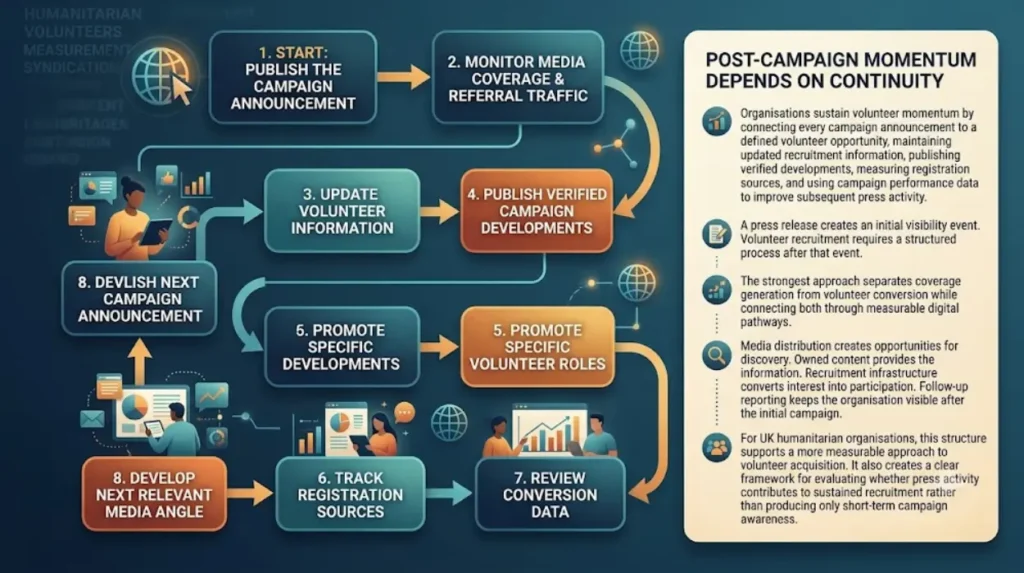
Organisations sustain volunteer momentum by connecting every campaign announcement to a defined volunteer opportunity, maintaining updated recruitment information, publishing verified developments, measuring registration sources, and using campaign performance data to improve subsequent press activity.
Post-campaign momentum depends on continuity.
A press release creates an initial visibility event. Volunteer recruitment requires a structured process after that event.
Organisations can establish a repeatable workflow:
- Publish the campaign announcement.
- Monitor media coverage and referral traffic.
- Update volunteer information.
- Publish verified campaign developments.
- Promote specific volunteer roles.
- Track registration sources.
- Review conversion data.
- Develop the next relevant media angle.
This process turns press release syndication into an ongoing communication asset.
The strongest approach separates coverage generation from volunteer conversion while connecting both through measurable digital pathways. Media distribution creates opportunities for discovery. Owned content provides the information. Recruitment infrastructure converts interest into participation. Follow-up reporting keeps the organisation visible after the initial campaign.
Explore More Expert Insights:
Designing a Press Strategy to Drive High Attendee Turnout for Urgent Charitable Galas and Auctions
Timing Your Announcement: Synchronizing Press Distribution with Global Awareness Days and Rallies
For UK humanitarian organisations, this structure supports a more measurable approach to volunteer acquisition. It also creates a clear framework for evaluating whether press activity contributes to sustained recruitment rather than producing only short-term campaign awareness.



