
Direct-to-consumer (D2C) brands depend heavily on online visibility to attract customers and generate sales. Social media platforms provide access to large audiences, but their algorithms determine what content users see. These algorithms change frequently and operate according to platform-specific priorities rather than business objectives. Depending entirely on algorithm-driven visibility creates significant commercial risk for new D2C brands.
A balanced marketing strategy uses multiple communication channels that remain under the brand’s control. This approach creates stable visibility, supports customer acquisition, and reduces dependence on external platforms.
Why is relying only on social media algorithms risky for new D2C brands?
Relying exclusively on social media algorithms places customer reach under the control of external platforms. Algorithm updates, declining organic visibility, increased competition, advertising costs, and account restrictions reduce predictable exposure, limiting sustainable audience growth, customer acquisition, and long-term business stability for emerging direct-to-consumer brands.
Social media algorithms are automated systems that rank and distribute content. They evaluate thousands of signals before deciding which posts appear in users’ feeds. These signals include engagement rates, viewing time, user interests, posting frequency, and content quality.
New D2C brands often build their entire marketing strategy around these systems because social platforms offer immediate access to consumers without requiring significant infrastructure.
However, platform owners regularly update ranking systems. These updates change how content is prioritised without consulting businesses using the platform.
A brand receiving 80,000 organic impressions one month can experience a significant decline after a platform update despite publishing similar content.
This creates uncertainty because customer visibility depends on rules established by another organisation rather than the brand itself.
What is a D2C brand?
A direct-to-consumer brand sells products directly to customers without traditional retail intermediaries.
Examples include skincare companies selling through their own websites, clothing labels operating online stores, and specialist food producers offering subscription services.
What is a social media algorithm?
A social media algorithm is an automated ranking system that determines which posts users see.
Examples include recommendation systems used by Instagram, TikTok, Facebook, LinkedIn, Pinterest, and YouTube.
How do social media algorithms affect brand visibility?
Algorithms determine which content appears before users by analysing engagement signals, behavioural patterns, content relevance, viewing duration, and platform objectives. This limits consistent organic visibility because businesses cannot directly control ranking decisions or distribution priorities across changing digital platforms.
Organic reach refers to unpaid visibility.
Most platforms display only a small percentage of published content to followers. Content generating strong engagement receives wider distribution, while weaker-performing posts reach fewer users.
This creates unequal exposure.
Two posts published on consecutive days can receive dramatically different reach despite similar quality.
Which factors influence algorithm rankings?
Common ranking signals include:
- User engagement such as comments, shares, and saves
- Watch time for videos
- Content freshness
- User interests
- Posting consistency
- Previous interactions
- Click-through behaviour
Each platform assigns different weight to these signals.
As ranking models evolve, successful content formats also change.
Why does organic reach decline?
Organic reach declines because platforms prioritise user engagement, advertising revenue, and new content formats.
For example:
- Facebook reduced organic page reach over several years.
- Instagram prioritised Reels after introducing short-form video.
- TikTok continually adjusts recommendation patterns based on user behaviour.
These changes directly influence business visibility.
What happens when algorithm updates reduce exposure?
Algorithm updates instantly alter content distribution rules across millions of accounts. Brands relying entirely on organic social traffic experience reduced impressions, fewer website visits, declining customer engagement, lower sales opportunities, and unpredictable marketing performance after significant platform adjustments.
Platform updates occur throughout the year.
Businesses receive limited notice before implementation.
When exposure decreases, multiple business metrics change simultaneously.
Website traffic falls.
Product page visits decline.
Newsletter sign-ups reduce.
Customer enquiries decrease.
Sales pipelines weaken.
The impact extends beyond social media because fewer consumers enter the overall marketing journey.
Why are updates difficult to predict?
Algorithms use machine learning systems.
These systems analyse billions of interactions continuously.
Platform operators rarely publish detailed explanations of ranking changes.
Businesses therefore respond after performance changes become visible.
Why is audience ownership important for D2C brands?

Audience ownership gives businesses direct communication channels independent of external platforms. Owned audiences improve marketing stability because brands control customer relationships through websites, email databases, customer accounts, loyalty programmes, and subscription lists without algorithm interference.
Audience ownership means maintaining direct customer relationships.
Unlike social followers, owned audiences remain accessible regardless of platform policy changes.
Examples include:
- Email subscribers
- Website accounts
- Loyalty programme members
- SMS subscribers
- Customer communities
- Purchase databases
These channels remain under business control.
This creates predictable communication opportunities.
How does overdependence on one platform increase business risk?
Concentrating marketing activity on one platform increases operational vulnerability because policy changes, account suspensions, technical failures, audience migration, or declining engagement immediately reduce customer access and business visibility across multiple commercial activities simultaneously.
Platform concentration creates single-point failure.
Several situations affect visibility:
- Account restrictions
- Security breaches
- Platform outages
- Content moderation actions
- Advertising policy updates
- Audience behaviour changes
If every marketing activity depends on one platform, business disruption becomes immediate.
Diversification reduces this exposure.
Which marketing channels reduce dependence on social media algorithms?
Multiple marketing channels create diversified customer acquisition by combining owned, earned, and searchable digital assets. This improves resilience because traffic sources remain distributed instead of relying on one algorithm-controlled communication platform for customer discovery and engagement.
Diversification spreads marketing activity across different channels.
Examples include:
- Search engine optimisation
- Email marketing
- Company websites
- Product review platforms
- Industry publications
- Podcasts
- Video platforms
- Online communities
- Search advertising
- Public relations
- Referral programmes
Each channel contributes different types of visibility.
Together they reduce concentration risk.
Readers seeking practical implementation strategies can explore:
Integrating Strategic Press Distribution as an internal resource.
Why does search visibility provide greater long-term stability?
Search visibility connects businesses with users actively seeking information, products, or solutions. Search traffic accumulates through published content, technical optimisation, and authority rather than depending entirely on continuously changing recommendation algorithms or social engagement patterns.
Search engines organise information according to relevance and authority.
Unlike social feeds, users actively search for answers.
Search visibility develops through:
High-quality informational content
Educational articles answer common customer questions.
These pages continue attracting visitors after publication.
Technical optimisation
Fast websites, clear navigation, structured headings, and mobile usability improve accessibility.
Topic authority
Publishing multiple related articles strengthens subject relevance.
Search traffic therefore develops over time rather than disappearing after a short publishing window.
How does content diversification strengthen brand resilience?
Publishing different content formats across multiple platforms reduces exposure to changing distribution systems. Educational articles, videos, newsletters, guides, product information, and downloadable resources reach audiences through different discovery methods and customer behaviours simultaneously.
Different audiences consume information differently.
Examples include:
- Blog articles for search users
- Email newsletters for existing customers
- Videos for visual learners
- Product demonstrations
- Buying guides
- Frequently asked questions
- Case studies
- Customer stories
Each content type serves a different stage of customer research.
Diversification creates broader visibility.
Explore More Expert Insights:
How Modern Retail Industry Analysts and Influencers Discover Breakthrough Startups
What Happens to an Online Store’s Reputation During a Supply Chain or Shipping Crisis?
What practical steps help new D2C brands reduce algorithm risk?
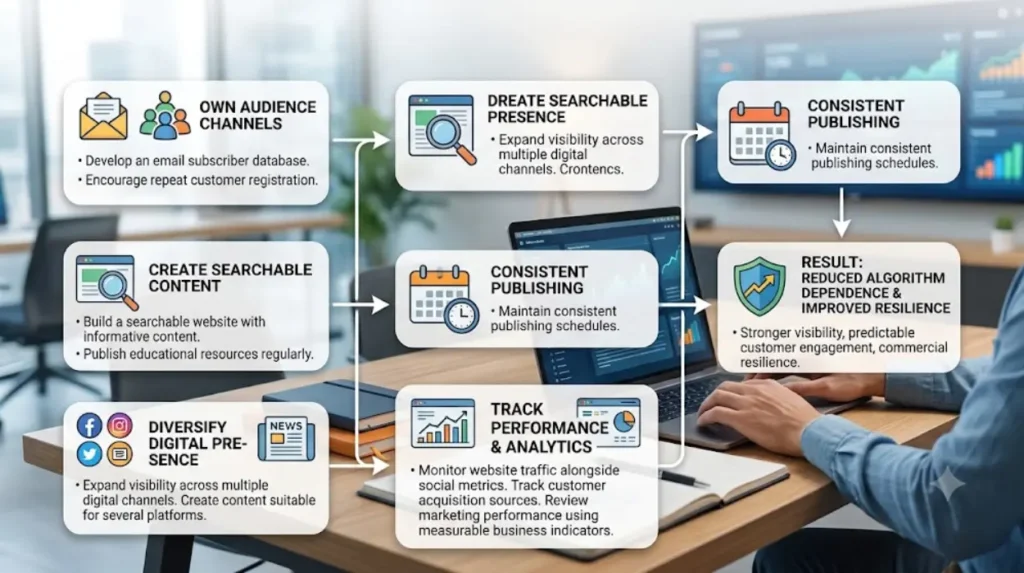
Reducing algorithm dependence requires structured marketing diversification, audience ownership, measurable analytics, consistent publishing, and investment across multiple communication channels. These practices create stronger visibility, predictable customer engagement, and improved commercial resilience over extended business growth periods.
New D2C brands benefit from structured planning.
Key actions include:
- Build a searchable website with informative content.
- Develop an email subscriber database.
- Publish educational resources regularly.
- Monitor website traffic alongside social metrics.
- Encourage repeat customer registration.
- Create content suitable for several platforms.
- Track customer acquisition sources.
- Maintain consistent publishing schedules.
- Expand visibility across multiple digital channels.
- Review marketing performance using measurable business indicators.
These activities reduce reliance on any single distribution system.
Businesses interested in evaluating structured communication approaches can continue with:
Full-Service Consumer PR Agencies as the next stage of learning.
Social media remains an important communication channel for D2C brands, but algorithms operate according to platform objectives rather than business goals. Organic visibility changes as ranking systems evolve, reducing predictability for companies relying on a single source of customer attention.
A diversified marketing strategy creates greater stability by combining owned communication channels, search visibility, educational content, email marketing, referral activity, and multiple traffic sources. This balanced approach reduces operational risk, strengthens customer relationships, and supports sustainable long-term growth for new direct-to-consumer brands.