
Launching a product across the United Kingdom requires more than inventory, logistics, and marketing. Strategic press distribution ensures important announcements reach journalists, trade publications, business media, search engines, and industry audiences at the right time. Including press distribution within a national product rollout checklist creates coordinated communication, stronger media visibility, and broader market awareness.
Why does strategic press distribution belong in a national product rollout checklist?
Strategic press distribution belongs in a national product rollout checklist because it aligns communications with launch milestones, expands media visibility, improves search discoverability, supports stakeholder awareness, and ensures consistent messaging reaches journalists, retailers, partners, investors, and customers across the United Kingdom simultaneously and efficiently.
A national product rollout checklist is a structured plan covering every operational and communication activity before, during, and after launch.
Strategic press distribution is the organised delivery of a press release through media distribution channels targeting relevant journalists, publishers, trade media, news platforms, and digital syndication networks.
Without coordinated communication, marketing activities operate independently. Retail announcements, website updates, influencer campaigns, paid advertising, and customer communications lose consistency.
Including press distribution creates alignment between:
- Product availability
- Marketing campaigns
- Retail announcements
- Corporate communications
- Investor updates
- Media outreach
For example, a UK consumer electronics company launching a smart home device benefits when national retailers, technology journalists, and online publications receive the same verified announcement before products appear in stores.
What planning steps strengthen strategic press distribution before launch?
Effective planning establishes clear objectives, identifies target publications, defines announcement timing, prepares approved messaging, assigns responsibilities, and synchronises communications with operational milestones before products reach retailers or online customers throughout the national launch period successfully.
Preparation begins several weeks before launch.
Define the announcement objective
Every press release requires one primary purpose.
Examples include:
- National product launch
- Retail partnership
- Market expansion
- Sustainability initiative
- New product category
- Technology innovation
One announcement focuses on one news event.
Identify target audiences
Different publications serve different readers.
Examples include:
- National newspapers
- Consumer lifestyle magazines
- Retail trade publications
- Technology publications
- Business media
- Regional news outlets
Each audience requires relevant information while maintaining consistent factual messaging.
Create an approval workflow
Legal teams, product managers, communications specialists, and executives review announcements before distribution.
A documented approval process reduces publication delays.
Prepare supporting assets
Media packages often include:
- Product photographs
- Executive biographies
- Company background
- Fact sheets
- Product specifications
- Launch dates
Providing complete information improves journalist efficiency.
How does press distribution integrate with other launch activities?
Press distribution integrates with advertising, digital marketing, retail availability, social media, email campaigns, search optimisation, and internal communications to deliver consistent information across every customer and stakeholder touchpoint during a coordinated national product launch programme.
Press distribution works alongside other marketing functions rather than replacing them.
Website publication
The company website publishes the product page at the same time as media announcements.
Customers arriving through news coverage immediately access product information.
Retail activation
Retail partners receive launch materials before public announcements.
This sequence ensures product listings remain accurate when coverage appears.
Social media communication
Social platforms amplify media coverage after official publication.
This approach differs from relying entirely on social algorithms for visibility.
Brands seeking background on this topic can explore:
Email marketing
Existing customers receive launch announcements immediately after media distribution.
Messaging remains consistent across channels.
Paid advertising
Advertising campaigns reinforce awareness generated through editorial coverage.
Combined communications increase overall visibility.
Which elements make a product launch press release effective?
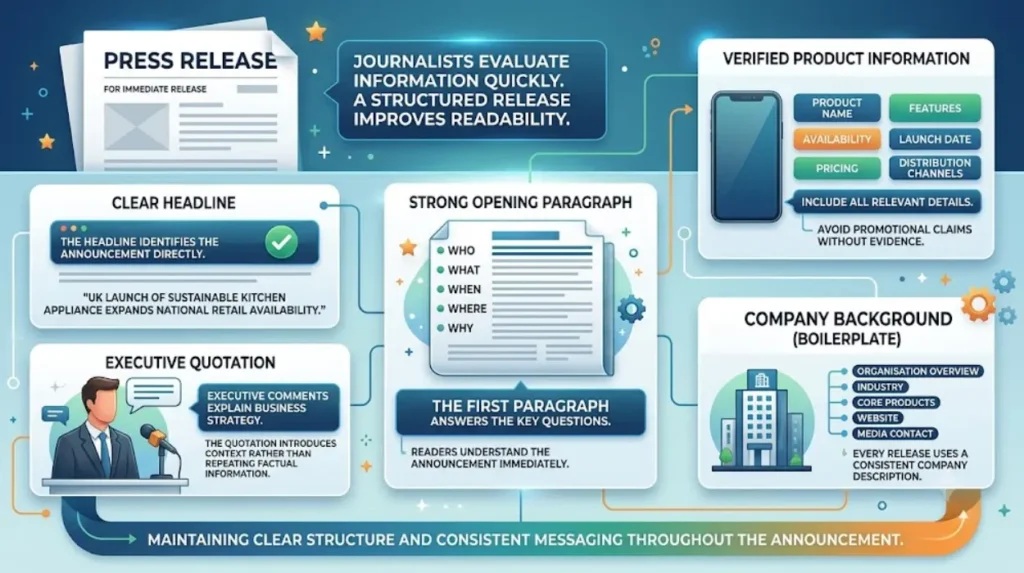
An effective product launch press release presents verified information, explains customer value, includes executive commentary, provides factual product details, identifies launch timing, and offers media contacts while maintaining clear structure and consistent messaging throughout the announcement.
Journalists evaluate information quickly.
A structured release improves readability.
Clear headline
The headline identifies the announcement directly.
Example:
“UK Launch of Sustainable Kitchen Appliance Expands National Retail Availability.”
Strong opening paragraph
The first paragraph answers:
- Who
- What
- When
- Where
- Why
Readers understand the announcement immediately.
Verified product information
Include:
- Product name
- Availability
- Pricing
- Features
- Launch date
- Distribution channels
Avoid promotional claims without evidence.
Executive quotation
Executive comments explain business strategy.
The quotation introduces context rather than repeating factual information.
Company background
The boilerplate explains:
- Organisation overview
- Industry
- Core products
- Website
- Media contact
Every release uses a consistent company description.
How does strategic press distribution improve national launch performance?
Strategic press distribution increases announcement visibility, supports consistent messaging, strengthens search indexing, expands industry awareness, improves stakeholder communication, and reinforces launch credibility through verified editorial publication across trusted news and trade media platforms nationwide effectively.
Media coverage contributes to broader communication objectives.
Greater visibility
Editorial coverage introduces products to audiences beyond existing customers.
Examples include:
- National newspapers
- Consumer magazines
- Retail publications
- Technology websites
Improved search presence
News coverage creates additional indexed content.
Search engines recognise authoritative publications.
This improves long-term content discoverability.
Stronger stakeholder communication
Stakeholders include:
- Retail buyers
- Investors
- Suppliers
- Business partners
- Industry analysts
Consistent communication supports informed decision-making.
Higher launch coordination
Marketing teams, sales departments, customer service, and communications teams work from identical information.
This reduces inconsistencies during launch.
What common mistakes reduce the impact of national press distribution?
Common mistakes include distributing announcements too late, targeting irrelevant publications, publishing inconsistent information, ignoring regional media, lacking approval processes, omitting supporting assets, and separating communications from wider product launch planning activities unnecessarily.
Timing represents one of the largest challenges.
Late announcements reduce media opportunities.
Inconsistent messaging
Different departments publishing conflicting product information creates confusion.
A single approved communication document prevents inconsistency.
Poor publication targeting
Retail news differs from consumer lifestyle journalism.
Technology reporters cover different subjects than financial editors.
Relevant targeting increases publication quality.
Missing launch assets
Journalists work under strict deadlines.
Missing product images, specifications, or contact details reduce publication efficiency.
Ignoring regional coverage
National launches still benefit from regional media.
Examples include publications covering:
- Scotland
- Wales
- Northern England
- South West England
- Midlands
- Northern Ireland
Regional audiences contribute to nationwide awareness.
How can businesses evaluate strategic press distribution options?
Businesses evaluate strategic press distribution by comparing media reach, editorial targeting, reporting quality, turnaround times, compliance processes, distribution technology, industry expertise, and measurable launch support before selecting an appropriate communications solution for national product announcements.
Different distribution approaches suit different organisations.
Evaluation criteria include operational capability rather than promotional claims.
Distribution coverage
Assess whether providers reach:
- National media
- Regional publications
- Trade journals
- Online news platforms
- Industry publications
Coverage quality matters alongside distribution volume.
Reporting
Useful reporting includes:
- Publication placements
- Distribution confirmation
- Audience reach
- Coverage links
- Timing records
Structured reporting supports campaign evaluation.
Industry experience
Consumer products, financial services, healthcare, and manufacturing each operate within different communication environments.
Relevant sector knowledge improves operational planning.
Businesses comparing provider models can continue to:
Full-Service Consumer PR Agencies for a structured evaluation of available approaches.
How does strategic press distribution support long-term product growth?
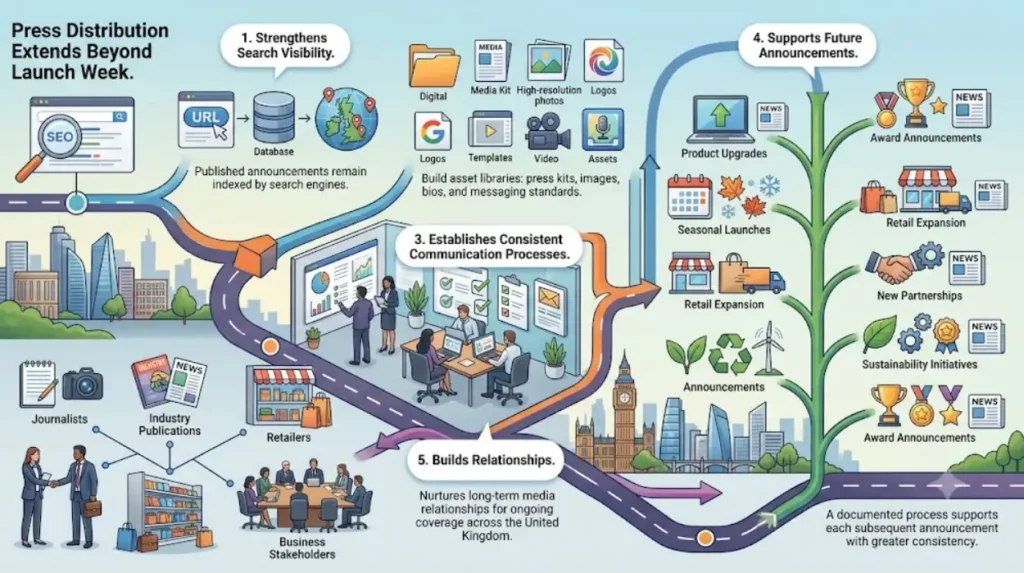
Strategic press distribution creates reusable media assets, strengthens search visibility, supports future announcements, establishes consistent communication processes, and builds relationships with journalists, industry publications, retailers, and business stakeholders throughout successive product launches across the United Kingdom.
Press distribution extends beyond launch week.
Published announcements remain indexed by search engines.
Journalists reference previous company announcements when covering future developments.
Businesses also create reusable communication frameworks.
Future announcements become faster because approval workflows, media lists, asset libraries, and messaging standards already exist.
Product launches rarely occur in isolation.
Examples include:
- Product upgrades
- Seasonal launches
- Retail expansion
- New partnerships
- Sustainability initiatives
- Award announcements
A documented press distribution process supports each subsequent announcement with greater consistency.
Explore More Expert Insights:
Leveraging Milestone Press Releases to Attract the Attention of Major Marketplace Partners
Crisis Communication Frameworks: Issuing Rapid Statements to Retain Customer Loyalty Fast
Strategic press distribution forms an essential component of a national product rollout checklist. It aligns communication with operational milestones, ensures consistent messaging, expands editorial visibility, strengthens search discoverability, and supports stakeholder awareness throughout the launch process. Organisations that integrate press distribution into structured rollout planning create coordinated communications across marketing, retail, digital channels, and media outreach, resulting in a more organised and measurable national product launch.